By Patrick F. Cannon
Although they may be dwindling, America’s roadside attractions still demand your attention as you tool along the backroads of our great and goofy country. Books have been written about the more compelling, but I have personal experience of only a few. I find that often you find them on the day after you’ve visited a famous attraction like Disney World or the Mammoth Caves and have time to spare. It’s usually raining.
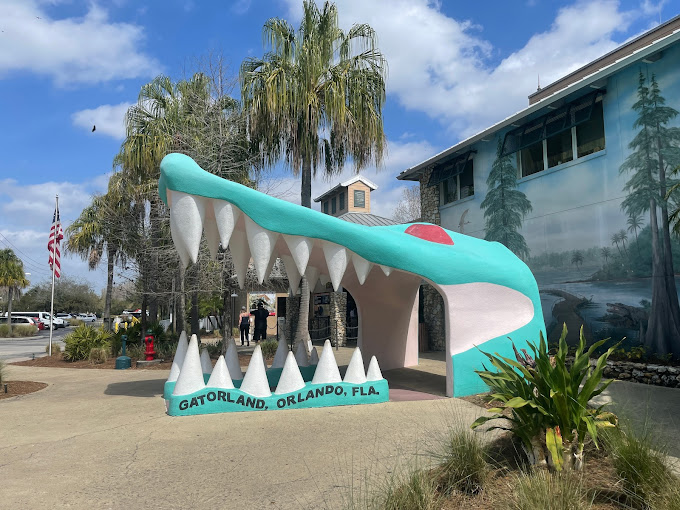
Although I can’t exactly recall where in Florida it was, I once spent an hour I’ll never get back at some kind of shell museum. I can only tell you that there are numerous varieties of seashells; and that you can string them, frame them, and otherwise arrange them in a bewildering variety of ingenious displays. After a few agonizing minutes, they make you wish they would all return to the waters whence they came. Florida is also the home of the Gatorland Zoo and Jumperoo! It’s in the Orlando area, conveniently close to Disney World.
My children were young when we visited, and to this day I’m sure they count it among their most cherished memories. You entered through a Gator’s maw to pay your fee and enjoy a gift shop chockful of Gator-themed stuff, including toys, models, key chains, tee shirts, and cute stuffed Gators looking for their next meals. Speaking of meals, a highlight of a visit is feeding time. You sit in a grandstand with other families; many look like they came out of the cast of Deliverance.
On a platform over the water, an employee dangles (dead) chickens on a pole, whereupon a gator will “jump” and grab the chicken (no doubt raised hormone and antibiotic free). Gators can’t really jump – praise the Lord – but rear up on their tails. Because their tail is under water, it does look like they’re jumping for joy. To be fair, Gatorland is also a nature reserve, with a little train to take you to see Gators (and Crocodiles and Caimans) in a more or less natural setting. What these Crocodilians (scientific terms) have in common is they’ll all happily eat you given a fair chance.
On another family trip, this time to Kentucky, we visited the Mammoth caves, then went on to thoroughbred horse farms in Lexington. At Spendthrift Farms, we saw Triple Crown winner Seattle Slew, who might have bitten off my daughter Beth’s hand had she not been warned off by a frantic farm employee. On one of those rainy days, the only indoor attraction we could find in the area after visiting the caves was a biblical wax museum.
If you’re inclined to see a wax figure of Moses carrying the Ten Commandments, I find that these days you can find biblical museums in many locations. There’s the Museum of the Bible in DC, funded by Steve Green of the Hobby Lobby family. The Creation Museum in Kentucky (lots to see in Kentucky!), and its sister attraction, a recreation of Noah’s Ark, will do their best to convince you that the Earth is only 6,000 years old, Darwin and geologic evidence be damned!
Recently reading Richard Ford’s novel, Be Mine, reminded me of two attractions I could have easily seen, if I had been inclined to drive west for a few hours from Albert Lea, Minnesota, where I lived for two years in the late 1960s. In the book, a father and his son – who has ALS and is dying – travel from the Mayo Clinic in Rochester to Mount Rushmore in South Dakota. Along the way, they visit Wall Drugs in Wall; and the Corn Palace, in Mitchell, South Dakota. I saw signs for both (“only 200 miles to Wall Drugs!”) many times as I drove in Southern Minnesota. I regret not driving the few hours to these still-famous attractions.
To be honest, though, my greatest regret is not driving a mere twenty miles east of Albert Lea to Austin to visit the Spam Museum at the headquarters of Hormel Foods. Then again, maybe it’s not too late. And then there’s the beer can house in Houston, the only reason I can think of to go back to that otherwise dull city.
Copyright 2024, Patrick F. Cannon
 cannonnadedotcom
Your shell museum may have been on Sanibel Island. A shell collector’s mecca, it had a prominent shell museum before Hurricane Ian did its best to return the shells to the sea. It is being rebuilt, however, so you may soon have a chance to relive cherished memories.
When it comes to roadside attractions, Indiana’s may not be as famous as Wall Drugs and Corn Palace (there is Dairy Adventures at Fair Oaks Farms, off I-65, and Santa Claus Land in Santa Claus. And there was a Butt Drugs in Corydon, now closed). But what the state’s tourism may lack in bucket list destinations is more than made up for in novel sights that touch on such universal themes as love, art, death, and inebriation.
In reverse order, we start in Fortville, where people entering Elite Beverages to stock up on gin and other intoxicants get a forecast of delirium tremens from the vision before them: a giant pink elephant sipping a martini.
It is a sight one does not easily forget, but also a sobering reminder, if not a life lesson, to be moderate in all things (except, of course, store mascots).
Moderation is a middle road, but how many roadside attractions can you name that are in the middle of the road? If you drive just south of Franklin, you come upon a curious bifurcation. In 1831, Nancy Burnett was buried on a hill. About a century later, the county decided to build a road over the spot. A relative, Daniel Doty, objected and wielding a shotgun, guarded the grave day and night. The county wisely reconsidered, and, in a spirit of compromise and respect for the departed, built the road with one lane on one side and one on the other.
It may be the only roadside attraction that is always on your left, no matter in which direction you are headed.
In Alexandria, time and space seemingly converge. The town boasts a distinction no other locality anywhere can match. Residents Mike and Glenda Carmichael are the proud owners of the world’s largest ball of paint.
Forty years ago, it started out as a humble baseball, and after innumerable coats, it became the magnificent object that it is.
Just wait until MOMA learns about this!
Hoosiers may be art lovers but otherwise shun pretense for the practical. In Roselawn there is no doubt about it: They view things as they are.
The town is home to not one but two nudist camps. One of them, the Sun Aura Nudist Resort, opened in 1933 as Club Zolo. It was founded by Chicago lawyer and German Nacktkulturist Alois Knapp, known by some as “the father of nudism in America.” (I wonder who the mother was.)
The camp later passed into the hands of Dale and Mary Frost. Their son Dick, however, had bigger aspirations. He named the place Naked City, started the Miss Nude Teeny Bopper Contest and annually held an “Erin Go Bra-less Dance” on St. Patrick’s Day. And for the benefit of patrons who lacked wristwatches, he constructed a Giant Lady’s Leg Sundial so they could know the time.
Naked City closed in 1986 when Dick was run out of Indiana on child molestation charges. But the resort reopened under new management, and the leg is still there. You can visit it, clothing optional, by appointment.
There are too many other notable Hoosier roadside attractions to name here, like the KokoMantis in Kokomo, World’s Largest Sycamore Stump also in Kokomo, Joe Palooka Statue in Oolitic, and Ultraviolet Apocalypse in Munster. Suffice it to say, you can hardly drive anywhere in the state without running into one. Bring the family!
LikeLiked by 1 person
When I worked for the City of Chicago, our contract photographer was also the official photographer for the Miss Nude American pageant. As I recall, he was happy to share his art. Glad I don’t have to go to MOMA to see true art! Paint on!
LikeLike