By Patrick F. Cannon
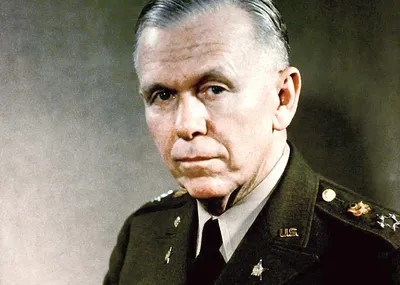
Although he rarely agreed with him on strategic issues, Britain’s World War II Chief of the Imperial General Staff, Alan Brooke, was impressed by General George C. Marshall’s “grandeur of character.” In another context, he called him “a great gentleman.” He was, numerous historians believe, one of the greatest public servants this country has ever produced.
From the time he was commissioned as a second lieutenant of infantry in 1902 until his final retirement as secretary of defense in 1951, Marshall served the country in a variety of ways, most notably as Army chief of staff from 1939 to 1945. By the end of the war, he had directly commanded 11.2 million men and women in the Army and Air Corps. As chairman of the Chiefs of Staff Committee, that number rose to 16 million.
When the war ended, he was ready to retire and turn his duties over to General Dwight Eisenhower. As he said then, he wished nothing more than to spend time with his family and his garden. But after just a few months, President Truman asked him to act as a special envoy to China in an effort to prevent its takeover by the Communists. He was doomed to failure, primarily because of the corruption of the Nationalist government under Chiang Kai-shek.
In 1947, Truman asked him to become Secretary of State. During his tenure, what came to be known as the Marshall Plan helped Europe rebuild from the war’s devastation (and save at least Western Europe form Russian domination), for which he was awarded the Nobel Peace Prize in 1953. When he left the State Department in 1949, he served in the less onerous positions of head of the American Red Cross, and as chairman of the American Battle Monuments Commission. But his country was not yet willing to let him retire. He was appointed Secretary of Defense in September 1950, and finally retired from public service in the following September. He died in 1959, having been given at least 8 years to tend his garden.
Marshall was born in Uniontown, Pennsylvania in 1880. His father was a distant relation to Chief Justice John Marshall. His father’s career had its difficulties, and you could say that George grew up in genteel poverty. Throughout his youth, he held a variety of jobs. Because he always wished to have a military career, he followed his elder brother to the Virginia Military Institute, since he would have been unlikely to get an appointment to West Point due to his spotty academic record.
He was a captain with 15 years of service when we entered World War I. Before the war was over, he had been promoted to Colonel and served as an operations officer under General Pershing. After the war, he became a captain again, reaching the rank of colonel again only in 1933, in an Army where promotion to that rank came only with seniority. With war approaching, his abilities caused rapid promotion, and he became Chief of Staff over the heads of many senior officers. He desperately wanted to be supreme commander of the invasion of France in 1944, but the job went to Eisenhower because FDR said he couldn’t sleep nights without Marshall in Washington. As usual, Marshall didn’t complain.
I tell you all this because George Marshall represented the caliber of people who once served in the president’s cabinet. Here are some others who have served during my lifetime: Dean Acheson, John Foster Dulles, George Schultz, Colin Powell, Madeleine Albright, Averel Harriman, Tom Clark, Henry Kissinger and Colin Powell. While I may not have agreed with their policies, I never questioned their qualifications for office.
You may want to think about George Marshall and these other cabinet members of both parties as you study the lives and careers of the men and women the current president-elect has decided are worthy to represent you and the United States. Some are clearly qualified. As for the rest…
Copyright 2024, Patrick F. Cannon
 cannonnadedotcom
How many Cabinet members have high schools named after them? Marshall is one, Colin Powell, another. Since them, role models have been hard to come by in our DEI (Didn’t Earn It) era. Hillary Clinton? Leon Panetta? Eric Holder? Janet Napolitano? John Kerry? Hmm, I don’t think so. They’re mostly political hacks. But even high schools ain’t what they used to be.
Maybe we don’t live in times that demand grandeur of character in our government. Obama put on a good act; Joe Biden didn’t even bother. Trump? Good grief! But he’s only been put there to disrupt a festering status quo.
I just returned from Europe, Italy specifically. Their situation isn’t any better. Mostly “sick” men and women of Europe. Ursula von der Leyen? Huh? Asia? About the same. South America? I kind of like “Chainsaw” Milei of Argentina. Africa? Forget it. Bibi in Israel has been rising to the occasion. But other than that I’m drawing blanks.
Maybe we are not that badly off. At least there are memories!
LikeLiked by 1 person
And it looks like France is returning to the good old days of a government a month!
LikeLike
Never thought I’d see the day when Italy had the stable government in Europe.
LikeLiked by 1 person
Great one, Pat. You are at your best when you tell a good story/ Well done you. kmk
LikeLike
Thanks!
LikeLike