By Patrick F. Cannon
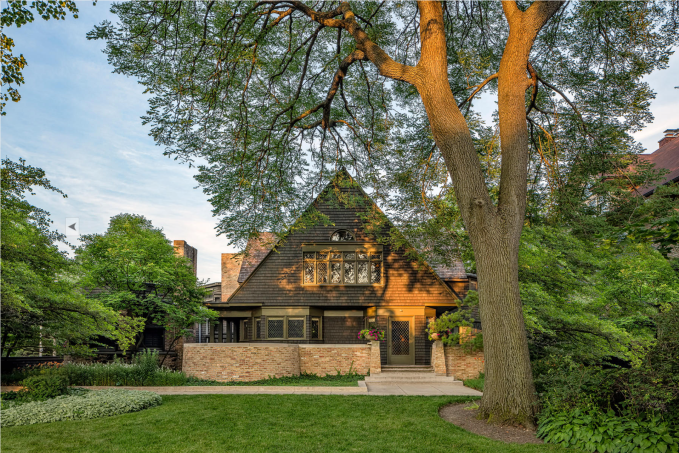
I mentioned in last week’s piece on Bill Bryson that I was currently reading his At Home, which is a story of how private homes have developed over time. As it happens, I give tours at legendary architect Frank Lloyd Wright’s original home and studio in Oak Park, Illinois. It was built in 1889 and added on and changed over the years, with the connected studio added in 1898. It was restored as it was in 1909, after which Wright left his family, closed the studio, and moved his basic operations to Wisconsin.
The house has indoor plumbing. This is no surprise to visitors until I comment that in 1890, only about one percent of American homes were so equipped. Most homes had an outhouse in the back, above a cesspit. You didn’t necessarily have to trudge out there in all weathers; you could use chamber pots, then empty them outside at your leisure. As usual, it was good to be rich – your servants could do that for you.
Nor does anyone comment on the electric lighting that can be turned on when darkness falls. That same one percent would also have applied to electric light in 1890, mostly in the homes of the rich, who often powered their houses with on-site generators. As it happened, the electric lines reached Wright’s neighborhood in 1891.
Where did Wright get these new-fangled ideas? Almost certainly from his employers, the architectural firm Adler & Sullivan. The year he built the house was the same year they finished building Chicago’s Auditorium Building, which Chicagoans will know as the home of Roosevelt University and the famous Auditorium Theatre. It was not only then the largest private building in the United States, but a marvel of technology.
The building encompassed a 400-room hotel; a 4,000 plus-seat theatre; and an office tower (the tallest structure in Chicago at the time). Not only did it have electric lighting – often spectacular in its effect – but the theatre also had a sophisticated air circulation system, which included an early form of air cooling, consisting of massive blocks of ice and blowers! I should also mention that the structure was supported by massive rafts, which floated on Chicago’s spongy subsoil. It was assumed the building would settle 18 inches, which it in fact did. Later buildings would be supported by caissons drilled down to bedrock. Had the bedrock been inaccessible, Chicago’s skyline would be quite different today.
By 1889, Wright was the firm’s chief draftsman, so would have been responsible for producing the working drawings that made construction of this marvel possible. So, it’s no wonder that he would want the latest technology in his own, more modest, home. Indeed, embracing technology would be a hallmark of his lengthy career. One of his early essays was titled “The Art and Craft of the Machine.” Another house that embodies these concerns is the famous Robie House, completed in 1910.
I led tours there for many years, and my partner James Caulfield and I are currently working on a book on the house, which should be published early next year. The house has a sophisticated lighting system; a pump driven hot water heating system (since replaced with a modern climate-control system); a three-car-attached garage; and even a central vacuum system. By the way, by 1910, only 10 percent of American homes had electricity. This had only reached 50 percent by 1924, but large areas of rural American were only electrified starting in the 1930s with the New Deal rural electrification programs.
As to indoor plumbing, as late as the early 1970s, 20 million people in rural America still did without it. I know that because a client of mine at the time was a government-funded program to bring water and sewer service to unserved areas. I quoted that number in a news release that the New York Times printed verbatim on the front page, albeit below the fold! Anyway, as you wander about your house, keep in mind that the facilities we take for granted were once luxuries enjoyed only by folks like the Rockefellers and Morgans. So, flush with pride (unless you have one of those new toilets that flushes itself!).
Copyright 2025, Patrick F. Cannon
Image of Frank Lloyd Wright Home & Studio, copyright James Caulfield, all rights reserved.
 cannonnadedotcom
Another highly engaging Bryson book.
Visionary Frank Lloyd Wright was certainly ahead of his time, not only with electric lighting but indoor plumbing. His cantilevered toilet combined the concept of falling water with natural spiral forms that evoked whirlpools:
Now if only he had devised a way to keep roofs from leaking!
The 1950s were a fertile period for futuristic home ideas. The war was ended and everything was possible. There was even something for the tired businessman, as Tex Avery amply described:
https://archive.org/details/3-tv-of-tomorrow/1+-+The+House+of+Tomorrow.mp4
And you didn’t even have to be rich!
LikeLiked by 1 person
Those were the days. A double feature, short subject, a cartoon, newsreel, and a box of Mason Dots.
LikeLike
They were, and you could enjoy all that in the comfort of your car.
We have a drive-in just outside of town that’s been in operation since 1955. The movies aren’t great, but you can take your girl out on a date in your pickup.
LikeLiked by 1 person
Not sure there are any in the area anymore. I can recall kids appearing from car trunks!
LikeLike