By Patrick F. Cannon
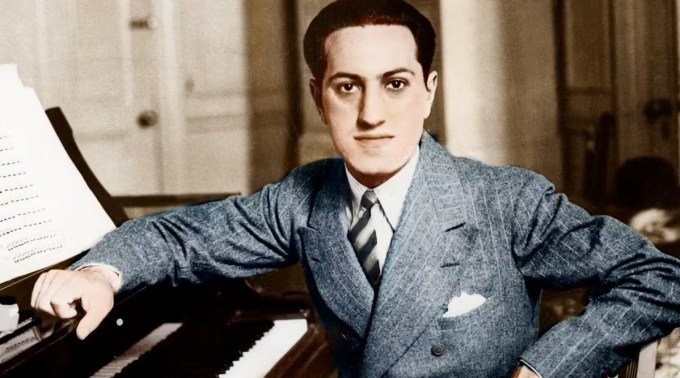
I have always thought of composer George Gershwin as the American Mozart, and not only because they both died young, Gershwin at 38 in 1937 and Mozart at only 35 in 1791. They both had that magical and mystical gift for melody.
I’m not sure how you define “melody.” In simple terms, it’s a pleasing sequence of musical notes that helps you remember a composition, making it easy to hum or whistle, or even hear in your mind (sometimes when you’d rather not!). Mozart and Gershwin were by no means the only composers with this gift – off hand I can name Schubert, Beethoven, Tchaikovsky, Brahms, Foster, Berlin, Kern, Lennon, McCartney – well, you get the idea.
One remembers the lyrics to some songs only because of the melody. Although I might get a word or two wrong, I can recite the lyrics to songs I have rarely heard recently. On the other hand, I once knew many poems by heart but can now only recall snatches. For example, I once memorized a good deal of Shakespeare and could recite The Rime of the Ancient Mariner. Now only snatches remain: “It is an ancient mariner, and he stoppeth one of three…” If only Coleridge had set it to a catchy tune!
It’s difficult to say who was more prolific. Mozart composed 41 symphonies, 22 operas, and 27 piano concertos among his more than 600 published works. Gershwin composed far fewer symphonic works and only one opera, Porgy and Bess, but he composed over 500 songs, many of which were featured in the dozens of Broadway and Hollywood musicals for which he wrote the scores. His melodies have also been the basis for interpretations by Jazz artists from around the world.
If I am wrong, please do correct me, but I doubt that any major university requires a course in music history as part of the core curriculum. Like so many other aspects of our culture, young people can graduate with little or no knowledge of their artistic heritage, unless they major in one of the arts. To too many people, music history consists of the Beatles and the Rolling Stones. The performers they idolize, the Taylor Swifts and Beyonce’s, wouldn’t even think of mining the great American song book, preferring to write songs targeted at the emotions of teen age girls, whose parents seem happy to pony up fortunes to send their kids to concerts, often in faraway cities.
I think no harm and much good would be done if our schools set aside part of every day to expose children to their artistic heritage. And not, and I want to emphasize this, as a credit course, but simply as a part of the day when they can open their ears and eyes to what their fellow human beings have accomplished. No grade pressure. What if they could hear Mozart’s Piano Concerto No. 17 one day, and the next hear Ella Fitzgerald singing “But Not For Me,” followed by Fred Astaire’s version of “Let’s Call the Whole Thing Off.” Or perhaps Lester Young playing anything by Gershwin, or Leadbelly singing the blues. On another day, they might be shown a sequence of paintings and etchings by Rembrandt or hear a series of poems by Frost.
Of course, I realize this may be a vain hope. But in an era of tawdry public and political discourse, aren’t such reminders needed more than ever?
Copyright 2025, Patrick F. Cannon
 cannonnadedotcom
I had the great good fortune of attending, as an undergraduate, a university (Harpur College, then State University of New York at Binghamton, later Binghamton State, and now I think Binghamton University) which required students to fulfill a core curriculum that included two semesters of musical history.
Not only that, the Guarneri String Quartet and, when on leave from Juilliard, the New York Wind Quintet were in residence and gave weekly concerts which I rarely failed to attend. Pianist Jean Casadesus (son of Robert and Gaby) was also in residence and occasionally came to the class to demonstrate the particular style of music we were covering. Guest musicians often visited the campus. I remember in particular Ruth Laredo who performed the Brahms piano quintet with the Guarneri. Watching her on that piano was, how shall I put it, like an aphrodisiac?
If all that weren’t enough, the school had an extensive listening library. Since you were allowed to record music, I was often there on Saturday mornings with my bulky tape recorder.
IU’s Jacobs School of Music is still quite active, though maybe not as stellar as it once was (budget cuts?). Just a few years ago musicians like Menachem Pressler, Janos Starker, Andre Watts and Stanley Ritchie were on the faculty. Joshua Bell and Sylvia McNair are alumni and often performed. The school still offers concerts as well as weekly operas. The Pacifica String Quartet is in residence and occasionally plays. I sense, though, that since the Covid lockdown and recent emphasis on career-based education, music’s importance has diminished. There are few careers in classical music, and live concerts are usually some awful mating-ritual stuff offered at extravagant prices. I don’t get the Taylor Swift thing at all, other than as a triumph in marketing. The music sucks.
Has our culture degenerated into petty animosities, social media rantings and mean political ambitions? You bet it has!
I’m not sure enlightened musical appreciation can overcome such pathetic mass stupidity as No Kings protests (what about MLK, BB, Burger, Billie Jean and Larry?), but it can have a magical effect on the mind.
Over the course of history even prominent composers have fallen into obscurity. No doubt someone in some future century will rediscover our forgotten musical greats, in the manner of stout Cortez, with a wild surmise.
LikeLiked by 1 person
Great orchestras like Chicago are kept alive by donors. Ticket sales, ever more expensive, just won’t pay all the bills. We do still have the free Grant Park concerts in the summer. I imagine your local music school has some freebies!
LikeLike
It does, but as noted, the offerings even if mostly free or at modest prices are less than stellar, mostly student and faculty recitals and the like. Also, the programming has drifted into that dreary world of woke didacticism and propaganda so common on campuses and elsewhere today.
LikeLiked by 1 person
I’m always amazed at how amazed critics are by the lack of audience interest in contemporary music (if that’s what it is).
LikeLike