It’s Never Perfect

By Patrick F. Cannon

I read an interview the other day of a reasonably famous couple – not Lucy/Desi, George/Amal, Mickey/Minnie, or Donald/Melania, but certainly familiar names in theatrical circles. He is an actor/playwright; she an actress of ability. During the interview, she said she wouldn’t bring a child into a world with the likes of Donald Trump in charge.

            She isn’t alone. One has heard many women (and men) say similar things over the years, not about Trump specifically but the state of the world generally. Our low birth rate seems to partly reflect this attitude. The rate in this country was 1.6 children per woman in 2024, the lowest in our history. Even in the depths of the Depression in the 1930s, it never went below 2.22. Can I point out that the 1.6 rate would result in reducing our population, unless we bring in sufficient immigrants to bolster the numbers?

            Our bad old world is only one of the reasons of course. Liberation from the expectation of early marriage and motherhood is surely another. Humans are unique, as far as I know, in being able to rationally decide whether to have children or not. Many young women put their career first, sometimes with the intention of having children later. Since the ages of greatest fertility are the early to mid-twenties, many are happy enough to have just one if they wait until their mid-30s or later. Of course, the reasons for the low birth rate are more complicated, so let’s just explore the reluctance to bring children into our messy world.

            I was born in March 1938, the last of three children. The unemployment rate then was about 20 percent, and Adolph Hitler was well on his way to plunging the world into the most destructive war in history. As it happens, my father had some kind of job during most of the Depression, but my parents could have been forgiven for wondering if the world  in 1938 was a fit place and time to have children. They went ahead anyway, and by the time I graduated from high school in 1956, the unemployment rate was 4.2 percent. Median family income was about $4,800 ($1.231 in 1940); life expectancy had risen to approximately 62 years; and infant mortality was 28.37 per thousand births. We had won World War II and were the world’s dominant economic and military power. People prone to nostalgia look back on the 1950s as a kind of Golden Age.

            The current unemployment rate is 4.6 percent, still historically low. Adjusted to inflation, that 1956  median family income would now be about $55,000: it’s actually $83,000. Life expectancy is now 78.4 and infant mortality is 5.2 per thousand births. The percentage of college graduates has increased from eight in 1956 to nearly 40 percent now (in 1940 it was under five percent). And to broaden the perspective, despite wars, famine, and recurring natural disasters, in 200 years the number of people living in extreme poverty had been reduced from 80 percent of the world’s population to just under 10 percent today.

            Children born today will be 18 in 2044. Who can predict what the world will be like then? Today’s convenient bogeyman, Donald Trump, won’t be around. I was born during the Depression and just before World War II. The world has had its ups and downs since then, but I’m glad I was here to see it. It makes no sense to me that people with the highest education and economic status have the fewest children. There will always be reasons not to have children, but I can tell couples from personal experience that having them can be a great consolation as they age. As is said, you always have family. Unless you don’t.

Copyright 2026, Patrick F. Cannon   

Get Out of Jail Free!

By Patrick F. Cannon

I was once a juror in a capital murder case. To be brief, it involved a black married couple who had attended a party in a Chicago public housing complex parking lot. The wife had become very drunk, and one of the attendees began making fun of her. Her husband went to their unit, got a metal baseball bat, and proceeded to beat her tormenter to death.

            The trial took a week out of my life – four days of motions and testimony and one of jury deliberations. The jury included representatives from Cook County’s three major ethnicities – white, black, and Hispanic, and of both sexes. I was elected foreman. The defendants had separate attorneys, who did their best, but the state had numerous eye witnesses whose testimony was consistent. In our deliberations, it was agreed that the wife had been too drunk to meaningfully participate in the murder, so we voted to acquit her.

            The husband was a different matter. He had gone to his home intentionally to get a weapon, which he had clearly used with the intent to kill. It should have been an easy matter to find him guilty, but there was one female black juror who refused to do so, on the grounds that she would never vote to convict a black man who had come to the defense of a black woman. She wouldn’t budge, so I finally sent a note to the judge that further deliberations were pointless. She was forced to declare mistrial.

            While most jury trials result in a verdict, mistrials do happen. I was sorry it happened in my case, but I got over it. But I find it harder to get over President Trump issuing pardons to everyone convicted of participating in the January 6, 2020, riots at the U.S. Capital. As a reminder, 1220 defendants were convicted, 221 at jury trials and the rest through plea bargains. Although some defendants were found not guilty on some charges, all were convicted of at least some. There were no mistrials. So, I ask myself this question: what do the 2,652 people who served as jurors in these cases think of President Trump’s pardons? Perhaps Fox News should ask them.

            Maybe they could also ask the jurors who convicted Nevada politician Michele Fiore for using police memorial funds for her plastic surgery; or those who sent reality TV stars Todd and Julie Chrisley to jail for tax evasion and bank fraud. They received pardons too, as did Juan Orlando Hernandez, the former president of Honduras who was just beginning to serve his sentence for drug trafficking.

He also commuted the sentence of major donor Imaad Zuberi , convicted of concealing his lobbying for Sri Lanka, illegal campaign contributions, obstruction of justice (and a few more too). And let’s not forget the full pardon he signed for Paul Walczak, who pled guilty to tax fraud, for failing to pay nearly $11 million in withholding, Social Security and Medicare taxes for his employees. The pardon came shortly after his mother, Elizabeth Fago, had attended a $1 million a person fundraiser at Mar-a-Lago.

            President Trump isn’t alone in abusing the pardon power. President Biden pardoned his son and granted preemptive pardons to a few more of his relatives just in case. And other presidents have abused the pardon power on behalf of friends and relatives. Both Presidents Obama and Biden commuted the sentences of thousands of prisoners serving mandatory time for drug-related crimes that they believed were unduly harsh. Not everyone agreed.

            I have been accused of suffering from Trump Derangement Syndrome, about which I wrote just last week. But I’m always happy to give him credit for fixing the mess at the southern border (which got him elected), and for forcing our NATO allies to admit they have a role in defending Europe. He brokered the (I’m afraid) temporary peace in Gaza, severely damaged Iran’s nuclear program, and is now working to bring peace to Ukraine. He has also managed to reduce the Federal workforce, while increasing spending overall. A notable achievement!

            While the jury is still out, he’s attempting to redress the historic imbalance in import duties charged by us and our so-called friends; and in reducing the often-onerous rules and regulations that have stymied growth and progress. So, let’s give the devil his due, and not be surprised when he pre-emptively pardons his appointees, relatives, and friends on the morning of January 20, 2029. After all, Joe did it.

Copyright 2026, Patrick F. Cannon

A Plague Upon the Land!

By Patrick F. Cannon

Although only rarely fatal, the country is experiencing a pandemic of historic proportions, one that — depending on which reports you believe – now affects more than half the population. I refer of course to Trump Derangement Syndrome, or TDS. Apparently, the number of victims increases every time President Trump opens his mouth.

            Recently, the president blamed TDS for causing the December 14 murder of actor/director Rob Reiner and his wife Michele. Their son Nick has been charged with their murder. Apparently, according to the president, his father’s TDS must have been at least part of the motive for the killings. Perhaps Nick thought it would slow the pandemic’s spread.

            The president is no stranger to pandemics. He was unlucky to be in office when Covid 19 emerged as the deadliest pandemic since the Spanish Flu killed 50 million worldwide in 1918-19.  Among his many suggestions to halt the spread was to inject disinfectants like Clorox into the bloodstream, positing that if it could kill germs on surfaces, why not in the blood? Another idea was to apply immensely powerful ultraviolet light both outside and inside the body. He also touted the use of anti-malarial drugs, even taking some  himself. Nevertheless, he was hospitalized with Covid in October 2020. To his credit, however, he supported the development of the vaccines that finally brought Covid under control.   

            To be of  help in overcoming TDS, I thought I might offer some practical advice to its legion of sufferers. For example, you could leave the country. Since all of us come from somewhere else, many would be eligible to claim citizenship in their country of origin. For example, since my father was born in Ireland, I could become a citizen of the old sod. Do you like Guiness Stout? You’ll find it’s cheaper there. On the other hand, you’ll have to pay higher taxes, and it does rain a lot. And, who knows, you might run into Rosie O’Donnell at the local pub. That could be a deal breaker for many.

            You could try a news blackout. No New York Times or your local newspaper, MSNBC, CNN, Fox, NBC, CBS, ABC, or blogs (except those with home decorating tips). Take a pass on invitations to cocktail or dinner parties. Shun family get-togethers  Stop playing bridge. These tactics will not totally insulate you from hearing the name “Trump,” but should lessen the pain somewhat. A more radical approach would be to “go off the grid.” Imagine a cabin in the woods, cutting your own firewood, foraging for a diet of nature’s bounty, becoming one with woodland creatures (except maybe for Grizzly Bears).  

            Or you could wait for the pandemic to run its course, which it will do on January 20, 2029. This will encourage aged people like me to exercise regularly and eat a healthy diet, so we’ll still be around on that joyful day. Or will  there be another “derangement syndrome” lurking in the shadows? Perhaps “MDS”, for Mandami Derangement Syndrome?

            Anyway, Happy Holidays and always keep in mind the immortal words of that legendary philosopher, Monty Python:

            Some things in life are bad

            Other things make you swear and curse

            When you’re chewing of life’s gristle

            Don’t grumble, give a whistle

            And this will help things turn out for the best,

And

            Always look on the bright side of life

            Always look on the light side of life.

Copyright 2025, Patrick F. Cannon (Except for the last bit, of course.)

Happy Holidays From Dogpatch!

By Patrick F. Cannon

Well, another year has passed, so I thought I’d bring you all up to date on my family as the holidays approach. As usual, there wasn’t a dull moment. First the bad news: old Uncle Abner won’t be with us again this year – the Parole Board turned him down. He didn’t help his case this time when he got caught running a dice game behind the mangles in the laundry and compounded the felony by being caught with loaded dice.

            I guess he’ll have to serve the full sentence, unless he gets smart and lets the screws share in the take. But heck, he’ll only be 70 when he gets out. If he watches his health, he ought to be able to enjoy some of the cash he has stashed away. He still refuses to tell me where it’s hid, despite me telling him inflation is eating away at it, regardless of what that fella Trump says. and I’d be happy to invest it for him. Oh, well, he’s as cantankerous as ever. The color did drain from his face when I told him Amazon was building a new distribution center on that flat land near Dismal Seepage Creek.

            Daisy Mae is pregnant again. Not sure who the father is this time either. As you know, all her kids look just a little different. I call them the rainbow coalition. She’s a worker though. Took an online course in beauty culture, using money borrowed from the government. She says no one ever pays off them loans, so it’s like a free education. Aren’t these young folks smart? Anyway, she’s got everyone in the holler sporting green, red, purple, or pink hair (even yours truly).  

            As you know, young Georgie is in the army. He made it all the way to corporal before he got busted back to private for drinking on duty. At least they didn’t give him a dishonorable discharge like his brother Amos. I guess they treat drunkenness and attempted murder different. Anyway, he’s determined to stick it out for 30 years and retire so’s he can be the richest man in Dog Patch.

            You probably heard that Aunt Nellie got married again. You kinda lose track, but I think this might be number seven. I’m sure it’s just a coincidence that her former husbands all died suddenly.  At least they all left her some money. Maybe she’ll have better luck this time. Last year’s new husband looked healthy enough, but I guess he was on the clumsy side; he managed to fall off the balcony in that luxury Miami condo he bought her as a wedding present. Her new hubby is the building maintenance man, so that should be handy for her. Lately, he’s looking a bit peeked; maybe it’s that Covid thing again.

            I’m proud that the family remains on the cutting edge of social change. Cousin Charlie announced that he was changing his name to Charlene. Guess we’ll all have to bone up on our pronouns. I suggested to Charlene that the beard might be considered odd for a lady, but he’s (she’s?) quite fond of it, reminding me that the carnival that comes through town still features a bearded lady. So, it looks like a career change might be in the offing too.

            I’m sure you’ve seen all those stories about son Ralphie. As you know, he’s the only member of the family to graduate from college – and Harvard no less. He’d already graduated by the time they found out he’d phonied up his transcripts and ACT scores to get in, and by then were too embarrassed to go public. Ralphie says the trick is to get in. After that you don’t have to do much, since they think you’re already smart enough.

            Anyway, Ralphie’s now got the record for the greatest Ponzi scheme in history. Unlike old Madoff, he got away to Russia with the dough before it was discovered, so all that education sure paid off.  That picture of him and Putin riding those white horses bare-chested made all the papers. Funny though, when we tried to get a passport to visit him, we got turned down. I complained to our congressman, and he told me he was surprised too, since he thought they would be happy to see us leave the country. Not sure what he meant by that. Anyway, we might not need to go to Russia. Ralphie tells me  he’s being considered for a pardon by President Trump and may also be in line for Secretary of War if that fella Hegseth gets fired.

            I hope you won’t believe that story about wife Rosie being found naked with the preacher. She told me it was just a new way of praying; something about going back to the innocence of Adam and Eve before they ate the apple. She said it made her feel so good she might try it again.

            As for me, my run for Congress didn’t work out so good. I thought for sure having President Trump’s endorsement would do the trick, but those crooked Democrats foiled me by going to the polls and voting. I was wrongly criticized for not having any political experience, which I thought was a plus. I also thought it was unfair to bring up those accusations of sexual misconduct, especially since the statute of limitations had already expired.

            Anyway, if the president of the United States can play grab (censored), why not your humble servant? I guess I’ll just have to go back to selling used cars salvaged from the recent hurricanes. I always hate to see stuff go to waste. Of course, if my new book, Hillbilly Theology, takes off like my publisher thinks it might, I understand a senate seat might come open!

            My brother Caleb says he won’t be attending any of the family’s Christmas gatherings again this year. Says he can’t afford to, since he claims I borrowed $5,000 from him some years back and never paid him back. He’s the eldest you know, and it’s sad to see his memory starting to fail him.

            Well, that’s all for this year. You have a Merry Christmas and Happy New Year. As for me, I can’t wait to see what the future has in store for the Yokum family.

Copyright 2025, Patrick F. Cannon

Goodbye, Jim

By Patrick F. Cannon

When you reach my age – I’m 87 now – you sadly get used to your contemporaries dying, both friends and relatives. After all, life expectancy in 2022 was 74.8 years for men and 80.2 for women. So, when my cousin James Mark Goldstrohm died on December 2 at age 89, he beat the odds. Still, for me, it was hard to accept.

            “Jimmy” to many of his relatives, “Goldie” to many of his friends, but always “Jim” to me, for most of our lives, we were not just cousins, but friends. We attended the same school, St. Peter’s in McKeesport, PA, for a few years, and even had the same jobs: setting pins at the McKeesport Elks Club; and working in the restaurant at nearby Kennywood Park, Pittsburgh’s legendary amusement park. After my brother Pete died, Jim was the person I knew the longest.

            I went  to my first concert ever with him, Jazz at the Philharmonic at Heinz Hall in Pittsburgh. Appearing were legends like Dizzy Gillespie, Ella Fitzgerald, Roy Eldridge, and Gene Krupa. A highlight was Ella’s 10-minute-long version of “How High the Moon.” After the concert, we had a couple of drinks at a nearby bar. We were underage – I was probably 17 – but wearing jackets and ties, so weren’t carded. I drank screwdrivers!

            The last time I saw him was at this summer’s Donnelly family reunion, held for many years in Western Pennsylvania’s beautiful Laurel Highlands. No one there bore the Donnelly name, but they were all descendants of my grandparents, Frank and Catherine Donnelly, and their seven surviving children (one boy and six girls). He was the second oldest of 20 first cousins and was eventually the patriarch. With his death, I am now the oldest of six  survivors.

            When we were kids, at family events he would gather the cousins and perform (the best word I could think of) movies he had seen. Movies were a lifelong passion, and he would describe the plot and action, and even quote dialog. He was an only child, and he lived next door to our grandparents with his parents Vernal and Clare in North Braddock. We went to the movies weekly in those days, and he often went with Grandfather Frank, who also loved them.

            When we were teenagers, I remember talking about a particular movie, one of whose cast members we couldn’t remember. It drove us both crazy, but the name escaped us. So, when I woke up in the middle of the night and remembered it, I picked up the phone and called him. It must have been 3:00 am, but when he groggily answered and I said “Franchot Tone,” he was happy I called.

            He was a handsome man, but on the thin side, and not at all athletic. But he had courage. One day when we were about 12 or 13, he lured my brother Pete and me to the nearby Westinghouse Bridge, which carried US Route 30 over Turtle Creek, Braddock Avenue and East Pittsburgh. On one side was the Westinghouse factory; on the other the Edgar Thompson Works of US Steel in Braddock, the mill where his grandfather was general foreman, his father an electrician and where Jim himself  would work for 35 years.

            At one time the longest concrete-arch bridge in America with a total length of 1,598 feet, its center span of 460 feet is 240 feet above the valley floor. Underneath is a cat walk, put there I imagine for maintenance and inspection. I’m sure there was a hatch of some kind to provide access, but we reached it by gingerly walking across a 2×10 board suspended over a gap. Looking at a photo now, I see that had anyone fallen off the board, there would have been a steep drop into the valley below. We walked all the way to the other side on the cat walk, and the views were impressive, but lurking in my mind was the reality of going back over that board! Jim, of course, had done it before!

            We walked to the bridge from the later Goldstrohm family home in North Versailles Township, a new house they had moved to from North Braddock. After his parents died, Jim lived and raised his own family there until he and his wife Rhoda moved into an apartment created for them in the home of his daughter, Emily Belchick, and her husband Tom. He was also loved and supported by his other children, Paul Goldstrohm and Claire Pingree, and his seven grandchildren.

            He spent his last years doing what he enjoyed most – watching his beloved movies, reading the great fiction of all eras, and listening to the jazz and classical music contained in his extensive record collection. While he was able, he was a prodigious walker, even often walking many miles to and from work. As I mentioned, he worked at US Steel for 35 years. He made many friends during those years and told wonderful stories about the characters he worked with. Of all the people I’ve known, he was the purest in spirit. He had no animus, but much love and loyalty to his beloved relatives and friends.

            For some reason, I’m reminded of the story in John’s gospel of Jesus asking the crowd about to stone the adulteress: “Let him who is without sin among you be the first to throw a stone at her.” Had Jim been among the crowd, he likely would have been that one without sin, but he never would have cast that stone. He was buried on December 8 at St. Joseph’s Cemetery, joining my parents and other members of the Donnelly clan. I know he will rest in peace.

Copyright 2025, Patrick F. Cannon

Rules, Rules, Rules!

By Patrick F. Cannon

If you watch football at the professional or major college levels, you are aware that the length of a game is often extended by penalties and disputes over them. The broadcast teams that describe the action almost always have a rules “expert” on call to unravel the intricacies of a particular situation.

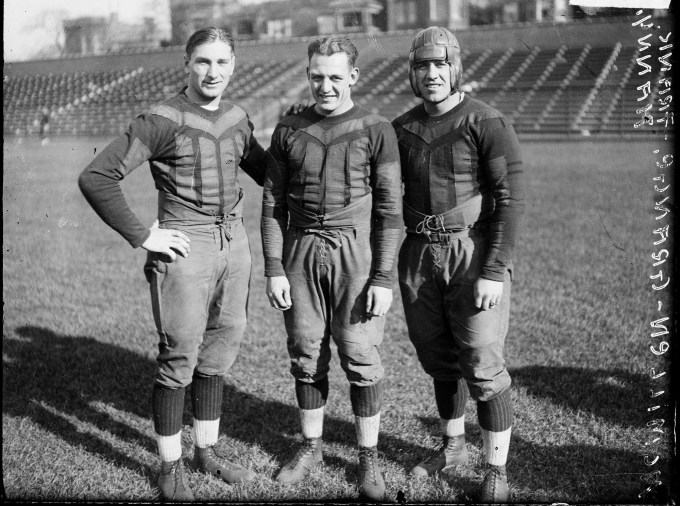
            When I played midget and high school football in the 1950s, most of the penalties called now didn’t exist. There was one called “unnecessary roughness,” but not one called “roughing the passer.” The former covered all instances of using extraordinary methods (punching, clawing, strangling, etc.) in your dealings with the fellows on the other team. The first penalty ever called on me was for using most of these techniques to get to a quarterback who was taking his own sweet time deciding where to throw a pass. As I recall, I never actually got to him, being too busy abusing his blockers. The penalty was 15 yards, and my coach counseled me to use more forbearance in the future.

            In those days, there was no such thing as “roughing the passer.” If you bumped into, tackled or shoved him after the ball was thrown, it was rarely called, one reason being that it was rare for the team to pass more than 10 times during the usual game. While the cheerleaders thought more highly of him than they did of grunts like me,  the quarterback wasn’t coddled like a rare flower.

            A penalty for being “offside” was common. I imagine that “encroachment”  is just another way of saying the same thing, but a bit fancier. There was no play clock to speed things up because I don’t recall slowing things down on a regular basis. If you did dawdle, the referee would bark at you to “speed up a bit gentleman,” or was it in saltier language?

            By the way, the refs’ decisions were final. This didn’t stop the coaches from complaining loudly and at length, but to no avail. The only red handkerchief he could use was to blow his nose. How could you have a video replay when video hadn’t been invented?

            I don’t recall many holding penalties. As I’ve suggested, the forward pass was not as common in my day, so most blocking was designed to shove the defenders out of the way to create holes for the running back, not to prevent them from getting to the quarterback. Another reason for fewer penalties was there were fewer officials. I think we may have had four or five; now, in the NFL and major colleges there are eight on the field and a few in the booth.

            “Face mask” penalties are common now, but in my day the face was just as vulnerable as the rest of the body. You could always tell a lineman of extensive experience by the condition of his nose. Various other offenses were often committed out of the ref’s views, including the occasional bending of a finger or two. Flattened noses and gnarled fingers were both badges of honor for the interior linemen.

            Strangely, the actual official time of the game hasn’t changed. There are still four quarters of 15 minutes each, or one hour of actual play. As late as the 1980s, the average length of a pro football game was 2.5 hours; now, it’s about 3.1 hours. In my high school days, the band would strut its stuff during about a 20-minute halftime. The evening’s festivities (we played on Friday nights) would take no longer than two hours.

            Our games were broadcast on the local radio station. I’m sure they mentioned the sponsors when they could, but the station and its sponsors didn’t control the game. Today, the average NFL game includes 50 minutes of commercials. While this is annoying enough for the fans at home, imagine watching the game in an open stadium in the dead of winter?  Nevertheless, football has become the national passion, eclipsing that old national pastime, baseball, whose average game takes only about 2.5 hours. Maybe they should do away with the pitch clock to give fans more for their money.

Copyright 2025, Patrick F. Cannon 

Blue Bears?

By Patrick F. Cannon

If you run into a bear in the wild, especially a Grizzly, your first reaction is bound to be stark terror. And rightfully so, as they have been known to not only attack humans but make a meal of them too. So, it’s more than a little incongruous that little tykes (and sometimes their elders) have long cherished their Teddy Bears, named after a Black Bear that Teddy Roosevelt – who bagged thousands of animals in his hunting trips – spared for reasons too complicated for our limited space.

            Smokey the Bear and goofy Yogi are also a legendary creatures, as are increasingly the blue (and sometimes red) bears that constantly extoll the virtues of Charmin toilet paper in television commercials. Who can resist this family of loveable bears as they face their bathroom visits with confidence and even joy? As the commercials remind us: “Everyone has to go. Why not enjoy the go?”  We may make fun of their escapades, but Charmin is America’s best-selling brand of toilet paper.

            It’s a product of Procter & Gamble, founded in 1837 in Cincinnati – where its headquarters are still located – by William Procter and his brother-in-law James Gamble. Their first products were soap and candles. In the most recent year, their total sales were approximately $85 billion, with a net profit of $16 billion. They have paid a dividend to their shareholders for 135 continuous years. They employ 110,000 people worldwide.

            It’s almost impossible to avoid buying their products. In addition to Charmin, here is a selection of  their brands that are the best-selling in their category: Tide, Pampers, Gillette, Bounty, Febreze, Bounce, Dawn, Cascade, and Head & Shoulders. I still remember the simple slogan they used for Tide: “Tide’s in, dirt’s out.”

            Their products are omnipresent around the world. For example, years ago I arrived in Chiang Mai, Thailand and discovered I had forgotten to pack my Head & Shoulders shampoo. I found what we would call a “mom and pop” grocery store down the block from the hotel. I would have been happy with any shampoo they might have had, but there was Head & Shoulders and other American brands prominently displayed.  Kind of like Coke, that universal thirst quencher.

            Are Procter & Gamble products better than those of their competitors? I have no idea. But I do know that they are master marketers. And not only because of their relentless advertising. Back to Charmin. Although I have never had a problem with the straight edge tear, they have now introduced a wavy edge, which they claim makes this tedious chore much more bearable (sorry). This  amazing advancement in bathroom equipment has rightfully been named best new product of the year.

            Choice is big with them. If you go to the shampoo aisle at your local drug or grocery store, you will find Head & Shoulders in a bewildering variety of formulations – regular, regular with conditioner, bare (no perfumes or other additives), extra strength, dry scalp, oily scalp, for men – well, you get the idea. Perhaps they even have one for dogs. I must make it a point to check the pet supply aisle the next time I go shopping. Perhaps after I count the many variations available with Tide.

            American consumer products companies like P&G have made us the cleanest and best smelling people on earth. Just one more thing to be thankful for on Thanksgiving Day 2025 (I bet you were wondering how I’d sneak this in – anyway, Happy Thanksgiving!).

Copyright 2025, Patrick F. Cannon

It Should Be Hard

By Patrick F. Cannon

You must be wondering, since I make so much fun of “found object” art, if there’s any stuff I like. Quite a lot as it happens. A common thread that runs through it is this: It can’t be easy to accomplish, and the artist must participate in its creation.

            One of the reasons I don’t value Andy Warhol highly is that most of his stuff is just the manipulation of other’s work. The anonymous designer of the Campbell’s soup cans labored in obscurity, yet Warhol copied it on a canvas and became famous. His even more famous paintings and silk screens of Marilyn Monroe are based on a publicity still taken by Gene Korman to publicize the 20th Century Fox 1953 film, Niagara. He neither paid Korman for nor even sought permission for its use. Nor did he ask Campbells.

            Andy called his studio the “factory,” and those that labored there did much of the actual work. Jeff Koons is another artist who creates art on an assembly line basis and happily admits that he’s the idea man. “Create giant metal ballon animals,” he decrees, and the factory springs into action. Or “give me a giant puppy covered with flowers,” and one duly comes to life outside Frank Gehry’s Guggenheim Museum in Bilbao, Spain.

            Defenders of Warhol and Koons often point out that many of the “old masters” had assistants who did some of the work. If you look at the immense production of Peter Paul Rubens, you know he must have had others do canvas preparation and other background work. But no one doubts that he did the major figures in his voluminous works.

            If someone asks me who my favorite artist is, I will have to say I don’t have only one. Among those I most admire are Rembrandt, Michelangelo, Titian, Monet, Caravaggio, El Greco, Rodin, and Valazquez. I also have a grudging admiration for Picasso, particularly his work before World War II. I have been fortunate to see many of their works in museums. Seeing a photo of Michelangelo’s David is a poor substitute for seeing the towering original in Florence. Rembbrandt’s The Night Watch at Amsterdam’s Rijksmuseum is approximately 14×12  feet; and Valazquez’s famous Las Meninas at the Prado in Madrid is 10.5×9 feet. Neither can be given full justice on a 12×9-inch page.

            One of my favorite Valazquez paintings is somewhat smaller, his 1640 Aesop, pictured here. I’ve seen it twice, the first time at the Art Institute of Chicago, where it was on loan and exhibited next to  Edouard Manet’s 1859 The Absinthe Drinker, which was clearly influenced by Valazquez’s work. Both figures are life size. I saw Aesop again at its usual home, the Prado.

            As you can see, Aesop is holding a book of his famous fables. The model is said to have been a beggar that the artist saw many times on the streets. Whoever it was, a lifetime of pain and experience are written on that face. While there may be pain within a color-field abstraction by Mark Rothko, it can only be in the eye of the beholder. Years ago, I heard a physiatrist claim that looking at a Rothko painting had reduced him to tears. He claimed that it had nothing to do with his knowledge of the artist’s suicide. I didn’t believe him.

            I don’t suggest that Rothko lacked skill or didn’t work hard. If you look at his paintings, you can see the skill and rigor it took to create his effects. As with so many purely abstract paintings, I’m just not convinced it was worth the effort.

Copyright 2025, Patrick F. Cannon

Now That’s a Throne!

By Patrick F. Cannon

Italian artist Maurizio Cattelan – he of the $6.2 million banana sold at auction last year – is back in the news. Sotheby’s auction house in New York has announced that his solid gold toilet titled “America” will go on the block on November 18 with a starting price of $10 million, which happens to be the current scrap value for the 223 pounds of gold it contains.

            Originally created in 2016, it was one of two. The other had been installed in Great Britains Blenheim Palace, ancestral home of the Dukes of Marlborough and birthplace of Winston Churhill. My visit to the palace predated its installation, so I couldn’t do the golden go. In 2019, thieves pried it from the wall, and although caught, it was not in time to prevent the fixture from being melted down and sold.

Prior to adorning a loo at Blenheim, the toilet had been at the Guggenheim Museum in Manhattan. It’s been reported that the museum offered it to President Trump during his first term after he requested a Van Gogh painting for the White House. Knowing his love of gold stuff, it must have seemed a reasonable tradeoff, but it seems not to have worked out.

The toilet is in the great tradition of everyday objects being promoted as works of art. That renowned artist/humorist/charlatan Marcel Duchamp started the ball rolling by exhibiting a urinal as a work of art. Not a urinal he had himself sculpted, but an off-the-shelf item (or one he swiped from a public loo. I can’t remember which). That was about 100 years ago, but the trend obviously has legs.

I first made note of this new avenue for budding artists in the early days of this series in 2016. For you newer readers, and those whose memory is something like mine, I reprint it here in part:

“Is it a Caddy, Daddy?

There was great jubilation at the University of Chicago recently when a work of art that many had feared might have been lost forever was returned to its rightful place on the University’s Hyde Park campus.

            Titled “Concrete Traffic,” it was by the well-known German modernist Wolf Vostell (1932-1998). Vostell was a leader in the early days of video art and in organizing the “happenings” that were such a feature of the art world in the 1960s and 1970s. In this case, he took a 1957 Cadillac Coupe Deville and encased it in concrete. Commissioned by the fledgling Museum of Contemporary Art in Chicago (now celebrating its 50th anniversary), it was finished in 1970 and parked in a nearby parking lot. It was there for some time and apparently accumulated numerous parking tickets. Who paid the tickets seems lost to history. As for me, I wondered how they were attached, since there were no windshield wipers. Perhaps the cops taped them on the concrete, artfully one hopes.

            Anyway, the sculpture was eventually donated to the University of Chicago, where it graced the campus until moved into storage to make way for the construction of the Logan Center for the Arts. In storage it may have remained – slowly crumbling away – were it not for art historian Christine Mehring. She heard about it and arranged a visit. What she found appalled her. Here was this splendid work of 20th Century art molding away from public view.  Hunks of concrete were actually missing, as if it were merely a public sidewalk or something!

            It was a challenge, and one that Professor Mehring has heroically met. At a cost of some $500,000, “Concrete Traffic” has been restored and proudly placed in a stall of honor at the University’s main parking garage. You may wonder how it could have possibly cost that much to do a bit of concrete patching. Instead of going to Craig’s List for a local concrete guy, they sought out the experts who had restored the concrete at Frank Lloyd Wright’s Guggenheim Museum in Manhattan. While the niceties might be lost to the layman, there is a significant difference between a concrete conservator and a concrete repairer. The former usually has a beard and charges more. I should mention that the only visible parts of the Caddy are its white wall tires. As you might expect, expert opinion was also sought on the proper tire pressure.

            The result, according to Mehring, is a work from an “important transitional period from the happenings in the 1960s to the monumental sculptures and environments of the 1970s.”  Since Herr Vostell is no longer with us, his intended meaning is lost to us. Most people think it was an ironic comment on the wasteful consumer culture of America, typified by the land yachts that floated over the (concrete) superhighways that connected our car-mad cities, towns, villages, and hamlets.

            Europeans in the 1960s, burdened as they were by astronomical gas taxes, tended to drive around in cars like the VW Beetle and the iconic French classic, the Renault 2CV, which, I recall, had a suspension that consisted of husky rubber bands and tore down French roads at a breathtaking 50 miles per hour.

 Alas, there aren’t too many Caddy convertibles of that vintage to be seen here anymore. Those that survive are cherished; many are housed in museums. But, thanks to Professor Mehring and her colleagues, you can at least sense the existence of a 1957 Coupe Deville beneath the concrete at the University’s parking garage at 55th and Ellis. If you want to park near it, it will cost you four bucks an hour. But walk-ins are always free. At the cost of a little shoe leather, you can relive the ironic “happenings” of a bygone era. And wonder, as I have, how they’re going to change the tires when they inevitably collapse under the 34,000-pound weight of German irony.”

So, the gold toilet is just the latest in a lengthy line of everyday objects posing as works of art. Given his lust for gold, I find it hard to believe President Trump passed it up back in long ago 2019. I see a new opportunity now though. Since he’s remodeling the bathroom in the White House Lincoln bedroom suite, maybe one of the president’s unselfish donors can spring for the toilet. Just imagine the thrill of flushing a golden toilet!

Copyright 2025, Patrick F. Cannon

What’s a Prop, Daddy?

By Patrick F. Cannon

If you watch sports on TV, you will see countless commercials for online betting services, some of which are “official” partners of one league or another. Many of them extoll the glories of “prop” bets. In the interests of public education, I investigated this and found that “prop” is short for “proposition.” While the possibilities are almost endless, you can place a bet on how many innings the starting pitcher lasts in a baseball game, how many touchdown passes a quarterback throws, which team scores first (any number of sports), how many home runs are hit, how many three-pointers a basketball player hits – well, you get the idea.

As for me, last weekend, I bet $32 on 14 Breeders Cup horse races. The top race, the Breeder’s Cup Classic, had a $7 million purse, with the others at least $1 million. When it was all over on Saturday evening, I lost $14.60. I can afford it.

            I am unlikely to make another bet until the end of the year, since all the major races  have been run, both in this country and in Europe. Except for one day early this year at Tampa Bay Downs during a visit to my son, all my bets are made online. There are off track betting sites in the Chicago area, but the only thoroughbred track left is Hawthorne, where purses are low and the amenities subpar. As you may know, the once wonderful Arlington International Race Course is now an empty lot.

            Other gambling opportunities in Illinois abound. In addition to the two remaining race tracks, the state has long had the lottery and now has 17 casinos. Add the taxes on sports betting, and state and local tax income exceeds $2 billion. Nationally, that number is closer to $20 billion. There are now 30 states and the District of Columbia that permit online sports betting. This ease of betting on the whims of chance has exacerbated gambling addiction. While it’s impossible to know with any exactitude, it has been estimated that more than 10 million Americans have some level of addiction.

            Regular readers will know that I was born in Pennsylvania. Although the state has long since joined the legal gambling bandwagon, when I was a kid, all gambling was illegal. What we did have was something called “the numbers.” It involved picking three numbers and betting a buck or two that those three numbers would match the last three numbers on that day’s Dow Jones industrial average. Chicago had a similar game called “policy.” Bets could be placed at the candy store, tavern, or other retail locations. My father was a regular player. Occasionally, he won a few bucks, always a cause for great celebration.

            I went to my first horse race in 1957, a year after I moved back to Chicago. The only legal gambling was at one of the Chicago area’s six tracks. On rare occasions, I placed a bet illegally with the runner for the local bookie, who happened to be LaSalle Street Station’s freight elevator operator. Most office buildings in Chicago’s Loop had someone who could take bets. You could, of course, also bet illegally on most sporting events. Later in my career, I participated in the weekly NFL office pool, where I put up $5 every week, and occasionally in World Series pools.

            Now, all this is perfectly legal. I can even drive a few minutes to a community that has legal slot machines in bars. A full-scale casino is operating in downtown Chicago, and another suburban casino is only 30 minutes away. I can buy lottery tickets by walking one block, although I can also buy them online. The same site I use to bet on horses (not only here but in many other countries), would also take my bets on other sports.

            Whether legal or not, people are going to gamble, so governments at all levels have decided they want a cut of the action instead of some shady bookie. Sports leagues ban their players from betting on their sport but are happy to name “official” betting site sponsors. Commercials for these betting services punctuate televised coverage of the games. At the bottom, if you look fast, there will always be an 800 number to call if you have a gambling problem. But, really, it’s just a bit of PR. Without the problem gambler, their bottom lines would suffer, and you can bet on that. Even the occasional scandal like the recent one involving the NBA won’t cause more than a little flutter (by the way, “flutter” is slang for a small bet, but also the name of the world’s largest online gambling company).

Copyright 2025, Patrick F. Cannon