By Patrick F. Cannon
If you look up lists of the world’s top universities, including lists compiled by other countries, on average seven of the top ten are likely to be in the United States. In the Chicago area, the University of Chicago falls just outside the top ten; my alma mater, Northwestern, ranks in the low thirties. The quality of these schools draws students from around the world.
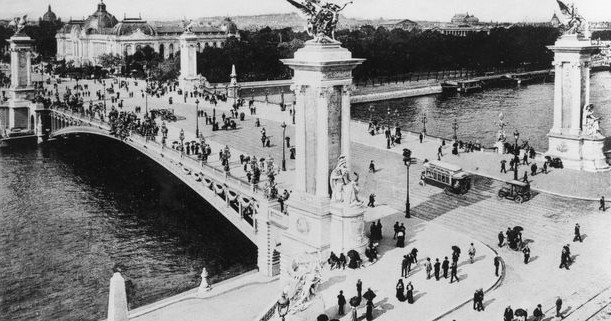
For much of the 19th Century, in contrast, Americans seeking higher education in engineering, architecture, the sciences, medicine and the visual arts had to travel to Europe to complete their education, with Paris the preferred destination. The story of these pilgrims is recounted in David McCullough’s 2011 book, The Greater Journey, which I recently re-read for my book group.
While Americans had access to a more than adequate education in the liberal arts – literature, history, languages, philosophy, etc. – the only engineering school in America until M.I.T. was founded in 1861, was the military academy at West Point. M.I.T. was also the home of the country’s first architectural school, founded in 1868.
Since I write about architecture, let me concentrate on the architects who attended the Ecole des Beaux Arts in Paris. As was true with the fledgling painters and sculptors who also attended, they would have had to be fluent in French, as all the instruction was in that language; and would have had to pass a stringent competitive entrance examination, also in Franch. For example, only 30 places were available for budding architects in 1874, the year Louis Sullivan took and passed the test.
(As you’ll find out if you read my new book with photographer Jim Caulfield, Louis Sullivan: An American Architect – published by Glessner House and distributed by the University of Minnesota Press – Sullivan left the Ecole after only a year. He felt he had learned all he needed, which was the process of designing a building, not its style. He would emphatically reject the dominant European models for a more purely American style.)
In 1846, Richard Morris Hunt was the first American architect to attend the Ecole. He would become America’s leading architect, responsible for New York’s Metropolitan Museum of Art; the base of the Statue of Liberty; and two homes for the Vanderbilts – the famous Breakers in Newport, Rhode Island for Cornelius, and the country’s largest private home, Biltmore in Asheville, North Carolina for George
America’s most admired architect when he died at only age 48 in 1886, Henry Hobson Richardson attended the Ecole from 1860-62. My Pittsburgh area relatives will know his Allegany County Courthouse and Jail; here in Chicago we have his Glessner House, a Chicago landmark and museum. Sanford White and his later partner William McKim attended – they designed the famous Penn Station in Manhattan – as did White’s close friend, the sculptor Augustus Saint Gaudens.
These architects and those in other disciplines who studied in Paris brought their knowledge back and helped educate new generations that would move the centers of knowledge to their own country. At the same time, Americans like Thomas Edison were proving you didn’t need a Paris education to change the world; self-education could do just fine!
Interestingly, McCullough’s next book would be 2015s The Wright Brothers, about two young men with high school educations from Dayton, Ohio who would accomplish what highly-educated engineers had been unable to do – put a person in a flying machine that could take you to a defined destination. Although they weren’t yet able to fly to Paris, they eventually got there as the most famous brothers in the world. An even more famous American – a dropout at the University of Wisconsin – Charles Lindburgh managed to drop into Paris from the sky. By then, we were well into what would become known as “The American Century.”
Copyright 2024, Patrick F. Cannon






 cannonnadedotcom