By Patrick F. Cannon
This is being written several days before Thanksgiving. On the great day itself, I’ll be busy preparing the turkey, which I’ve been doing every year for some 35 years. That includes my world-famous stuffing, whose recipe is a closely-guarded secret. Before my darling wife Jeanette died, she made or planned all the hors d’oeuvres and side dishes, a task now carried out with aplomb by daughter Beth and husband Boyd.
Before starting to write this, I read the Sunday Chicago Tribune and on-line New York Times. As usual, the world’s a mess. To be honest, I’d be hard pressed to remember a Thanksgiving where people in many parts of the world have much or even anything to be thankful for. Not for the first time, I find myself thankful for being born in the United States of America.
I could, of course, assault you with a litany of the problems facing our country. Not today, though. Perhaps it’s just a coincidence, but the auto workers, writers, directors and actors all managed to negotiate new contracts in time to eat their turkeys with new gusto. And, of course, to create new “content” that will be just as good or bad as the old stuff; and electric cars that will wander the highways looking for charging stations.
The unemployment rate is at 3.9 percent, almost as low as it has ever been. Inflation is now at 3.24 percent, less than half of what it was last year. And even the cost of Thanksgiving dinner has declined by about 5 percent. All of this despite a completely dysfunctional Federal government, which might suggest that accomplishing nothing might not be so bad after all.
Although the height of the Fall color season is behind us, it was a good one. What is more satisfying than walking down a street full of trees beginning to drop gold, orange and red leaves all around us? And seeing kids jumping into newly-raked piles? I do miss the smell of burning leaves, but you can’t have everything.
There will be 10 people (and a baby) around my table this year. My son Patrick is here from Tampa, and my niece Eve and her husband Tim round out my side of the family. Boyd’s sister Cathy, niece Rachel, her husband Peter and baby Nora, and nephew Riley represent his side. In addition to the turkey and dressing, we’ll have the requisite mashed potatoes and gravy; creamed spinach and carrots; cranberry sauce; and both apple and pumpkin pies (topped with ice or whipped cream). There will be the usual alcoholic and non-alcoholic beverages before, during and after dinner.
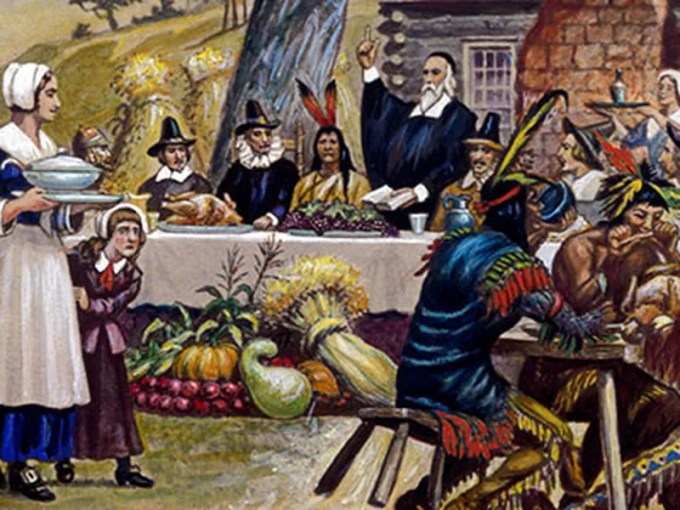
While I was salivating in anticipation of the feast, I got to thinking: what did those Pilgrims eat at the first Thanksgiving in 1621? While the historical record is somewhat spotty, in addition to wild turkey, it’s likely the Pilgrims and their Native American neighbors would have had the more plentiful geese and ducks, and even the now extinct but then abundent Passenger pigeons. The menu would also have included venison. Pilgrim leader Edward Winslow wrote that King Massasoit of the Wampanoag tribe contributed five deer to the festivities.
Alas, no mashed or any other kind of potatoes. The natives grew corn and a kind of green bean; and records suggest the colonists grew turnips, carrots, onions, garlic and a variety of squashes, including pumpkins! And, because they were on the Atlantic coast, seafood, including lobsters, clams and eels (!) would certainly have been enjoyed. As to booze, if it had been available, they would have happily quaffed some suds, which would have been the beverage of choice in England, where drinking the water might have been fatal. But it does seem to have been a bit early to have opened a brewery (Sam Adams wasn’t even born yet).
History tells us that the feast lasted three days! No doubt the meals were followed by naps, another tradition that remains to this very day. Happy Thanksgiving!
Copyright 2023, Patrick F. Cannon