Golfing with the Derdzinskis
By Patrick F. Cannon
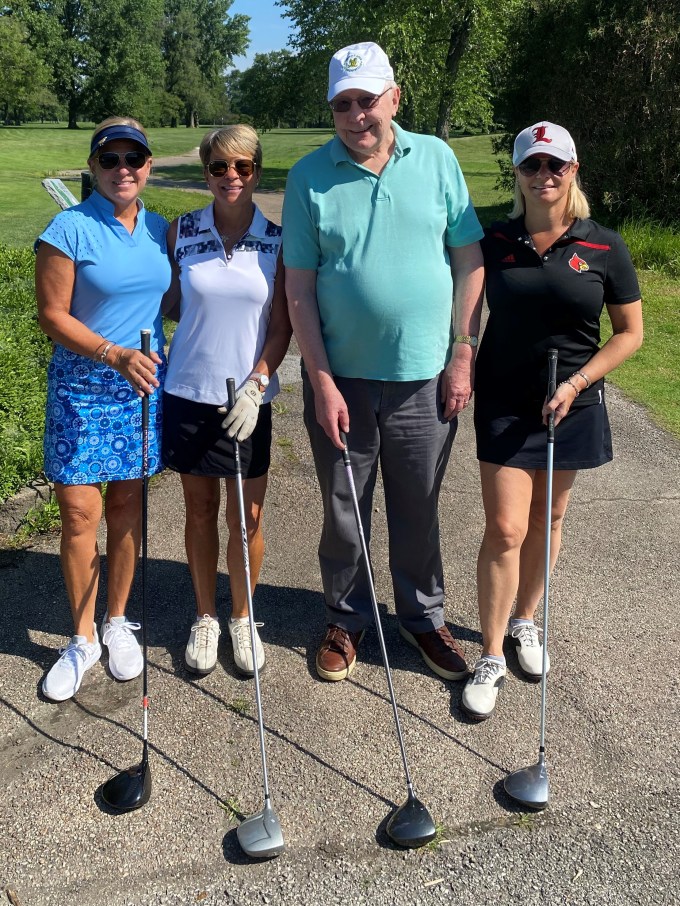
Last week, I played nine holes of golf and had lunch with three of my nieces, daughters of my late wife Jeanette’s sister, Mary Derdzinski and her late husband John. During the luncheon conversation, when talking about this weekly blog, one kiddingly suggested I do one titled “Golfing with the Derdzinskis.” So, here it is.
For the record, their married names are Beth Edwards, Julie Donzelli and Sue Ellen Vozza (left to right in the photo). In the interests of full disclosure, I rode the golf cart with Beth, who shot a 41 (even with an 8 on one hole) to my 43. I don’t know what Julie and Sue Ellen shot, but both of them hit the ball farther than me. Ah, youth! I would not hazard a guess as to their ages, but they were all teens when I first met them a bit more than 35 years ago. Most of my nieces’ own children have already graduated from college, a couple are married, and others have set wedding dates. As you can see from the photo, these three have aged well!
I actually have seven nieces from Jeanette’s family. The eldest of the Derdzinskis is Karen Fitzpatrick. Jeanette’s sister, Gerri Ciucci and her late husband Dominic, had three daughters: Mara Thanos, Laura Tyler and Michelle Woodring.
This “Golfing” piece has given me an opportunity to say something about the importance of family. When you marry into a family, you often just don’t know how you’ll be accepted. Jeanette’s family not only accepted, but embraced me. If you the read “Dear Amy” in the Chicago Tribune, as I do, you’ll have read many horror stories about the “in-laws from hell.” I lucked out. My own family and friends have also been all that I could have hoped for and more.
This became particularly important when Jeanette was diagnosed with leukemia in August, 2018. Although she was eventually cured of that, she was diagnosed with an unrelated brain tumor in January of last year, which took her from us in February. During the entire time of her illnesses, her nieces supported her (and me) in every way they could. They made regular visits to the hospitals – where she spent a total of three months – to our home and, in the last seven months, to the assisted-living facility where she died. She was never alone, not even for a single day.
(I see I have used the adjective “late” several times in this article. In the last couple of years, many people close to me have died: my wife; my brother; my best friend’s wife; both of my brothers-in-law; a close friend and golfing buddy; and a member of my book group, among others. At my age, this is expected. All the more reason to cherish the friends and family who are left, even if they do outhit you on the golf course!)
Copyright 2022, Patrick F. Cannon








 cannonnadedotcom