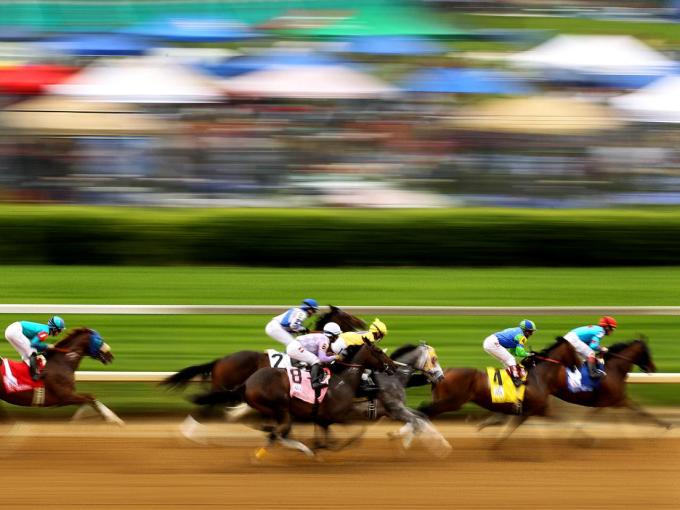
The Giddy-up is Gone
By Patrick F. Cannon
(Horse racing was once America’s favorite spectator sport. Now, it’s one of the least attended. So, if you are in the majority who are indifferent to the sport, I’ll forgive you for not reading this week’s essay.)
There are sufficient people who care about thoroughbred horse racing to keep it viable in states like Kentucky, New York, Arkansas, Florida and California. In Illinois, not so much.
Arlington International – once the crown jewel of Illinois racing, and the most beautiful track in the United States – has been closed, and its sale to the Chicago Bears is pending. To be honest, the racing there in recent years has been third-rate at best. It was owned by Churchill Downs, Inc. (CDI), which for years had lobbied our dysfunctional legislature for a law that would permit slot machines and other forms of gambling at the track, as was the case in some the states listed above. When they finally did so, CDI had already bought a controlling interest in the nearby Rivers Casino, which they decided was more profitable. So, goodbye Arlington.
The only track left in the Chicago area is Hawthorne, located in Cicero/Stickney. While in no way elegant, it’s serviceable, and does have plans to add gambling as a way to boost purses. That should substantially increase purses in the long term; in the short term, purses will increase somewhat because Hawthorn will no longer have to share off-track and other revenues with Arlington. But the real problem is that Hawthorne – as the only track in the Chicago area – will have to allot racing days to harness racing as well as thoroughbreds. To be fair, I’m sure the harness folks feel the same!
When I first went racing in 1957, there were six tracks in the area: Washington Park in Homewood; Arlington Park in Arlington Heights (both then owned by the Lindheimer family; Hawthorne (owned for more than 100 years by the Carey family); Sportsman’s Park in Cicero; Maywood Park in (you guessed it!) Maywood, and Balmoral Park (once called Lincoln Fields) in far south-suburban Crete.
After Washington Park burned down in 1977, and was not rebuilt, only Arlington raced thoroughbreds exclusively; the others, except for Maywood (standardbreds only), alternated both thoroughbred and standardbred (trotters and pacers) dates. Historically, both breeds could run at one or another almost the entire year.
Maywood went bankrupt and was demolished in 2019 to make way for an Amazon distribution center! Sportsman’s Park faced the wrecking ball in 2009, after an abortive experiment as a horse and car racing facility. Balmoral became a horse show facility, but is now closed.
Hawthorne, now the lone survivor, reopened for thoroughbreds last weekend. Purses will be up, which is good news for the horsemen. But when the standardbreds take over in later June, they will have to move their horses out of the Chicago area until September 23. Owners and trainers who race in Kentucky, New York, Florida, Maryland, or California don’t ever have to leave those states. The only other racetrack in Illinois, Fairmont Park, is nearly 300 miles away and offers live racing only three days a week and for paltry purses.
I think a new track dedicated only to harness racing in the Chicago area would be a boon to the industry, particularly if it also offered other forms of gambling and ran at night. A modest facility holding 5,000 fans and providing additional gambling might even be financially feasible! Hawthorne could then run thoroughbreds most of the year, with purses competitive with all but the top tier tracks like Keeneland, Belmont, Saratoga, Oaklawn and Del Mar.
Finally, it might revive a once thriving Illinois breeding industry. Lack of opportunities and low purses, among other reasons, have reduced mares bred in Illinois from 1,285 in 2001 to 105 in 2020. Kentucky of course leads the list with 16,727 mares bred last year. Illinois doesn’t even appear in the top ten.
As it happens, a revival in Illinois would come at a time of positive trends in racing. Fatality rates at most tracks are falling; and for the first time, there will be a national body responsible for uniform medication enforcement, instead of confused state-by-state regulations. Starting in July, the United States Anti-Doping Agency – the folks who finally caught Lance Armstrong – should largely put a stop to the few bad actors who have given horse racing a shady reputation.
Before I close, I should mention that the Kentucky Derby is only a month away. So far, there is no strong favorite. I’m inclined to favor Epicenter, the Louisiana Derby winner, but if Forbidden Kingdom wins Saturday’s Santa Anita Derby convincingly, I might just change my mind.
Copyright 2022, Patrick F. Cannon


 cannonnadedotcom