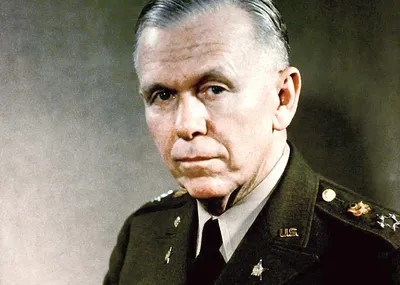
Grandeur of Character

By Patrick F. Cannon

Although he rarely agreed with him on strategic issues, Britain’s World War II Chief of the Imperial General Staff, Alan Brooke, was impressed by General George C. Marshall’s “grandeur of character.” In another context, he called him “a great gentleman.” He was, numerous historians believe, one of the greatest public servants this country has ever produced.

            From the time he was commissioned as a second lieutenant of infantry in 1902 until his final retirement as secretary of defense in 1951, Marshall served the country in a variety of ways, most notably as Army chief of staff from 1939 to 1945. By the end of the war, he had directly commanded  11.2 million men and women in the Army and Air Corps. As chairman of the Chiefs of Staff Committee, that number rose to 16 million.

            When the war ended, he was ready to retire and turn his duties over to General Dwight Eisenhower. As he said then, he wished nothing more than to spend time with his family and his garden. But after just a few months, President Truman asked him to act as a special envoy to China in an effort to prevent its takeover by the Communists. He was doomed to failure, primarily because of the corruption of the Nationalist government under Chiang Kai-shek.

            In 1947, Truman asked him to become Secretary of State. During his tenure, what came to be known as the Marshall Plan helped Europe rebuild from the war’s devastation (and save at least Western Europe form Russian domination), for which he was awarded the Nobel Peace Prize in 1953. When he left the State Department in 1949, he served in the less onerous positions of head of the American Red Cross, and as chairman of the American Battle Monuments Commission. But his country was not yet willing to let him retire. He was appointed Secretary of Defense in September 1950, and finally retired from public service in the following September. He died in 1959, having been given at least 8 years to tend his garden.

            Marshall was born in Uniontown, Pennsylvania in 1880. His father was a distant relation to  Chief Justice John Marshall. His father’s career had its difficulties, and you could say that George grew up in genteel poverty. Throughout his youth, he held a variety of jobs. Because he always wished to have a military career, he followed his elder brother to the Virginia Military Institute, since he would have been unlikely to get an appointment to West Point due to his spotty academic record.

            He was a captain with 15 years of service when we entered World War I. Before the war was over, he had been promoted to Colonel and served as an operations officer under General Pershing. After the war, he became a captain again, reaching the rank of colonel again only in 1933, in an Army where promotion to that rank came only with seniority. With war approaching, his abilities caused rapid promotion, and he became Chief of Staff over the heads of many senior officers. He desperately wanted to be supreme commander of the invasion of France in 1944, but the job went to Eisenhower because FDR said he couldn’t sleep nights without Marshall in Washington. As usual, Marshall didn’t complain.

            I tell you all this because George Marshall represented the caliber of people who once served in the president’s cabinet. Here are some others who have served during my lifetime: Dean Acheson, John Foster Dulles, George Schultz, Colin Powell, Madeleine Albright,  Averel Harriman, Tom Clark, Henry Kissinger and Colin Powell. While I may not have agreed with their policies, I never questioned their qualifications for office.

You may want to think about George Marshall and these other cabinet members of both parties as you study the lives and careers of the men and women the current president-elect  has decided are worthy to represent you and the United States.  Some are clearly qualified. As for the rest…

Copyright 2024, Patrick F. Cannon

Yes, We Have Gone Bananas!

By Patrick F. Cannon

Sometimes, the world throws irony right in our kisser. A couple of weeks ago, PBS ran a four-hour documentary by Ken Burns on Leonardo DaVinci. It appeared on November 18 and 19. The very next day, artist Maurizio Cattelan’s “Comedian,” which consists of a banana taped to a wall with duct tape, sold to a crypto currency billionaire for $6.24 million at Christie’s auction house in New York.

            The new owner planned to eat the banana, which seems counter intuitive. But wait. It was not actually that specific banana and piece of tape he bought, but the idea. He is now free to spend about 35 cents on a new banana; a fresh roll of duct tape can be had for less than $10. So long as he has his certificate of authenticity, he’s golden (or at least yellow). Of course, Cattelan has complained that he only got $120,000 to $150,000 for the three versions he originally sold in 2019. Since he created the work as an ironical comment on the craziness of the art market, I think he should feel vindicated by the stupidity of the transaction.

            Another of Cattelan’s masterpieces is a gold toilet, titled “America.” Presumably, it’s meant as a comment on our bathroom activities. It reminds one of Marcel Duchamp’s famous urinal of 1917, which he hung on the wall  and called “Fountain.” The original urinal is lost, but nice copies are available at your plumbing supply store. Duchamp has a lot to answer for!    

            Back to DaVinci. His “Salvator Mundi” is currently the most expensive art work ever sold at public auction. It also sold at Christie’s. The hammer price in 2017 was approximately $450 million. It’s said to be in storage in Saudi Arabia, awaiting the construction of a new museum to house it (and draw the tourists). Interestingly, the authenticity of the paining has been questioned by some experts, which is par for the course in the art world.

            The artist’s “Mona Lisa,” at the Louvre in Paris, is thought to be the most valuable of all paintings, estimated to be worth north of a billion dollars. It’s such a draw that it is now almost impossible to get close enough to study it. It is one of only about 20 finished works by him.

            As the documentary makes clear, painting may not have been Leonardo’s primary interest. He also left behind thousands of pages of illustrated journals, full of drawings just as brilliant as his paintings. He even managed to make drawings of our innards elegant and compelling. In trying to understand how we might fly, he observed and sketched hundreds of birds in flight. Almost nothing escaped his interest – military fortifications and weapons; methods and apparatus for moving and controlling water; a parachute design that would prove to be workable; and studies in solar power, geometry, and even plate tectonics.

            One of the expert talking heads claimed that Leonardo was transformative in art and science in the same way that Shakespear and Bach would become in literature and music. While you might argue that other painters were as good or better than him, none could claim his passion for discovering how things in nature actually worked. He simply wasn’t satisfied with the notion that the Gods were directing the world like some heavenly choir.

            Today is Thanksgiving. Like the rest of the year, we are surrounded by the absurd, not only in the art market, but even more in the political realm. On this day at least, let’s put all of that aside and concentrate on those like Leonardo who created the modern world. In my own lifetime, for example, the native Turkey has gone from bony and tough to the toothsome delight it is today. So, please pass the stuffing, and I’ll need more of that gravy!

Copyright 2024, Patrick F. Cannon

A Cabinet of Curiosities

By Patrick F. Cannon

As many of you may remember, I ran as a write-in candidate for president. As soon as my friends and relations come across with the dough, I intend to challenge the election of Donald Trump in the courts, claiming that votes for me were improperly counted. In the meantime, it behooves me to prepare for my administration. First step? Cabinet appointments.

            If you’ve been paying attention, you’ll be aware that President-elect Trump has decided that the folks he appoints to his cabinet don’t have to be qualified, except for lunatic loyalty to him. So, I thought I would appoint people who not only looked the part but could act like they did. How about famous actors?

            My readers tend to be an educated lot, so you know that some cabinet members are high on the list of officials who can become president if the elected people above them start dropping dead. Although the Constitution doesn’t say you have to be a citizen to serve on the cabinet, you do have to be one to serve as president and be native-born to boot, so no Brits or Frenchie’s can be considered

Now, as it happens, many fine actors have played the president on stage and screen. Many, alas, have gone to the great theatre in the heavens. But not Michael Douglas, so he’s my choice for the senior cabinet officer, Secretary of State.

            Next in line is Secretary of the Treasury. A bit of gravitas is needed here, so why not Meryl Streep? In her lengthy career, she has proven she can play any part. I would certainly trust her with my money, and I want to have a woman high up in my cabinet. Easy choice, don’t you agree?

            For Secretary of Defense, I need someone who has impersonated a soldier on the silver screen. Unfortunately, George C. Scott, who played George Patton with such brio, died in 1999. But then I remembered that  our best all-arounder, Tom Hanks, played a noble Army officer in Saving Private Ryan. While his character died in the movie, he’s still very much alive. By the way, the Secretary of Defense was inserted above the former Secretaries of War and Navy. They were demoted and are now joined by the Secretary of the Air Force, who is responsible for both the Air Force and the new Space Force. Notice that the government tends to add but never subtract.

            Attorney General is a particularly sensitive office. Many a fine actor has argued cases on the silver screen or tube. Who can forget Charles Laughton in Witness for the Prosecution, or Spencer Tracy in Inherit the Wind? Or how about Raymond Burr as Perry Mason, or Andy Griffieth as Matlock? Regrettably, all are currently disputing evidence in the great heavenly courtroom. But Sam Waterston, the Bulldog-like prosecutor in Law and Order, is still with us and would strike fear in the hearts of the lawless (and he also played that famous lawyer, Abe Lincoln, on Broadway). Beware, miscreants!

            I have often wondered why we have a Secretary of the Interior, but not a Secretary of  the Exterior. But that’s a subject of another day. The Interior secretary looks after the national parks and such stuff, so let’s lift its profile by having an environmental do-gooder, and cutie-pie like Leonardo DiCaprio join Smokey the Bear in making sure our trees are properly hugged.

            My choice for Secretary of Agriculture is a no-brainer. Who else but Kevin Costner, who was the farmer in “Field of Dreams,” and more recently the rancher in “Yellowstone.” Can’t you just picture him staring lovingly at an ear of corn?

            Nobody really knows what the Secretary of Commerce does, so let’s raise its profile by going for glamour. How about Margot Robie?

            I thought long and hard about Secretary of Labor, then the choice came to me in a flash. I remembered that there is an actor who’s also a union leader! Fran Drescher of “Nanny” fame is president of the entertainer’s union, SAG/AFTRA, and led it in its recent strike. She would certainly add a distinctive voice to cabinet meetings!

            For Health and Human Services, we need an actor who’s played a sawbones or two. I don’t think you can improve upon Geoge Clooney, who set hearts aflutter on ER. I think folks will listen when he says, “get vaccinated!” Or at least the women will.

            Although Barbra Streisand is getting on in years, I think she could handle Housing and Urban Development. After all, she owns quite a few houses, and I doubt if anyone’s domiciles have appeared more often in “Architectural Digest.”

            Denzel Washington is a natural for Secretary of Transportation. You may recall he played a railroad engineer who stopped a runaway train in 2010’s Unstoppable; and was nominated for an Academy Award for playing an alcoholic airline pilot who nonetheless heroically lands a crippled plane in 2012’s Flight.

            Robert Downey, Jr is my choice for Secretary of Energy. He won the Academy Award for playing Lewis Strauss in Oppenheimer. Guess what? Strauss was head of the Atomic Energy Commission.

            This may seem like an odd ball choice, but I can’t think of anyone better than Quinta Brunson, star and creator of the wonderful sitcom, Abbott Elementary, for Secretary of Education. She’s the eternal optimist, an absolute requirement when you’re dealing with an education system that produced Marjorie Taylor Greene.

            You may not know this, but the fine actor Adam Driver is a veteran of the Marine Corps. Not only that, but he also formed the “Arts in the Armed Services” non-profit to provide arts programing to active-duty service men and women. Clint Eastwood is also a vet, but he’s busy making movies. So, it’s Driver for Secretary of Veterans Affairs!

            Finally, for Secretary of Homeland Security, which oversees immigration and other stuff, we need someone who has both ;played an immigrant (in the Godfather); but would also scare the bejesus out of anyone who tried to sneak across the border (Al Capone, in the Untouchables). Robert DeNero even scares me!

            So, there you have it. As an extra bonus, they’ll stay behind after cabinet meetings to sign autographs!

Copyright 2024, Patrick F. Cannon

The Song, Not the Singer!

By Patrick F. Cannon

The late Canadian songwriter Leonard Cohen was a truly awful singer. I have long admired many of his songs as interpreted by others, but until recently had not actually heard him perform them.

            A little history. My car still has a CD player, and I rotate disks from my collection to provide a suitable soundtrack to my travels. The last time I did this, I came across a CD of Cohen singing his own works. It was a surprise discovery, since I frankly didn’t know I had it. My late wife Jeanette might have bought it, or it could have been a gift. “What’s this?,” I thought, and duly added it to the pile.

            After the fourth song – I think it was “Bird on a Wire” – I had had enough and rejected the disk. I had long thought that Bob Dylan was the least talented singer among the songwriters; but compared to Cohen, he’s a veritable Pavarotti. As it happens, I also own, and often play, a CD of Cohen songs sung by real singers. Called “Tower of Song,” it includes renditions by such as Elton John, Bono, Billy Joel, Trisha Yearwood, Sting and Willie Nelson (whose classic version of “Bird on a Wire” is a highlight). Not included, but also notable interpreters of Cohen’s songs, are Judy Collins and Joan Baez.

            Of course, not all songwriters are terrible singers. Depending on your taste, one could list John Denver, Neil Diamond (whose songs are now featured in a Broadway “Jukebox” musical), Joni Mitchell, Paul Simon, Prince, Elton John, Stevie Wonder,  the late Harry Chapin, Taylor Swift, and of course the Beatles as a group. Folk singers are a special breed. Although you can’t imagine them belting out an Irving Berlin classic, Woody Guthrie, and Pete Segar sound about right with their own stuff.

            I started wondering about great songwriters of the past. We’ll never know if Franz Shubert or Steven Foster ever sang their own songs. Irving Berlin had a decent tenor voice, but he left it to the greats to interpret his work. I came across Cole Porter singing “Anything Goes.” Not bad. He had been a member of the famous Yale University acapella group, the Wiffenpoofs. If they sang at all, greats like Gershwin, Kern, and Rogers must have limited their efforts to the shower.

            I’ve been known to belt out a song or two in the shower, or when no one’s around. Of course, one always sounds like Bing Crosby to oneself. I don’t ever recall my mother singing. My sister – who was 10 years older than my brother and I – often sang the hit songs of the day for us. My recollection is positive. But my father and brother – both Pete’s – conspired to give music a bad name. Although their actual speaking voices were pleasant enough, neither could sing on key. Of course, they loved to serenade me.

            We lived in Chicago’s South Shore neighborhood, at 67th and Merrill Avenue. As it happened, our school, St. Phillip Neri, was at 72nd and Merrill, and my father’s office at 75th and – you guessed it – Merrill. So, most mornings, my father drove us to school. Those five blocks could be pure torture, as the Pete’s sang along with the radio. One song I remember vividly was “Little White Lies,” a 1948 hit for Dick Haymes. Poor Dick (and me) never had a chance.

Copyright 2024, Patrick F. Cannon

There Is Joy

By Patrick F. Cannon

I started writing this before I knew the results of the presidential election. Depending on who you voted for, you may be feeling just a bit apprehensive today. In any event, the next four years should be interesting.

            As I’m writing this, in the background I hear one of Mozart’s 27 piano concertos. I own all of them, in versions played by Danial Barenboim and the English Chamber Orchestra. With a couple of exceptions, they are full of light and joy. Mozart died in 1791, aged only 35. But he managed to compose nearly 800 works in his short life. Many people know Mozart only through the 1984 Milos Foreman-directed movie, Amadeus, based on Peter Shaffer’s play. It’s quite entertaining, but mostly fictional.

            Think about it. 35 years. 800 works. Although he got minor church and court appointments, he mostly had to work for a living. He had a wife and six children to support. And we’re told he liked a bit of luxury, and a fun time. So, the grindstone was always waiting. He must have often been exhausted from his labor, but nevertheless he never lost the joy that his music expressed. He died young, but not from overwork, but from infections that could easily be treated today.

            When he died, he left the joy he felt in his music to us. Although there are other great German composers – Bach before and Beethoven after – none were able consistently to express the joy that Mozart did. When the sad state of our politics begins to get you down, turn to Mozart. His music is available in ways now that would have astonished him.  

            Listening to the overture to  the “Magic Flute” isn’t going to change the results of the election. But it might remind us that we can still find joy amongst the ruins. And that this country, as imperfect as it has sometimes been, has slowly but steadily made life better for most of its citizens (and millions of immigrants too). And that no matter who won, your neighbor is still your neighbor and deserves your understanding and respect.

            Of course, if you want to put America first, you can substitute George Gershwin for Wolfgang. He also died young, age 38. In addition to about 500 popular songs, he became America’s finest classical music composer.  Most people have heard his “Rhapsody in Blue,” even if they didn’t know what it was. He did many others later in his  short life, most notably the opera “Porgy and Bess.”

            While you’re listening to their music – or the Rolling Stones if they suit you better – you might want to accept that Joe Biden was a mediocre president, who should have never run for a second term; and that whoever ran in his place would have had to carry his record around their neck.  It also didn’t help that the new candidate was chosen without proper competition.

            Political parties need to understand their constituents, not force them to go places they don’t want to go. Frankly, we need a new centrist party. Since that’s not likely to happen any time soon, the Democratic Party needs to clean the wax out of its ears.

Copyright 2024, Patrick F. Cannon

Art or Desecration?

By Patrick F. Cannon

I’m very afraid I have shocking news to report today. Despite my longstanding efforts to prevent people from desecrating the bodies that evolution (or the Almighty if you prefer) has given them by splattering them with dubious “artwork,” the numbers are increasing!

            According to a recent issue of the Axios online newsletter: “For American women, tattoos are becoming powerful symbols of resilience, identity and joy.” What was once limited to drunken sailors on shore leave, now has a veneer of respectability. Some folks even – and I kid you not – call it “body art!” Now, and I shudder to think about it, 38% of American women have tattoos, compared to only 27% of men. Even more alarming – 56% of women between 18 and 29 have boldly entered tattoo parlors, along with 53% of their elders (30 to 49).  These once sleezy back-street emporiums now appear on grand boulevards and in tony shopping centers!

            Now, I don’t wish to suggest that tattoos are more acceptable on men. I no longer eat in restaurants with open kitchens because chefs and their minions are among the most tattooed of all. Seeing them would certainly put me off my feed. And artists of both sexes seem to feel having armfuls of flowers, squiggles and whirls sets them apart from the hoi polloi.

            I don’t argue against the reasons people get tattoos – dear old mom; a new love; a beloved pet; solidarity with flowers and trees; survival of some disease; even support for the local sports team. But why not wear a jaunty tee shirt or snappy cap instead? When love goes cold, or mom writes you out of the will, at least you can easily throw them away. Getting rid of a tattoo is both painful and expensive. And need I remind the adorned that they don’t look the same when you get old and withered?

            (By the way, tattoos can be expensive. Covering an arm with hearts and flowers could run you $5,000. And it will hurt. In contrast, I just bought a snappy Hawaiian shirt for less than $100. The design is based on 19th Century Japanese artist Hokusai’s famous “Great Wave” woodblock print. It’s also a popular subject for tattoos, which could easily cost you $2,000 for one of modest size. My shirt will last for many years. If I get tired of it, I can donate it go Goodwill. If you get tired of your tattoo, it will hurt again and cost you serious dough.)

            On a related subject, the other day I was having breakfast with a friend, and the server had a nose ring. It was small, but I was tempted to ask her what she did if she had to blow her nose? Of course I didn’t, but it made me think. Why would anyone drill a hole in a part of their nose – of all places – and insert a ring? The internet, that junkshop of sometimes factual information, says that “a nose ring can denote marital status, beauty enhancement, rebellion against Western culture (or maybe parents?), and devotion to deities of various cultures.”

            As it happens, you don’t have to pierce your nose to have one. They have clip-on rings for the faint of heart, like clip-on earrings. Of course, we’re used to seeing pierced ears, even on men! Now we not only sport nose rings, but lip rings, cheek rings, navel rings (and no doubt “private” places) rings.

            Count me among the apparent minority who think we should be happy with the body we were born with. I prefer to see beautiful flowers in a garden, not on someone’s arm, back or (God forbid) face. But, not for the first or last time, I seem to be swimming against the tide.

Copyright 2024, Patrick F. Cannon

The American Juggernaut

By Patrick F. Cannon

You can’t deny that politicians can influence the economy. Although now under control, the recent bout with inflation was certainly caused by Covid-related spending programs, and President Biden’s massive public works expenditures (Congress also played its role). And if Donald Trump is elected and gets his way, his tariff and tax programs are estimated to increase inflation beyond seven percent (it’s currently 2.4 percent). He’s a Republican? Really?

            Despite the best efforts of our politicians to screw things up, the Economist magazine in a recent issue called our economy “The Envy of the World.” According to them – and few magazines are more respected – our country “continues to rack up a stellar economic performance even as our politics gets more poisonous.” And why is this? “America’s dynamic private sector draws in immigrants, ideas and investments, begetting more dynamism.” Here are a few other highlights (and I quote):

  • American is a big country, blessed with vast energy sources. The shale oil revolution has driven perhaps a tenth of its economic growth since the early 2000s.
  • The enormous size of its consumer and capital markets means that a good idea dreamed up in Michigan can make it big across America’s other 49 states.
  • America has long married light-touch regulation (editor’s note: compared to the rest of the world) with speedy and generous spending when crisis hits.
  • It is home to the world’s biggest rocket-launch industry, but also its internet giants and best artificial intelligence startups.

Compared to our friends in Europe, our economy is still healthy and growing. And despite what you may think, our tax burden is among the world’s lowest. Our tax-to-GDP ratio is 27.7%, compared to the average of 42.8% in Europe. And the Economist reminds us that “China’s output per person remains less than a third of America’s; India’s is smaller still.”

Yet, Americans love to complain about the economy. Except for that inflation caused by Covid and infrastructure spending, the inflation rate was low for all the Obama and Trump years. I can attest to that because my Social Security payments barely increased, tied as they are to the cost of living. When Obama came into office in 2009, the unemployment rate was 9.9% (remember the fiscal crisis?); when he left, 4.7%. When Trump left, it was 6.7%; now it’s 4.1%.

Now, it’s true that grocery prices spiked in 2023. I remember paying about six bucks for a dozen eggs. The other day, those eggs were $2.79. Of course, A constant source of complaint is the cost of gasoline. In 1965, I paid about 35 cents a gallon for regular. The current cost of approximately $3.75 is about the same, adjusted for inflation. And should I mention that the stock exchanges are at all-time highs?

There is a cautionary note. Our national debt is now at $35 trillion, 124% of our GDP. The only time it came near to that percentage was at the end of World War II, when it reached 119%. By 1975, it was down to 32%. This year, the interest payments on our debt (I use “our” on purpose) will be nearly $1 trillion. Yet, as you may have noticed, neither candidate wants to talk about doing anything about it. Indeed, a non-partisan budget watchdog has estimated that programs proposed by Vice President Harris would increase the debt by $3.5 trillion over 10 years, while Trump’s would add $7.5 trillion.

So, while we have a dynamic economy, the “envy of the world,” it simply hasn’t kept pace with the profligate spending of our feckless politicians!

Copyright 2024, Patrick F. Cannon

Let Me Not Answer That Question!

Patrick F. Cannon

Back in the days when I worked for a living, as manager of public relations and communications for Lions Clubs International, I would often have our outside public relations firm train our incoming officers in “media relations.”  The intent, of course, was to put the association in the best possible light when dealing with those pesky reporters.

            Part of the training involved the officer memorizing a list of positive things Lions were doing around the world, in hopes that the reporter would ask a related question. Often, they did, but sometimes might ask about something the officer had little or no knowledge of, or that might be embarrassing (prior to 1987, “why don’t you permit female members?”). They were taught techniques that made them seem to be answering that question, while segueing to a more positive subject.

            Politicians learn these techniques early in their careers. In fact, many have this talent in their genetic makeup. During this endless election season, how often have you heard a candidate answer a direct question? Rarely? Never? It doesn’t matter if the candidate is a Democrat or Republican – they all seem unwilling or unable to use the simple words “yes” or “no.”

            In a recent interview with the New York Times, Senator J.D. Vance was asked if he thought Donald Trump had lost the 2020 election. He could have said “no.” If he had, however, the reporter would certainly have followed up with “why?” If he said “yes,” he would have soon received a hearty “you’re fired” from the boss of bosses. Instead, he asked the reporter why she hadn’t asked so and so why he or she hadn’t done such and such. She persisted, asking the same question three more times. In the end, he managed to make it seem like she was the one evading the question. Brilliant. Also, dishonest.

            The problem: we’re so used to our politicians not answering questions directly that we’ve built up an immunity to lies. We expect all politicians to tell their own versions of the truth. Despite the fact he’s a pathological liar, it looks like about 50 percent of American voters will cast their ballots for Trump anyway. Many of them will say that all politicians lie, so why single out the King of Lies for special approbation?

            A good many of my conservative friends tell me that they are not voting for president. They’re “never Trump” Republicans, who also can’t bring themselves to vote for Kamals Harris. As it happens, there’s no law that requires you to vote, much less one that forces you to make a disagreeable choice. As for me, I haven’t made up my mind. Of course, you could always write me in. Modesty forbids me to write myself in. I’m not sure you can vote for a dead hero. I was thinking Groucho Marx  He was a great connoisseur of the absurd.

Copyright 2024, Patrick F. Cannon

Chicago’s Island Paradise

By Patrick F. Cannon

The other day, a friend mentioned visiting Jackson Park’s Wooded Island. Just south of  the Griffin Museum of Science and Industry, the island was conceived by park designer Frederick Law Olmstead as an oasis of tranquility in the midst of  the bustling 1893 Columbian Exposition. In  the event, it became home for the Japanese government exhibit, including the famous Ho-o-den temple complex.

            It and the Griffin Museum building were among the few structures to survive the fair. Over the years, the Ho-o-den deteriorated but was restored in the 1930s with Depression-era public works funds. During World War II it was destroyed in a fire that may have been caused by anti-Japanese feeling caused by Pearl Harbor and other events.

            After my family moved to Chicago’s South Shore neighborhood in late 1945, Wooded Island became part of our (my brother and neighborhood kids) Jackson Park playground. We lived across from the park’s golf course. A short walk through the trees were the 7th hole fairway and the short par 3 8th hole, whose tee shot was over a stream. We got a set of basic golf clubs the next Christmas, and I’ve been a duffer ever since.

            Also nearby was the Jackson Park Yacht Harbor, home of the Jackson Park Yacht Club on one side and the Coast Guard station on the other. This and the adjacent inner harbor were part of Olmstead’s original park design. For us, in addition to the neat boats moored there, there was the hulk of a replica Santa Maria, sailed from Spain with the Nina and Pinta as part of Spain’s exhibit at the 1893 fair. It sat near the club, and we managed to get aboard once, only to be chased off by a club employee! The club is still there, but the hulk is gone.

            Near the club house was and is the La Rabida Children’s Hospital. Although much expanded now, it was once housed in a replica of Spain’s La Rabida Convent, also built for the fair. We used to bring our used comic and other books there as donations. Although most of the patients were being treated for rheumatic fever, they also had polio patients. Some were in iron lungs. When I hear anti-vaxxers rail against vaccines, I wonder if they’ve ever seen pictures of a kid in one of them?

            Another favorite playground was the (now) Griffin Museum of Science and Industry. In those days, entry was free! Well, almost free – you did have to pay 10 cents to go down to the coal mine! It’s still there. And I think you did have to pay 5 cents to see a silent comedy in the Nickelodeon. I also remember a giant heart you could walk through; planes hanging from the ceiling; a huge model train layout (there’s a newer one now); and a Bell Telephone exhibit where you could see yourself on TV! Oh, and a lower level with wonderful ship models.

            Wooded Island is in the lagoon just south of the museum. As I recall, there were still some leftover ruins from  the fire; otherwise, the island was unkempt and unloved. Of course, we thought it was great. You could pretend you were in Sherwood Forest, a jungle, or the wild west. Kids made up their own games in those innocent days. In the winter, we prayed for snow! There were forts to be built and snowball battles to be fought!

            Now, thank goodness, the island has been transformed as a nature preserve, with native plants, flowers, and a Japanese garden. It’s a birder’s paradise, with approximately 250 species having been identified, both permanent residents and migraters in Spring and Fall. Paved paths circle the island, with other paths providing access to the interior. Unfortunately, the view from the island to the West has been marred by the construction of  the Obama Presidential Center, built in park land and whose tower I hereby christen “The Sore Thumb.”

            It’s an interesting comment on Chicago that former President Obama got his center on actual park land, and the Bears will likely not get their new stadium on what is now a parking lot. Go figure.

Copyright 2024, Patrick F. Cannon

The Truth Shall Set Thee Free

By Patrick F. Cannon

I thought about calling this “Liar, Liar, Pants on Fire,” but decided to take a more dignified approach to the subject of lying politicians. This was occasioned by an article in the New York Times (if you can believe it) calling out Kamala Harris for various statements.

            Written by James Kirchik, it in no way absolves Donald Trump; indeed, he rightly notes that “Mr. Trump has lied more frequently and egregiously than perhaps any other major figure in American History.” On the other hand, he points out that “Kamala Harris did not strictly adhere to the truth at the presidential debate earlier this month.” (Nor, I should point out, was she “fact checked” by the moderators as Trump was.)

            Two examples should suffice. She claimed that Trump had said there would be a “blood bath” if he weren’t elected. Any fair reading of the context shows he was referring to the jobs of auto workers. She then said, “there is not one member of the United States military who is in active duty in any war zone around the world – the first time in this century.” Please tell this to the service members deployed to the Middle East since the October 7 attacks on Israel last year; or to the families of the service members killed in Jordon in January’s drone attack.

            Kirchik’s article, How Lying Became Misinformation, appeared in the September 23 Times. The very next day, the Axios news web site published an article showing the sharp gaps between what we think “publicly,” and what we really think about political issues.

            In public surveys, only 22 percent of us say we trust the government to tell the truth. If asked privately, the percentage drops to four! Trust the media? In private, only seven percent say they do. Defund the police? Only two percent say we should.

            We’ve invented numerous ways to minimize the lies our side tells. We talk about disinformation, misinformation, selective “facts,” “shading” the truth, and on and on. We “mis-speak;” the other side, of course, just blatantly lies.

            Do our politicians know they’re lying? You bet they do. And they’re aided and abetted by their professional staff members, who’s jobs depend on trying to determine what messages will get the most votes. You wonder how candidate A can change his or her position on an issue like immigration or abortion almost overnight? Easy to explain. They never really had any principled position to begin with – just one that they thought would get them elected.

            (Vice President Harris has learned, after her disastrous run for the nomination in 2020, that what gets you elected in California doesn’t necessarily get you elected anywhere else. While she has been criticized for changing her positions on many issues, she’s smart enough to shade or even reverse them to get elected. You may have noticed that Donald Trump is doing the same.)

            There are a few exceptions. I can’t think of a politician I disagree with more than Bernie Sanders on most issues, but I grudgingly admire his steadfast adherence to his socialist principles. He wouldn’t change them even if it meant bettering his chances of running for president. I saw him a couple of days ago grilling a drug company president about soaring prices. He would have done the same thing 10 or 20 years ago, because he continues to believe they’re screwing the consumer.  

So, our politicians lie to us. We vote for them anyway, as if it made no difference. When you vote in November, as I hope you will, at least take off your rose-colored glasses.

Copyright 2024, Patrick F. Cannon