By Patrick F. Cannon
Texas Democrats – who like most politicians lack any sense of irony – chose to escape to the poster child for political redistricting (which we like to call Gerrymandering), my own Illinois, to prevent a mid-decade attempt by Texas Republicans to redraw the Congressional map in their state to add more Republican seats in time for the mid-term elections in 2026. They were asked to do this by President Trump, who never takes “no” for an answer.
Illinois Governor Pritzker welcomed them with open arms. As I recall, when he ran for governor in 2018, he promised to support “fair maps” for Illinois. I gullibly donated my own money to an effort to amend the Illinois Constitution to provide for an independent commission to draw the maps. More than enough signatures were obtained to get this on the ballot, but the Illinois Supreme Court – dominated by Democrats – found a loophole to keep it off.
At the time, the chief justice was Anne Burke, wife of the since convicted Chicago alderman Ed Burke. But I’m sure the one who whispered in Pritzker’s ear that the maps weren’t his concern was then speaker of the Illinois House Michael Madigan, who has since also joined the ranks of convicted Illinois politicians.
To today’s politicians, the term “fair maps” can have many meanings, but most would agree it should be a map that gives them the best chance to be elected. That may mean a district that captures the most Democrats or Republicans; or the most blacks; or the most Hispanics (further broken down between Puerto Ricans or Mexican Americans); or the whitest evangelicals. I could make it more complicated, but you get the idea. The goal is to create so-called “safe” seats, not only for the candidate, but for his or her party.
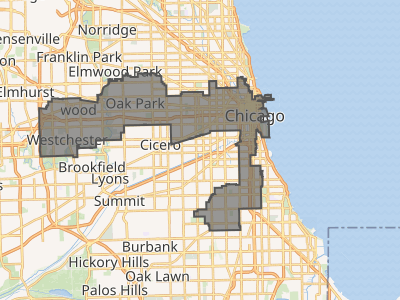
The map shows the Illinois 7th Congressional District. I live in the district and my representative for many years has been Danny Davis, who is retiring after this term. He is black, and the worthies who have so far announced they would like to succeed him are also black. The district, you see, was designed to capture the maximum number of black voters and thus ensure that it will always be represented by a black. I could show you other maps from the Chicago area designed to capture as many Hispanics as possible.
Although not all representatives are guilty of this, it does lead to the feeling in many that they are really only representing the part of their constituency that voted for them. A case in point: Republicans representatives have been warned not to have so-called “Town Hall” meetings in their districts because Democrats might show up. The implication couldn’t be clearer.
One of the ways to get out of this mess is to eliminate all factors except population in creating congressional districts. One of the bedrocks of our democracy is that all men are created equal, and that they are entitled to one vote. Voting rights laws should guarantee only one thing – the unhindered right to cast your ballot. Until we use the computer to create districts based purely on population, many of us have been denied any real choice on election day. Apparently, that’s the way our politicians like it. And we just have to lump it.
P.S. My regular readers will know about my trials and tribulations as a part (small) owner of thoroughbred race horses. Things are looking up. On Friday August 8, my two-year-old filly Love Like Lucy won her first start at Gulfstream Park in Miani. It was limited to Florida breds, for which there is a lucrative series of stakes races in the coming months. The very next day, my three-year-old filly, Reputation, won the Tyler Gilpin Stakes at Colonial Downs in Virginia. It’s a big deal, because it greatly increases her value as a broodmare when she finally retires. Who knows, someday I may break even.
Copyright 2025, Patrick F. Cannon