Music, Music, Music!

Music, Music, Music!

By Patrick F. Cannon

Two articles in the online edition of the New York Times got me thinking about music. Rap and Hip Hop superstar Kanye West, who now prefers to be called Ye (as in Ye Gods?) was being upbraided for a couple of  things – wearing a “White Lives Matter” T-shirt and for having made some antisemitic remarks. Ye, who has a very high opinion of himself, was also mentioned as being our eras equivalent of  Mozart.

            The other article was about the new movie Tar, which stars the always wonderful Cate Blanchette as a female symphony orchestra conductor who has risen to conducting the Berlin Philharmonic, considered by some to be the world’s greatest (although many just rank it as part of the “big three” with Vienna and, yes, Chicago). While generally praising the movie, the writer couldn’t resist pointing out that the protagonist also seemed to prefer the so-called “standard” reparatory (Mozart, Beethoven, Brahms, etc.) to “new” and experimental music.

            Let me discuss this first. As it happens, most major orchestras have “composers in residence” programs which pay stipends to young serious-music composers. In most cases, they eventually produce works which are then featured during a concert. Over the years, I have heard some of these works, and a few have been pleasing. Most, however, have been annoying – unmelodic, discordant, and loud. It is said by some that this music is simply reflecting the ugliness that surrounds us in a chaotic world, as if these were qualities unique to our times.

            Here’s a scoop. Mozart’s world was even uglier and more chaotic. He died tragically at 37, which was about the average life expectancy then. Abject poverty was more widespread. Europe had been almost continuously at war for 250 years, and would stay that way for another 25 after Mozart’s death. The gap between rich are poor was at least as wide as it is now, probably wider. Yet, with just a few exceptions, Mozart’s music – all 800 compositions! – is melodic, dramatic and, yes, beautiful. Listening to it, whether in a concert hall or in a recording, gives pleasure.  Is it any wonder that concert goers prefer it to angst-filled contemporary music? (Much visual art also seems angst driven. A cartoon I saw recently showed a couple looking at a painting, which was a blank canvas with a single black dot at its center. The man comments: “Such anger.”)

            Mozart was a real genius. He produced an astonishing number of works in his 37 years because that’s how he made his living. No work, no money. Today’s serious composers exist on grants and academic appointments. I would guess the only non-rock, rap and hip hop composers who make any money are those that compose music for the movies, television, video games and the Broadway stage. John Williams of “Star Wars” fame comes to mind, but I would guess Ye/Kanye tops him with an estimated net worth of $2 billion!

            The audience for his kind of music – if that’s what it really is – is huge and growing. The audience for classical music is declining, if you consider it as a percentage of the total population. Major orchestras exist on philanthropy more than ticket sales (the cost of which are high and getting higher). I wonder how many people will actually pay to see Tar, which is receiving strong reviews, and has one of our greatest actors doing some of her best work. After all, large parts of it have her rehearsing the Berlin Philharmonic in Mahler’s 5th Symphony, which, by the way, takes nearly 75 minutes to actually perform.          

            So I guess Kanye West is a kind of genius. Not perhaps a musical genius, but a genius in gauging the popular taste. He can fill stadiums with 50,000 screaming and jumping fans, most of whom will have never heard a note of Mozart’s music. And now they have courses in rap and hip hop in the same colleges and universities that once offered courses in classical music appreciation. Kanye even has an honorary doctorate from the School of the Art Institute of Chicago, which knows a good deal about pandering to contemporary taste. I leave you today with two quotes from Kanye’s “music.”

            “I feel like I’m too busy making history to read it.”

            “For me to say I wasn’t a genius would be lying to you and myself.”

Copyright 2022, Patrick F. Cannon
What’s Under Your Bed?

What’s Under Your Bed?

By Patrick F. Cannon
When I was about four years old, my sister Kathleen (who then would have been 15) took my year-older brother Pete and I to the movies. As I recall, there were three theatres in our hometown of Braddock, PA. The fanciest was the Capitol. That’s where the big productions went after closing in downtown Pittsburgh. The others were the Paramount and Times. We usually ended up at the Paramount, which featured double features of mostly B westerns.

            Along with Hopalong Cassidy, Johnny Mack Brown, Gene Autry, and other heroes, you would get a newsreel (dominated by World War II, which was just underway) and a cartoon. On that  particular day, the bill of fare instead included two horror movies – The Mummy and The Wolf Man. The latter sometimes appears on old movie channels. The Mummy, originally released in 1931, is generally only available on DVD and maybe streaming services. 

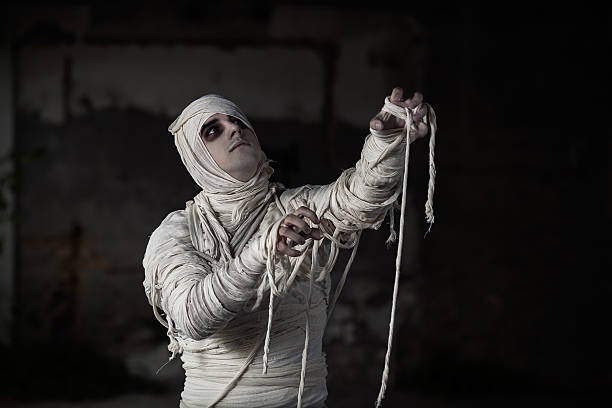
            In case you’d forgotten, a Mummy is a dead Pharoah embalmed and wrapped in bandages. In this particular movie, he’s played by Boris Karloff, who’s more famous for impersonating Frankenstein’s monster. But you have to start somewhere. It seems this particular Pharoah was dug up by a diligent grave robber (a British archeologist). This is a no-no, so Boris rises from his coffin, staggers haltingly toward the camera (the audience), then unwraps himself and takes off after the grave robber. Needless to say, he looked better wrapped up.

            (The discovery of King Tut’s tomb in 1922 and it’s curse would have been fresh in people’s minds in 1931. Similar stories have been a staple of the movies ever since.) 

            Lon Cheney, Jr appeared as the title character in 1941s The Wolf Man, which is now considered a classic of the genre. Poor Lon was strolling through the woods one evening when he was confronted by a snarling wolf, played by Mickey Rooney in wolf’s clothing (just kidding). Anyway, the wolf, whose fangs were dripping with goo, bites poor Lon, but doesn’t finish the job. He recovers, but ever after, when the Moon is full, spouts shaggy fur and a mouth full of sharpish teeth in an early classic of special effects. As with the mummy, panic ensues. The supporting cast was somewhat more memorable, and included Bela Lugosi and a real actor, Claude Raines, best remembered as Captain Renault in Casablanca.   

            On those long ago Saturdays, my sister would often deposit us at the Paramount and go on to the Capitol to see some mushy romance. If her movie finished first, she would be waiting for us; if not, we were instructed to wait for her to take us home.

            Why would I remember this day out of hundreds of forgotten childhood days? Simply because I spent a night of pure terror. As it happened, our parents were away, and Pete and I slept in their bed. Every creak and every shadow foretold the imminent arrival of either the mummy or the Wolf Man. What was under the bed? What lurked in that partially open closet! I’m sure we eventually went to sleep out of pure exhaustion, but eighty years later, I still remember that night.

            While I have occasionally seen a horror movie, in general I have avoided them ever since. To be frank, I have never understood the public’s demonstrated interest in stories about zombies, vampires and fellows wielding chain saws. If I want to be truly frightened, I need only pay attention to the knuckleheads we keep electing to political office.

Copyright 2022, Patrick F. Cannon

Lowdown on Higher Education

Lowdown on Higher Education

By Patrick F. Cannon

The New York Times, our newspaper of record, that great “grey lady” of journalism, occasionally runs focus groups. People of diverse sexes, ages, ethnicities and political persuasions are gathered together over coffee, tea, flavored water, sweet rolls, bagels and rice cakes to discuss subjects of contemporary interest. Politics? Sex? Dogs vs. cats? Trump? No Trump? Almost anything could be grist for the mill.

            Last week, a group of 12 college undergraduates were assembled to talk about their expectations and experiences. As you might expect, there were an equal number of men and women; a no doubt scientifically-chosen selection of races; a mixture of family income levels; and even political party affiliation (two actually identified as Republican!). Although college names were  not disclosed, it was clear that both public and private institutions were represented.

            As you might have expected, student loans weighed heavily on some (a few hadn’t needed them), and they were predictably pleased about the recent forgiveness of some debt. White guilt plagued some – they seemed to think their family’s prosperity permitted test tutoring that minority student students hadn’t been able to afford. One black girl was sure her classmates looked down on her because they assumed her race had factored in her admission.

            It was also clear that most of them saw college only as a means to an end; that end being their future careers. One young man complained that he had somehow been forced to take an art history course, when it had nothing to do with his career choice; and besides, he had zero interest in the arts. Others made similar complaints. Those career choices, by the way, included medicine, speech pathology, psychology  and the law.

            I was interested in discovering whether they experienced restraints on freedom of expression. A few said their professors actually encouraged free discussion of relevant issues; while others, confirming what one has heard reported, claimed they felt constrained in voicing their opinions. Two even said they felt their professors were given to expressing their personal left-wing political views even in courses where they had no possible relevance. In this case, it would have been helpful to know the name of the colleges.

            But the most interesting single thing to me was that only one of the students – just one of 12 – actually seemed excited to be there. He said that he was learning something new and exciting almost every day! Imagine spending four years with that attitude, instead of being impatient to get the whole thing over with.

            While it may be too late to reverse the tide, I think the aim of an undergraduate degree should be a liberal education instead of vocational training.        At a minimum, every college graduate should have full knowledge of United States history, both the good and bad, but untainted by political ideology. There has been a tendency in recent years to emphasize the darker aspects of our history, ignoring a trajectory that has given us more personal freedom and less abject poverty than ever before. And demagogues have always been able to impose their own version of history on those who have none of their own.

            In general, we need to return to the concept that the first two years of college are meant to ground the student in the history and culture (literature, art, music) of the United States and the wider world. I was asked 60 or more years ago to also choose basic courses in the sciences or math. I chose biology and chemistry and it did me no harm! But I was also inspired to become an English major (a dwindling choice these days) and further my studies in the arts. Although I didn’t publish my first book on architecture until I was retired, it was a course in Chicago architecture as an undergraduate at Northwestern that eventually led to the six I’ve done (so far!).

            A seventeen- or eighteen-year-old should be given at least two years to explore the possibilities for future studies and a career. Like that lonely young man, they just might be anxious to get out of bed every morning and get to class. That enthusiasm might lead to eminence in the law or medicine, or a Nobel Prize in literature. At the very least, they might learn that the world wasn’t created on the day they were born.

Copyright 2022, Patrick F. Cannon    

A World-class Skater

A World-class Skater

By Patrick F. Cannon

Despite being the most disreputable man to ever serve as president of the United States – which is saying something — Donald Trump has managed thus far to avoid being charged with anything that could send him to jail. This has caused severe consternation among his many enemies, but they are now hopeful that the January 6 investigation, or the document business at Mar-A-Lago, will at long last do the trick.

            While Trump has lost in many civil matters over the years, and had to pay up in some cases, heck, it’s only money (and often other people’s at that). And he may well end up settling before trial in the latest civil suit in the State of New York. Even if it goes to trial and he loses, and is banned from doing business in the state, I suspect he’s long since moved most of his operations to Florida.

            But what if he’s actually criminally indicted for his obvious crimes? I’m indebted to David Brooks of the New York Times for questioning whether 12 tried and true American jurors would unanimously vote to convict him. As I know from my own experience as a juror in a murder trial,  one holdout can make a lengthy trial a pointless exercise.

            Trump and his supporters are fond of saying all of  this is a political witch hunt. Of course it is. With a few notable exceptions (Liz Cheney, Adam Kinzinger, Mitt Romney, and a scant few others), it’s Democrats who are leading the charge to indict him. But it’s also political for the Republicans office holders who are willing to overlook Trump’s obvious moral, ethical and legal transgressions – and world-class narcissism – because (a) he seems to have a solid base of support among Republican voters, and (b) they’re scared he’ll go after them come election time.

            This is clearly not the same Republican Party that sent a delegation consisting of Senators Goldwater and Scott and House Minority Leader John Rhodes to the White House to tell Richard Nixon in August, 1974 that the jig was up, and he was certain to be impeached, convicted and removed from office. Who now would want to compare Ted Cruz and Lindsey Graham to Barry Goldwater?  

            As it happens, I tend to be more conservative than not. I have voted for as many Republicans for president as Democrats. I believe in free trade, free speech, actual separation of church and state, fiscal restraint and international engagement. That’s pretty much what Republicans used to believe in; some perhaps still do. Too many, alas, have fallen victim to a cult of personality. While there is still time, I would urge the rational ones to organize now to stop Trump from even getting the nomination in 2024.

            First, they should discourage fringe candidates from entering primaries. In 2016, the debate stages were full of candidates whose names you have likely forgotten. Encourage someone like former Indiana Governor Mitch Daniels to run; discourage sure losers like Ted Cruz (bribe him if necessary). Force Republican voters to choose between Donald Trump and a rational human being. Choose integrity.

            By the way, Trump wasn’t and isn’t a Republican. He ran as such because it was his best chance to get nominated. He was and is a Trumpist, and, thus far, a world-class skater. But all skaters eventually fall.

Copyright 2022, Patrick F. Cannon     

Home, Sweet Home

Home, Sweet Home

By Patrick F. Cannon

Ken Griffin of Citadel LLC, known as Illinois’ richest man ($30 billion plus), is famously planning to decamp from Illinois and move his company to Palm Beach, Florida. Not sure how many homes he owns currently, but I see that two of his Chicago condos are on the market for north of $50 million. Oh, and he just put together a property near Trump’s in Palm Beach where he plans to build a home for dear old mom. Total cost? About $450 million.

            It appears he owns an opulent residence in just about every place he might wish to visit. Apparently, even the best hotels aren’t good enough for him. Nothing like “home sweet home” for a man who would be worth even more if he hadn’t gotten a divorce that cost him about half his net worth. Reading about Griffin’s mania for real estate got me thinking about the irresistible urge some people have to buy houses more as status symbols than just a nice place to live.

            Young men who play professional sports – and their coaches and managers too – seem particularly vulnerable to the urge to house themselves extravagantly. Of course, real estate can be a good investment in a rising market. But at its highest reaches, it can be notoriously fickle. In perhaps the most famous case, Michael Jordon still has not found a buyer for his Highland Park, IL estate, which he originally listed for $29 million, but which you can now have for just under $15 million. Could be that not everyone wants an elaborate gym, full-size basketball court, and 16-car garage.

Writer Bob Goldsborough has a weekly column in the Chicago Tribune’s Sunday Real Estate section that chronicles the ups and downs at the top of the market. While Griffin’s transactions are a favorite subject, many of the stories involve recently-fired or traded local sports figures. As you  sports fans know, it’s rare for a player, coach or manager to spend his or her entire career with one team. Some will move four or five times during a career. Yet, they think nothing of spending several million dollars on a  mansion with more bedrooms, bathrooms and parking spaces than  they need. And don’t forget the wine cellar!

I wonder how many of these properties sit empty at any given time? Perhaps the owners rent them out through Airbnb or Vrbo. Might I suggest also that they would be great as places to house the homeless? Imagine all those bedrooms put to good use. An added benefit would be healthy exercise on otherwise dusty treadmills and rowing machines.

Perhaps Griffin hasn’t heard about it yet, but there’s a summer home for sale in the Adirondacks that might catch his fancy. Associated with the Whitney family (look them up) it’s a steal at $180 million. It includes a rustic, but substantial, home and associated buildings. But what sets it apart from even a Palm Beach estate is its 36,302 acres of forests, lakes and ponds, all connected by 100 miles of roads and trails. That’s less than $5,000 an acre. Talk about bargains! If you’re interested, please feel free to call 518.624.2581.

Copyright 2022, Patrick F. Cannon

Goodbye Columbus (with apologies to Phillip Roth)

Goodbye Columbus (with apologies to Phillip Roth)

By Patrick F. Cannon

Poor Christopher Columbus. Statues of the intrepid explorer are being hauled down across this great land. Residents of the many cities and town named after him – including the state capital of Ohio – are agonizing of whether they might want to change their names. (May I suggest Rogersville? So far anyway, Mr. Rogers and his neighborhood have remained unblemished.)

            As a young lad, I was taught that Chris had discovered “America.” I probably assumed that by “America,” they actually meant our dear United States. Eventually, of course, I found out that he had never actually set foot on the mainland of North America, and had instead blundered into what we now call the Bahamas, thinking (hoping?) that he has reached the East Indies.

            (Let me digress for an interesting story. A friend of mine told me years ago that he had gotten a summer job at a union office in Chicago. On the wall was a large painting of Columbus and his crew landing on the shore of what he would call San Salvador. You have probably seen similar views: Columbus at the front of the group proudly holding the Spanish flag; behind him his elegantly-dressed crew holding various standards, including crosses. According to my friend, the title on the frame proclaimed: “Christopher Columbus Dedicating the United States to the Blessed Virgin Mary.”)

            In actuality, Chris was out to make a buck and maybe convert the heathens to Roman Catholicism. That’s pretty much what the so-called Age of Discovery was all about.  In our rush to judge Columbus by our own standards (none too perfect, if we’re honest), we ignore the realities of the times the explorer lived in. And we should not minimize the sheer courage it took to brave the Atlantic in a ship just a bit more than 100 feet long. As a kid, I boarded the hulk of the replica that sailed to Chicago for the 1893 Columbian Exposition. It lay rotting in the Jackson Park Yacht Harbor; it’s gone now, but I remember being disappointed at how small it was.

            The profit motive, of course, is timeless. In those days, the spice trade was king. Once folks who could afford them discovered that their heretofore bland food could be greatly improved with spices like pepper, cinnamon, nutmeg and sage, they couldn’t get enough of the stuff (they never got to Ireland, but that’s another story). 

            When Columbus sailed in 1492, the Roman Catholic church was dominant in Europe (the beginning of the Reformation was about 30 years in the future), and Columbus would have believed that so-called heathens – anyone not a Catholic – would be eternally damned unless they embraced the true faith. In Europe, heretics were routinely tortured and burned at the stake. After the Reformation, things got even worse. No one knows for certain, but at least 20 to 30 million people died during the wars of religion that devastated much of Europe until late in the 17th Century.

            It’s true that the Europeans brought diseases along with them for which the natives had no immunity. Still happens, doesn’t it? And unless they embraced the true faith, staunch Catholics would have had no compunction in enslaving and otherwise mistreating them. Actually, they did similar things at home to their own people who strayed from orthodoxy, and were applauded for doing so.

            Columbus was, of course, an Italian, and it’s the Italian community that’s most up in arms at his “cancellation.” As for the man himself, he’s been dead for 516 years. Despite what many now consider his sins and transgressions, he may well be in heaven. After all, it was a different world then, with a different God.

Copyright 2022, Patrick F. Cannon

Let’s All Do Our Part!

Let’s All Do Our Part

By Patrick F. Cannon

It behooves each and every one of us to take global warming seriously and do our part to reduce the amount of carbon dioxide we spew into the air we breathe. It will be many decades before we can wean ourselves from fossil fuels (of which we have more than enough for ourselves, and to sell to our buddies around the world). In the meantime, all of us has a sacred duty to do what we can to foster cleaner power generation.

            We’re all aware of the obvious ones: wind, solar, hydro and nuclear. But I believe there are others that should be obvious to any woken observer. For example, just the other day, I was on  the way to the golf course for an early tee time when I passed a fitness center. This one happened to have large windows, offering a view of the workout spaces. Plain to see were members young and old, male, female and other, running, pedaling, lifting, rowing and thrusting in or on various contraptions that would not have looked out of place in the torture chambers of the Tower of London.

            What if, I asked myself while keeping one eye peeled on the road, all of these contraptions were wired together to generators connected to the grid or to storage batteries? How much clean energy could the nation’s fitness fanatics provide for their families, neighbors and friends? Some way could even be found to wire the stuff in our own homes into the system. That might even provide an incentive for actually using that dusty treadmill in the basement.

            As I continued my journey, I crossed over the Des Plaines River. While it’s an unlikely location for a mighty dam, it got me to thinking about hydro power. As you may know, many of our fellow Americans get their power from dams like the Hoover, Grand Coulee and Tinker’s. And many parts of the South only got electricity when the Tennessee Valley Authority damned up its many rivers to provide cheap and abundant power, as well as water for drinking and irrigation . Water, I thought to myself, has even more great untapped potential!

            We make use of it before it arrives in our homes and businesses, but what of after? Just the other morning, as I was shaving, I heard the unmistakable sound of rushing water in the wall behind the nearby toilet. As it happens, there are three apartments above me and one below. The entire building includes no fewer than 60 similar units, many with not one but two toilets! Imagine if the power of all this rushing liquid could be somehow harnessed?

And that’s just the toilets! How about all the sinks? Then add my modest building to the hundreds of thousands – or is it millions? – of mighty apartment and office buildings that dot our great land, and you have torrents that could turn vast turbines! And how about the beer-fueled urinals at Wrigley Field and other sporting venues? It’s easy to imagine the flow keeping the lights on for night games.

And why only harness the power of wind with those huge blades that dot our rural landscapes. Their average size is 116 feet, or 20 times longer than yours truly. It is not unknown for the odd blade to break off and cause havoc to nearby cattle or pickup trucks. Just this morning, I was watering the plants on my balcony when it occurred to me that modest-sized (and shrouded) wind turbines could be clamped on balconies, roof tops, street lights and other convenient places, all wired together and making the power grid hum. The blades could even be multi-colored to create a rotating rainbow effect!

I’m sure my faithful readers can come up with their own ideas to save the planet from boiling over. I’ll happily put them all together and forward them on to the Department of Energy. As you know, sometimes bureaucrats overlook simple solutions in their quest to overcomplicate and delay. I’m sure many of them would give up their naps to save the planet.

Copyright 2022, Patrick F. Cannon

They Hired It, Didn’t They?

They Hired It, Didn’t They?

By Patrick F. Cannon

Although some of my younger family members may be benefitting from it, I think President Biden’s cynical election-year forgiveness of $10,000 in student debt was a bad idea. It thumbs his nose at all those who actually paid back their loans; or worked their way through school; or joined one of the armed-services for their educational benefits; or whose family sacrificed to pay their tuition and other costs.

            In a very real way, it also rewards the many colleges and universities that think nothing of charging outrageous sums for what is often a dubious return. The last time I looked, my own alma mater, Northwestern University, was charging $58,700 per year for full tuition and fees. I concede that few students actually pay that much (the average for a middle-class family is $41,600), except for the foreign students who are courted for their parents’ willingness to cough up the entire $235,000 for an American college education.

            Why these high costs? Administrative bloat is one reason. Highly-paid professors who don’t teach much is another. I had one complain to me that he was being required to teach an actual class in a coming semester, as if it were an intolerable imposition! In many cases, our children are being taught instead by low-paid and resentful teaching assistants or non-tenured “adjunct” faculty.

            It doesn’t have to be that way. I am indebted to my friend Steve for reminding me that Mitch Daniels, former governor of Indiana and currently president of Purdue University (retiring on January 1), has actually managed to reduce the costs of tuition and fees in real terms during his tenure. Full costs for in-state students are about $20,000 per year; and for out-of-state, $38,000. And let me remind you that no one needs to apologize for a Purdue degree.

            In this crazy world, when the Democrat-controlled Congress passes a trillion dollar spending package, they call it a Debt Reduction Act! Now, I guess we’re going to spend another $300 billion to further reduce the deficit! George Orwell would recognize the irony.

            It occurred to me that we might ask the Chinese – who hold much of our debt – to forgive some of it, maybe a few trillion or so. It’s the least they can do for their best customer. Perhaps you didn’t know we owed them so much?

            Oh well. I’ll stop there. One last thing though. When President “Silent Cal” Coolidge was asked whether we should forgive Great Britain’s World War I war debt, he responded with: “They hired the money, didn’t they?” In those days, people tried to avoid debt in the first place, but believed you were obligated to pay it back. We stopped believing in that a long time ago, and the government is leading the way.

Copyright 2022, Patrick F. Cannon

Consequences, Intended or Not

Consequences, Unintended or Not

By Patrick F. Cannon

Although not as widely recognized as the Bald Eagle, which managed to become one of our national symbols, the Golden Eagle is slightly larger and has more powerful talons. It’s range extends from Mexico to Alaska; it is rarely seen in the Midwest or East.  

            The noble bird, which can have a wing span of nearly eight feet, was recently in the news as a victim of the clean-energy movement. It seems that wind farms in Wyoming are killing more than a few of the raptors, who blunder into them as their vast blades slowly rotate in the Western winds. While I won’t go into all the details here, there’s a law in Wyoming that penalizes anyone who kills a Golden Eagle, so the company that runs the wind farm has been heavily fined.

            There is a wonderful irony here. Wind, along with solar, hydro, and nuclear,  is one of the non-polluting sources of the energy which modern folks gobble up so rapaciously. So, a company in the business of generating “clean” energy is fined because birds fly into their slowly rotating (and giant) blades. Of course birds of all kinds bump into all kinds of things – buildings, cell and radio towers, and power lines, among other obstacles. Some are just stunned, shake it off and resume their journeys. Others, alas, make the ultimate sacrifice to progress.

            The Golden Eagle, which has no enemy save us, keeps the population of bunnies, squirrels and other rodents in check. It’s a beautiful creature, and certainly worth preserving. It may be that scientists will find a way to save them from the danger of the wind turbines – perhaps by painting the blades in colors or patterns that alert them to the danger; or generating some kind of sound waves to scare them off.  But if not, what’s more important, our clean energy (and some say, survival as a species) or the loss of a few hundred birds a year?

            Don’t ask me who figured this out, but it’s said that 99.9 percent of the earth’s total of four billion former and current species are now extinct. Since about the year 1500, we have been responsible for directly causing the extinction of about 1,000. Most of the time, it was because we enjoyed eating and/or shooting them; or we built cities, towns and public works that eliminated their habitat. In some cases, we may have killed them off while trying to get rid of some other pest.

            Let’s face it. We’re at the top of the species chain, and usually make decisions meant to maintain that primacy. At the moment, many of us feel threatened by, or at least grudgingly admit, the existence and perils of global warning. After all, most of that 99.9 percent became extinct because of climate change or natural disasters.  

            We have been making choices like this throughout our history, sometimes for convenience, or greed, or survival. Is every species sacrosanct, even if it means forgoing sources of clean energy?  Will a vast solar array despoil a pristine wilderness? Will the view of rich residents be ruined by an off-shore wind farm? Will a hydro project cause the extinction of an inedible crawfish?

            History is full of unintended consequences. Now, we will increasingly be asked to weigh intended consequences. While I’m sure we’ll try to find ways to minimize the peril to the Golden Eagle, I’m just as certain that we’ll still put ourselves first.  

Copyright 2022, Patrick F. Cannon

I’m Too Fat!

I’m Too Fat!

By Patrick F. Cannon

I’m technically obese, which means that I have a body mass index (BMI) above 30. The formula for computing it involves your weight and height, but that would only provide an approximate BMI; a more precise one would need to take into account your percentage of muscle to fat. While I have little excess fat on my legs and arms, I’m sure my tummy would still put me over the magic 30.

            In the last year or so, I’ve lost about 10 pounds. I should lose another 20, which would probably get me down below that 30 BMI. On the other hand, I’m consoled by a recent report that said having a little extra weight at my age (84) might have some advantages. And of course I have a good deal of company. We live in the most obese country in the world. Overall, 42.4 percent of us are technically obese.

            The percentage of the morbidly obese, with BMIs over 40, is at seven percent and rising (it has doubled in the last 15 years). While this seems a low number, it means that at least 22.5 million of our neighbors are dangerously overweight.  It hardly seems necessary to point this out, but excess weight leads to serious health problems —  heart attack, stroke, diabetes, kidney failure, cancer, and increased infant mortality, among many others. It’s estimated that caring for them adds $150 billion a year to our healthcare costs.

            Although more men than women are overweight, more women (11.5%) than men (6.9%) are morbidly obese. The highest numbers are among African-American women. This is certainly concerning, as is the childhood obesity rate of 19.7 %. But before I get carried away with the statistics, I think we can agree that we have a serious public-health problem, and one that’s getting worse. So where is the urgency in addressing it?

            To give some perspective, in 1954, 45% of Americans smoked; in 2020, the percentage had dropped to 12.5. Why? Because of a relentless advertising campaign to educate the public about the true effects of tobacco on the public health, deaths from lung cancer, heart disease, stroke, diabetes, and COPD have all declined. That campaign obviously worked and continues to this day.

            If you look at the 10 leading causes of death in the United States, obesity can be a contributing cause in all but one or two. Yet where is the kind of public health advertising and public information campaign that was so successful against smoking?  I see no evidence that it exists or is even contemplated. Indeed, against all logic, being obese seems to be becoming chic.

            (There are, of course, numerus ads for weight-loss products and systems. Notice that they mostly emphasize appearance, not health. How many millions of pounds do people lose and gain back every year? It’s estimated that at least 80 percent of weight lost is gained back.)

            We now have performers who actually flaunt their excess weight; they even dress to emphasize their bulges. Overweight models increasingly appear in both print and television advertising, and not – as you might suppose – for weight-loss programs and nostrums. And just the other day, I saw a promo for a new program on WE-TV that will feature morbidly-obese beauty-salon workers who cater to (you guessed it) morbidly-obese customers.  It’s as if being obese is a lifestyle choice, like deciding which sex you would rather be.

            We are told that it’s blatantly discriminatory to “shame” the obese. But I have to wonder if we have reached the point where public health education has become shameful? If so, why is it not shameful to point out the proven health risks associated with smoking, but not to highlight the very real risks associated with excess weight?  No one is advocating yelling “hey fatso” to our obese neighbors, or playing the “Too Fat Polka” at weddings or other events, but simply educating them continuously about the very real health risks (including premature death) associated with those excess pounds. Such a campaign might even encourage me to lose those 20 pounds!

Copyright 2022, Patrick F. Cannon