Biggest Apple
By Patrick F. Cannon
Chicago would strike most visitors as a big, crowded city. It’s America’s third most populous with a bit over 2.7 million residents. 12,000 or so people occupy each of its 235 square miles. I’ve lived in the city and surrounding suburbs most of my life, and sometimes the traffic and congestion can be annoying.
Just above it on America’s population ladder is Los Angeles. It’s more spread out at nearly 500 square miles for its population of 3.9 million. Each of those square miles is home for about 8,210 “Angelanos,” as they like to call themselves.
Top of the heap, of course, is New York City. It’s slightly smaller than Los Angeles at 472 square miles, and encompasses five distinct boroughs: Manhattan, Brooklyn, Queens, The Bronx, and Staten Island. With a total population of 8.8 million, it has more people than Los Angeles and Chicago combined. 29,303 people live in each of its square miles.
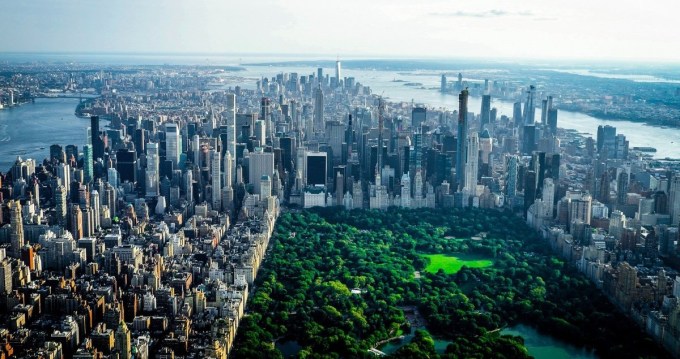
Although Brooklyn is gaining in popularity among tourists, when most people think of New York, they really mean Manhattan. It has a population of 1.7 million in its 22.83 square miles, each of which is home to 74,782 souls. On an average weekday, add 1.6 million commuters and 750,000 tourists and you have about four million people fighting for their share of the streets and sidewalks. That’s nearly 174,000 per square mile.
Although New York has some complicated real estate laws, unless you live in a rent-controlled apartment, a studio apartment in Manhattan will rent for $3,300 a month; a one bedroom at $4,130; and a two bedroom at $5,500. Rents in the best neighborhoods in Chicago would be $1,750, $2,300, and $3,200, respectively. And from what I’ve read, the Chicago apartments will be larger on average than those in Manhattan.
There are some single-family homes, generally townhouses, but most people live in apartment buildings, which are getting taller and taller. When I first went to Manhattan in the late 1950s, the Empire State Building dominated the skyline. No longer. Now it seems lost among newer skyscrapers, particularly the so-called “pencil” towers that now dominate.
Mostly surrounding Central Park, these ridiculously thin apartment buildings take advantage of anomalies in the building codes to reach as high as 1,550 feet (Central Park Tower); and 1,428 for Steinway Tower, the thinnest with an astonishing height to width ratio of 24 to 1. Many of them are used as a “pied-a-terre” or a home away from the owner’s main residence, usually in another state. Apparently, even the finest hotels aren’t acceptable to very richest among us (or not among us actually). The proliferation of these apartments has encouraged the state and city to propose an added tax on these getaways for out of state billionaires.
Anyway, it’s getting increasingly expensive to live in Manhattan. Frankly, it has become the very definition of “I love to visit, but I wouldn’t want to live there.” While even a visit can be frustrating, where else are you going to find such riches? Take museums for example. While Chicago has the Art Institute and Museum of Contemporary Art (and a few smaller university-related museums), New York boasts the country’s largest art museum, the Metropolitan. Not too far away on Fifth Avenue are the Guggenheim, the Frick Collection, and the Neue Gallery. A bit further south are the Museum of Modern Art and the Whitney Museum of American Art.
As to restaurants, New York boasts four Three-Star Michelin restaurants (Chicago has two). But really, you would be hard pressed to find a block in Manhattan that doesn’t have at least one restaurant, and the sidewalks are full of food carts offering all manner of exotic fare. You could certainly visit Des Moines for less money, but why would you?
And last, but by no means least, you can pay your fare on buses and the subway by just tapping your credit or debit card! No special transit cards or cash. Chicago’s CTA, Metra, and Pace should take note!
Copyright 2026, Patrick F. Cannon