
Lay On, Macduff!

Lay On, Macduff!

By Patrick F. Cannon

Several days ago, I resumed my theatrical career by playing both Duncan and Macduff in a production of Shakespeare’s Macbeth, or the “Scottish Play” as superstitious actors call it to avoid the curse associated with actually naming it. The cast also included my wife Jeanette; daughter Beth and son-in-law Boyd; his sister Cathy, and brother Bart and wife Lisa; their children, Riley and Rachel and niece Hannah. Everyone played multiple parts; in addition to Duncan and Macduff, I was also the first murderer (of three, there being copious amounts of blood in the play).

The venue was not the Old Globe or Stratford-Upon-Avon, but on various laptops and tablets, courtesy of Zoom. Actors joined from Seattle, the Chicago area, Minneapolis, and Madison, Wisconsin. I have to confess we didn’t do the play as the Bard had written it, but a somewhat abridged 45-minute version. Nevertheless, everyone involved played their roles with great spirit; my own performance received high praise from my dear wife. Alas, when the doomed Macbeth yells “lay on Macduff” during the climactic battle, I was unable to do so, being in another room.

My theatrical career actually goes back many years. I believe I was in the fourth grade when I appeared in a production of The Wizard of Oz. It was a joint effort of Chicago’s Aquinas High School for Girls and the adjoining St. Philip Neri grammar school, both run by Dominican nuns. The main protagonists came from the high school, but I was given an important supporting role – heroine Dorothy’s faithful mutt, Toto. I was very serious about learning my lines, and declaiming them when cued. They varied based on the situation – either “woof woof” or “arf arf.” According to my parents, I handled both with aplomb.

It would be 30 more years before I almost trod the boards again. The company I was then working for had transferred the management staff from Chicago to its plant in Lake Mills, Iowa, a town of about 2,000 souls with limited housing choices. All of us chose to settle 20 miles to the north in Albert Lea, Minnesota, a comparative metropolis of 20,000. Built around a lake, Albert Leas was not without its charms, but had limited cultural attractions; one had to drive about 100 miles north to what they called the “Cities,” namely Minneapolis and St. Paul, for professional entertainment.

The one exception was the Albert Lea Community Theatre, which typically did three productions a year, including one musical. My first wife, Mary, partly to stave off boredom, had auditioned for a production of Guys and Dolls. She got a part in the chorus, which required both singing and dancing. I was eventually dragooned into doing some publicity work for them, then began doing the programs. The leader, and lead actor, was a Scottish doctor who had a long history of amateur theatricals, including in nearby Rochester, where he had been associated with the Mayo Clinic.

The cast parties were legendary, and during one, after having had a few drinks, I agreed to audition for a part in a coming production of Wait Until Dark. Originally a Broadway play starring Lee Remick and Robert Duvall as blind heroine and villain, it was later adapted as a movie starring Audrey Hepburn and Alan Arkin. It also included a husband, who appears at the beginning and end. In the movie, it was played by Richard Crenna. I was given this role.

In the opening act, I left on a business trip. I won’t go into the plot, except to say it involved a doll filled with heroin, which the husband had brought home not knowing what it contained; and the efforts of the bad guys to retrieve it. In the end, the wife prevails. The husband – me – returns home and finds that things had gotten messy in his absence, but that his plucky wife had won the day, despite being blind.

I had been learning my lines when another drama unfolded. My boss, the CEO, had hatched a plot to take over the company. I won’t go into the details, except to say that the palace coup failed and we were all fired. Finding a job back in Chicago seemed more important than my theatrical career, so I dropped out. Rehearsals hadn’t actually started, so it was no problem to replace me.

In the intervening years, I have done a good deal of public speaking, which requires a kind of acting, but it was another 40 years until my acting career resumed. At this rate, my next role might have to be the ghost of Hamlet’s father.

Copyright 2020, Patrick F. Cannon

Last Man Standing

Last Man Standing

By Patrick F. Cannon

Smithers was excited when he learned that limited crowds would now be permitted to attend football games at his beloved alma mater, Huxley University. As a long time season ticket holder, he would be given priority for the limited number of seats that could be occupied under the protocols demanded by the pandemic.

A football power in the Northwest, Huxley’s legendary stadium normally sold out its 100,000 seats. Only 25,000 could now be accommodated. Even at his advanced age, Smithers was famous for his penetrating basso profundo, and was ready to lead the cheers for the Huxley Hedgehogs. To add to his joy, it was a clear cool day – perfect football weather.

Alas, tailgating would not be permitted, with its smokey smells and hearty bonhomie. But his status as a major donor meant he was entitled to valet parking, a blessing for his aging legs. The modernized stadium even had escalators, which made his ascent to his lofty seats on the fifty yard line much easier. Normally, his dear wife attended with him, but she was committed to a Zoom board meeting of her favorite cause, the Society for the Protection of the Spotted Polecat.

Yet, as he took his seat and waved at his social-distanced fellow fans, he was conscious of an increasing sense of dread. He noticed that the two teams were leaving the field after their pre-game warmup, and the famous Hedgehog marching band was gathering for their usual medley of peppy band music, followed by the university’s Alma Mater – “Noble Huxley, Gem of the Great Northwest.” The opposing teams would then return to the field of legendary combats – his  beloved Hedgehogs to deafening cheers!

As he sat in his seat, small beads of sweat began to appear on his forehead. He was barely conscious of the music rising to him. Instead, he looked at the space between his seat and the back of the seat in the next row below. Was there enough room? Could he perhaps leave his seat and find sufficient space on an aisle? While he was agonizing over this decision, he was suddenly aware that the Alma Mater was being played. Normally, he would heartily sing along with its stirring words; and be among the loudest to cheer as his team was announced. Today, he was distracted and sat in silence.

In years past, when all the preliminaries were over, the field announcer would say the expected words: “Please rise while the Hedgehogs marching band plays our National Anthem!”

But earlier in the year, the Washington legislature had bowed to public pressure and  passed a new law mandating that public performances of the National Anthem be preceded by these words only: “We will now hear the National Anthem.”

And now, Smithers heard the words he had been dreading. All around the stadium – on the field of battle and in the seats – people went to their knees, and raised their fists. Only Smithers stood. As the Anthem was performed by the kneeling band, all eyes gravitated to him, still standing. There was an audible gasp when Smithers actually placed his hand on his heart. Only those near him noticed that he was in fact clutching his heart, a grimace on his face. He fell to his knees, then pitched forward, dead of a heart attack.

Even so, he would forever be known as the last man to stand for the National Anthem.

Copyright 2020, Patrick F. Cannon


Toothsome Delights!

Toothsome Delights!

By Patrick F. Cannon

I have previously written about my mother’s culinary prowess, but I’m afraid I failed to do little more than mention some of her triumphs, without giving full instructions as to their preparation. With apologies to my dear friend and mentor, Jacques Piepan, I will here attempt to atone.

Perhaps my favorite dish was her noodle/ketchup/sausage casserole. The joy of this dish is that you probably have the ingredients at hand – egg noodles, ketchup and breakfast sausage. I would choose ½-inch wide noodles. Don’t be tempted to substitute egg-free noodles. They get their color from “yellow dye 978,” which is a known Carthaginian. My many followers will be shocked that I recommend Hunt’s Tomato Ketchup instead of Heinz’s. I do so because Hunt’s flows more easily and thus can be more readily mixed with the noodles (and also because I have a nephew-in-law who works for the company that makes the stuff).

My mother always used Oscar Mayer breakfast sausage, which was just the right size and had no particular taste. I’m afraid it’s no longer available, so you might want to substitute something from Mr. Bob Evans or the Johnsonville group (despite the commercials, Jimmie Dean is actually dead, so I’d steer clear of that brand). If they are pre-cooked, so much the better – it saves a step. This is a one-dish meal; in this case, a 9x4x3-inch glass loaf casserole. If you don’t have a glass one, you could substitute a metal loaf pan, but the presentation would be less visually impressive.

Fill a pan with water and a bit of salt. Turn on the burner. When the water comes to a boil, toss the noodles in, stirring occasionally. When they’re suitably soft, drain and pour into the casserole. Pour the Hunt’s over the noodles, mixing until all the noodles have a lovely reddish cast. Arrange the sausages – perhaps a dozen? – on top, then put the whole shebang in a 325-degree oven. Twenty minutes later, perfection. As a side dish, you could quarter a head of Iceberg Lettuce. Place each quarter on a salad plate, and pour on a liberal amount of Kraft French Dressing. Its lovely orange color adds a festive note to a notable meal. Some people prefer Thousand Island dressing, but I’m not sure why.

You ham lovers will embrace this other Cannon delight, Jambon a la Cerise (ham with cherry sauce). This is another one-pan delight, in this case, a cast-iron frying pan. For this dish, you must purchase a ham steak, typically a large slice of ham about ½-inch thick. My wife Jeanette cubes just such a steak to make a delicious quiche-like creation. Jambon a la Cerise is a simpler, but no less satisfying, dish.

In addition to the cast-iron frying pan, you will require a jar of Maraschino Cherries. Heat the pan until really hot, then place the ham in it. Do not use any oil or butter, as this will tend to inhibit the desired crustiness. Fry on one side until a crust forms, as near to black as you can get it. Turn over and do the same to the other side. When both sides are crusty and the ham dried out, pour in the jar of cherries. When they are heated through, transfer the ham onto a serving platter, and pour on the colorful sauce. This should serve four lucky people.

To my amazement, I find that many people don’t seem to like organ meat. Some will tolerate liver, but draw the line at brains, hearts, gizzards, intestines and kidneys. As a child, I always asked for the turkey gizzard, but the modern birds don’t seem to have one. But my very favorite is kidneys. A stew of lamb kidneys was a staple of the Cannon menu. Preparation could not be simpler.

Ask your butcher for a pair of lamb kidneys. Chop them into bite-sized pieces, removing any gristly stuff as you go. Fill a cauldron with water, adding chopped onion, carrots and celery. Add the kidneys and bring the water to a simmer. Open the windows, and turn on an exhaust fan if you have one. This will permit your neighbors to share in the heady aromas. As the mixture simmers, you will notice a whitish crud forming on the top. Skim this off until it ceases to appear. Add cut-up potatoes and continue cooking until the spuds are tender. Ladle into bowls and serve your anxious family.

Speaking of spuds, my mother served mashed potatoes almost every day. Occasionally, there were leftovers, which, properly transformed, could be served the next day. Many of you, I’m sure, have eaten potato pancakes. Some recipes I’ve seen mix the spud mash with an egg, onions, salt, pepper, flour and assorted spices. All of this conspires to destroy the pure essence of the noble potato. All you really need do is form the mashed potatoes into patties and throw them into your faithful cast-iron frying pan. Again, you’re looking for that crusty surface that always satisfies.

In closing, I should mention that my father was born in Ireland, as were my mother’s grandparents. As you may know, the Irish favor simple, hearty food. I fully subscribe to  their general policy of never eating food from a country one has never heard of, or whose name one can’t pronounce.

Copyright 2020, Patrick F. Cannon

 

Tap, Tap, Tap

Tap, Tap, Tap

By Patrick F. Cannon

I mentioned to my daughter Beth that my laptop was in the shop getting its Wi-Fi connection fixed (it’s back, I’m typing on it now), and we got to chatting about the various ways one has had to type in my lifetime, and she suggested a piece on this subject might be of interest.

I guess I’ve probably written millions of words over the years. As late as the 1950s and 60s at Northwestern University I was still doing my papers in long hand. Not long after that, professors began to refuse to accept anything not typed. I remember in particular a paper I did on Existentialism. It must have run to a couple of thousand words. I got an A, most likely because the prof didn’t want to bother deciphering the scrawl. In that regard, I often wonder if Count Leo Tolstoy had good handwriting? Imagine typesetting the manuscript of War and Peace!

I really didn’t learn how to type until I was in the Army. Because I went to Signal School, I was taught on a Teletype machine. When I got out in 1963, I bought a manual portable typewriter; a Royal as I recall. In my first real job after the service, I didn’t need a typewriter, as I dictated most of my correspondence. I did see my first Xerox machine there, and it seemed the marvel of the age. It was roughly the size of a refrigerator and could make only one copy at a time. You fed an original into a slot and – voila! – a copy come out below.

Of course, there was nothing like e-mail then. If there was a need for urgency, you would send a Telex! We also had a direct phone line to corporate headquarters in New York, and a WATS line for other long distance calls.

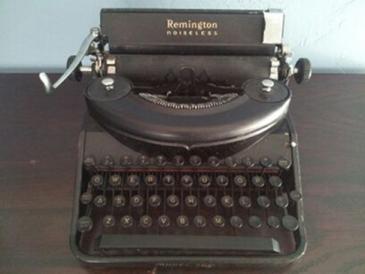
In my next job, I did a good deal more writing – newsletters, brochures, and news releases. I used a manual, office-size machine for the drafts, which were then finish-typed by a secretary. It was only in a subsequent job that I got my own typewriter. My then boss told me to buy any electric portable I was comfortable with. I chose a Remington, which churned out reams of deathless prose. By the way, in those days, if your copy was going to appear in print, it had to be sent to the typesetter. When I started, it would have been composed on a linotype machine, which produced what we called “hot type.”  Very soon, however, this was replaced by photo-type, then by computer-generated type. The type house would send galleys. If you made any changes, you were charged.

To this day, I still remember the glee I felt in being given my IBM Selectric typewriter in a later job. It had the magic type-ball, and a correcting feature! No more need to use the dreaded white out! There was a time when every desk in the civilized world had a little bottle of the stuff at the ready. The next advance – was it sometime in the early 1980s? – was having a word processing terminal at my desk. This was something of an advance, since you could print documents and letters yourself after making corrections. Alas, you still needed a typewriter to make envelopes. But the magical thing in both cases was the automatic carriage return!

People will perhaps be amazed to discover that most typewriters had a dandy feature called the carriage return. As you typed away and got close to the right margin, a warning bell would ring. If you didn’t heed its call, and kept on typing, the little letters would keep appearing until they ran off the end of the page. Not good. Heeding the bell, you were faced with a decision. If you had typed a complete word, your right hand would rise up and manually use the supplied lever to return the carriage to the left margin. Most electric machines had a key to accomplish the same.

But if you were in the middle of a long word – let’s say exaggeration —  you had to hyphenate it, i.e., decide where to separate the word into two parts, with one part on the line you’re currently typing upon, and the rest on the next. This could not be done willy-nilly, but according to established rules. If you were unsure about just where you could properly separate a particular word, you looked to a dictionary for guidance. Many of you will be amazed to discover that dictionaries were once actually contained in large books. A knowledge of the alphabet was required to navigate them.

Nowadays, all the fun has been taken out of writing. The laptop I’m writing this on would let me type away until the end of days without worrying me about hyphenating a word, or using a return bar or button. It even alerts me when it thinks I have misspelled a word, or even composed a run-on sentence. By the way, I just misspelled “sentence” and it corrected me automatically.

The job of typesetter is no more. For all of my five published books, I simply sent the publisher the Word texts as e-mail attachments (it took several). They then ran the files through a program that gave them the text in a style and size they wanted. Of course, some writers still prefer to compose in long hand. I once worked with one who would write all his articles by hand, then type them on his computer. He had to work longer hours to do all this, but he didn’t mind.

By the way, typewriters have now become collector items. If you happen to have an old Smith-Carona gathering dust in the attic, you might want to give Tom Hanks a call. He might be missing that model.

Copyright 2020, Patrick F. Cannon
Stuck in the Past

Stuck in the Past

By Patrick F. Cannon

I last saw my father’s oldest brother, Mark Cannon, when he was in his mid-80s. It was at my brother Pete’s house in Monroeville, Pennsylvania, near Pittsburgh. He was then living with his son Mark in Dayton, Ohio. They were visiting old friends in the area, and stopped by. I happened to be in from Chicago for a visit. It may have been 1980, plus or minus.

Uncle Mark was born on the island of  Innisbofin, Ireland in 1896, as was my father Peter in 1906. The whole family emigrated to the US in 1908, when Mark would have been 12. I don’t believe he ever returned to Ireland, and I don’t recall him having an Irish brogue when I would most often see him in the 1940s and 50s. Yet, that evening in Monroeville he seemed to have regressed to his boyhood and spoke as if he had just gotten off the boat. I don’t recall how it came up, but he spent a good deal of the time railing against the “bloody English.”

He was reflecting an animosity that lasted nearly 400 years, ever since the English began to seize Irish land in 1609 and transfer it to English and Scottish immigrants. The land grab culminated with the Battle of the Boyne in 1690, when the last Irish effort to turn the tide failed. It wasn’t until 1922 that Ireland gained a measure of independence from Great Britain after three years of war. Even then, the Irish Free State, as it was known, did not include the northern six counties, commonly known as Ulster, which still remains part of the United Kingdom. This partition initiated a civil war, in which the new government prevailed.

The discontent over the partition simmered over the years, with occasional violence, but what became known as the “Troubles” only began in earnest in 1987. During it, radical wings of the Irish Republican Army (IRA) initiated a series of armed attacks and bombings meant to force the British out of Northern Ireland, and ultimately to unite the two Irelands. An estimated 3,500 people died; not only combatants, but innocent civilians as well.

It’s too complicated to go into all the aspects of the struggle here; suffice it to say that the people of Northern Ireland began to demand that the politicians find a way to make peace and end the violence. Finally, on April 10, 1998 – Good Friday as it happened – the two sides signed a power-sharing agreement that has largely held to this day, although sporadic violence still occurs.

Why, after nearly 400 years of strife, did this happen? Largely because the people of Northern Ireland, both Catholic and Protestant, grew tired of living their daily lives burdened by past grievances. In looking at their history, they chose to understand it, but not be shackled by it. In short, they voted for the future. As a result, Northers Ireland entered a new era of prosperity. Tourists, who had feared being caught in the crossfire, began to return; and business and industry was revived. If Ireland is to be reunited, it will because the citizens of the six northern counties wish it.

There are many areas of the world that seem mired and constrained by the past – Israel and Palestine, the Balkans, India, and our own country. We can all learn from the past, but we don’t have the power to change or punish it. Pulling down statues doesn’t erase the past; nor will erecting new ones. It’s what we do today and tomorrow that counts. After all, there is a difference between studying and learning from the past, and stubbornly living in it.

Copyright 2020, Patrick F. Cannon

Take Ford Out of Their Future

Take Ford Out of Their Future

By Patrick F. Cannon

In what must be one of the most unselfish acts I’ve heard about in many a day, a number of Chicago employees of the Ford Motor Company have petitioned the company to discontinue production of the Ford Police Interceptor, which would also presumably discontinue the jobs of the workers who produce them.

Ford has long been involved in producing vehicles for the police. The latest version is based on one of their SUV models, and is produced at Ford’s Chicago plant. It was the first Ford assembly plant built outside Detroit, and is now the oldest in continuous operation. When it opened, it churned out Model T’s. No doubt some of them were used by the police of the day.

Although General Motors also makes police vehicles, Ford does dominate the market. So, one would hope that GM  would follow Ford’s lead and stop making these symbols of police oppression. While the cops would be able to get by with existing fleets for some time (maybe a long time; look at Cuba), eventually they would have to choose other ways to get around town. Here are some possibilities.

What’s wrong with walking? In addition to just plain good exercise, it would place our men and women in blue close to the action. I have visions of Office Friendly strolling down the avenue, saying howdy to one and all, poking his or her nose into the barber shop, shooting the breeze with passersby, helping the odd senior citizen across the street; all the while keeping an eye out for possible transgressors, and writing the odd parking ticket. This would be the legendary “beat” officer of yore. Since police in Chicago have to live in the city, let them take the CTA to work. As an added benefit, we might require our officers to wear only American-made shoes, preferably those with gum soles. And why not have them pick up discarded trash as they go along, thus beautifying the neighborhood?

By the way, I’ve noticed on many a TV cop show that our police seem capable of feats of running that would do justice to Usain Bolt. If a few of our cops seem a bit on the pudgy side, would not a bit of running do them good?

Perhaps you’ve noticed that bicycles are becoming common in police forces around the country. A bike permits the office to cover more ground. It also permits the possibility of carrying more equipment, like submachine guns, stun grenades, pepper spray, tear gas and candy for the kiddies. They are also better for pursuit, but leaping off to tackle an offender can be troublesome.

Many police departments, Chicago included, already have mounted units. Who doesn’t like these beautiful horses? Normally, we only see one at a time, usually with a smiling officer offering to let adoring children stroke the willing steed’s muzzle. But picture a hundred mounted police, sabers at the ready, and you have a crowd control tactic second to none! What Ford can compare?

While I would be loathe to recommend any vehicle with an internal combustion engine,  electric conveyances should be just the ticket. I believe the Chicago police already have the Segway transporter in use, but electric scooters and even skateboards can be had. While some of our finest might be a bit too heavy for them, they certainly can be an option for the few who are thin and fit.

Dangerous high-speed chases would eventually be a thing of the past. When bank robbers, for example, jump into a get-away car and flee, a nearby police officer might be able to note the license plate number. If the vehicle wasn’t stolen for the purpose, the offenders could be eventually tracked down and arrested, or perhaps sent a letter asking them to give themselves up.

While response to emergency 911 calls might be a bit slower, the environment would surely benefit from the lack of emissions from hundreds of idling Fords. Finally, to replace those police helicopters one sees hovering overhead, why not hot air balloons? With a 50-member City Council, Chicago would not lack for the necessary fuel.

Copyright 2020, Patrick F. Cannon



Among the Several States?

Among the Several States?

By Patrick F. Cannon

I’d like to call your attention to the Commerce Clause of the United States Constitution. Wait! Don’t delete this yet! Just give me a few minutes.

The Clause (Article 1, Section 8, Clause 3) permits the national government to “regulate commerce with foreign nations, and among the several states, and with the Indian.” To define it simply, it means that the individual states can’t go their own way if it affects the other states. For example, Illinois can’t charge Wisconsin cheese makers a tariff for shipping their cheddar from Kenosha to Waukegan. It also gives the Federal government the power to regulate companies that do business in multiple states.

Since Congress and the courts have been generous (sometimes too generous) in their interpretation of the Clause, it confuses me that the public health of the nation doesn’t seem to fit within its broad scope. During the current pandemic, the individual states have gone their own way, often with tragic results.

What could be more “among the several states” than a scourge that has killed 131,700 Americans in every state (as of 7/8). Yet, every one of the 50 states has gone its own way in addressing the crisis. Most were late in recognizing it seriousness. The light bulb eventually went on for some and they did everything they could to halt its spread. Others chose to follow the lead of the science denier in the White House and treated it like a passing fad. I don’t think it’s too much to say that many of our governors have blood on their hands.

If you pay attention to the news, you’ll notice that there’s a good deal of finger pointing going on. Let’s blame the Chinese government or the World Health Organization. If they’d done their jobs, we wouldn’t have this problem. Of course, the Chinese seem to be blaming the U.S. Army for loosing the plague upon the world.  And just recently, I read that Neanderthal DNA has been found in Covid-19, or was it the President’s?  At this point, it doesn’t matter! What matters is  that we screwed up. And what we can do now to make sure it doesn’t happen again.

I happen to think Congress can fix this by passing legislation to give the proper government agencies the power to compel the states to take whatever actions it deems necessary to prevent, or at least mitigate, future public health disasters. I would suggest that the Surgeon General of the United States, and the director of the Centers for Disease Control, jointly, be given the power to declare a public health emergency, and compel the states to act; and that the declaration not be subject to approval by the President.  Public health is not a political issue, which it most certainly has become in this instance.

While I believe the Commerce Clause gives Congress the power to act, it may be better in the long run to enshrine these powers in the Constitution itself. That way, the courts won’t be clogged with challenges to any laws that pass. And it would prevent frightened governors from looking over their shoulders fearfully at the kind of voters who put the current knucklehead in the White House, and who might make the same mistake again.

Copyright 2020, Patrick F. Cannon


Erasing History

Erasing History

By Patrick F. Cannon

I’m on record as supporting renaming United States government facilities named for Confederate soldiers. In a magnanimous gesture after the Civil War, they were permitted to regain their US citizenship after taking the required oath. Some were even later elected to Congress. But the soldiers in particular who had previously served in the United States Army had broken their oath, which had required them to defend the country against enemies “both foreign and domestic.” They were traitors, pure and simple.

I am also quite happy to see their statues removed from public places of honor, so long as this is done by lawful means. I am completely opposed to having it done by mobs of vandals who have decided they should have this power. Governments who stand aside while monuments are pulled down are derelict in their duty, just as are those who watch helpless and hapless as their cities are burned and looted.

The mobs of the far left have decided to condemn historical figures without themselves seeming to have any historical knowledge. Christopher Columbus has come in for particular attention. He had the misfortune of being the first proven European to stumble upon the Western Hemisphere. Had another Italian or Spaniard gotten here first, they would have likely behaved exactly as he did.

In fact, there were two main reasons why Columbus and other explorers set forth in the first place: to convert the heathens to Christianity, and to exploit the new lands for profit. Columbus wasn’t in the least unique, as anyone who has read the history of Spanish America will know. Nevertheless, if the people of Chicago, through their elected leaders, decide to remove his statue and replace it with one of Abbie Hoffman, that’s their prerogative.

The current “know nothings” also believe in guilt by association. General U.S. Grant’s wife came from a family of slave holders; thus his statues should come down, never mind that his victory in the Civil War was what made the theoretical emancipation of slaves an actuality. Speaking of emancipation, Lincoln’s wife, Mary Todd Lincoln, came from a family of Kentucky slave holders. Perhaps we should tear down the Lincoln Memorial; or, even better, keep the  structure and replace Abe’s statue with one of Karl Marx.

We cannot judge historical figures by today’s standards. Columbus lived in a violent age. If you were to actually read the history of England in the same period, for example, you would be appalled to discover the cruelty with which people were tortured and executed. What was done during the religious wars of the 16th Century, by both sides, would curl your hair.

While it may be true that the failings of our past were once glossed over, this has not been true for decades. That nearly every educated white person in the 19th Century, including Lincoln, believed that blacks were inferior is well known. Yet, at the same time, they also believed that all persons, regardless of their race, should enjoy the benefits of freedom, and that is to their credit. Yes, Jefferson owned slaves. He was a hypocrite for both owning them and espousing the concept that “all men are created equal.” But he knew he was a hypocrite; and despite his human failings, he wrote the Declaration of Independence and helped found a republic that is still trying to perfect itself.

We all know the old saying: “those who don’t know history are doomed to repeat it.”

Perhaps we should replace it with “those who don’t want to know history are bent on destroying it.”

Copyright 2020, Patrick F. Cannon


What’s in a Name?

What’s in a Name?

By Patrick F. Cannon

In my distinguished Army career, I had the pleasure of spending time at five U.S. Army forts. I’m ashamed to say that I was never much interested in who they were named after. When you’re drafted and thrust unwillingly into the clutches of lunatic officers and sergeants, who require you to march through muddy swamps and bogs, who they actually named these backwoods hell holes for is the last thing on your mind.

Recent events, however, have led me to inquire into this for the first time. On the day of my induction, early in 1961, we future soldiers gathered at the Chicago building set aside for that purpose. After a cursory physical exam to determine if we were still breathing, we boarded a bus for Central Station, the long gone Illinois Central terminal at 12th and Michigan. We boarded an overnight train for St. Louis. It was the first and only time I traveled in a Pullman car with upper and lower berths. I snagged a lower berth, but didn’t get much sleep, due to the exuberance of my fellow soldiers (we had already been sworn in).

We went from the train to a bus, and onward to Fort Leonard Wood. As it happened, I later found out who Wood was. He appeared prominently in biographies I read of Teddy Roosevelt, John J. Pershing and Douglas MacArthur. A Harvard-trained physician, he was  the only doc to become chief of staff of the US Army. A recipient of the Medal of Honor, he was the actual commander of the famous Rough Riders, although Teddy Roosevelt hogged all the glory.

I was only to stay there for a couple of weeks. After being fitted for uniforms by the justly famous Army tailors, we mostly tried to avoid KP and other duties while waiting to be assigned to a basic training unit. As it turned out, this was to be at Fort Benning, Georgia, a long bus ride away. Then, as now, a major training center, it was named after Brigadier General Henry Benning, who earned his high rank serving in the army of  the Confederate States of America (CSA). To put it as gently as possible, he was a traitor. After the Civil War, he returned to Columbus, Georgia to practice law. As it happens, Columbus is the nearest town to Ft. Benning, which straddles the Georgia/Alabama border, and it’s easy to imagine the House Armed Services Committee, led by segregationist Southern Democrats for much of the 20th Century, naming the fort after a local boy who shared their sympathies.

After basic training, I was sent to Signal School at Ft. Gordon, also in Georgia, but nearer the South Carolina border. The nearest city was Augusta, famous as home of the Augusta National Golf Club, site of the famous Masters golf tournament. The golf club has had many distinguished members, all white males until fairly recently, but I digress. The fort, still home to the Signal School, is named after Lt. General John Brown Gordon, another CSA stalwart and traitor. If anything, he was an even more rabid segregationist. In addition to having an army fort named after him, his grateful Georgians elected him to the US Senate in 1872. Oh, and he was apparently head of the Ku Klux Klan in the Peach State.

After leaving Fort Gordon, I was briefly at Fort Dix, New Jersey while awaiting a troop ship to take me to France. Major General John Adams Dix was from New York, and was a veteran of both the War of 1812 and the Civil War. He was later elected Governor of New York.

After my happy stay in France was over, I was sent to Fort Irwin, California, home of the army’s desert training center. It was in the middle of the Mojave Desert, 45 miles from the nearest town, which happened to be the unlovely Barstow. It was named in honor of Major General George Irwin, a division commander in World War I. George was the middle general in a family of soldiers. His father served the Union in the Civil War; and his son was a division and corps commander in World War II. He entered West Point from New York State; his father was born in Ireland, served as a medical officer, and was another recipient of the Medal of Honor.

My stay at Ft. Irwin – where our neighbors were scorpions, rattlesnakes, tarantulas and coyotes – was interrupted by my signal company’s assignment to support armored division maneuvers at Ft. Hood, Texas. All of our equipment – we were a combat support signal company – and ourselves were flown there on C-130 transports. It was October, 1962, so our stay in this jewel of the Texas hill country was ended by the Cuban Missile Crisis. Alas, we had to convoy back to California, which took three days.

The fort was named for a more famous Confederate general, John Bell Hood, the youngest man to be made a full general in the Confederate army. He had a sterling record until he faced William Tecumseh Sherman, who defeated him in a series of battles that culminated in the capture and burning of Atlanta. Although born in Kentucky, this graduate of West Point served in Texas as a young officer and adopted it as his home. When the Civil War started, he volunteered to be an officer in their militia. No doubt this noble gesture resulted in this major army fort being named in his honor.

Yet, he was another traitor, and along with Benning and Gordon, should have his name removed from the fort. Many in the current army agree with this, but our perverse and stupid  president disagrees, preferring to pander to his base. By the way, each of these men was an admitted and avowed racist, who went to their graves believing that African-Americans were inferior. If the Defense Department would like some suggested replacement names, I could start with Benjamin O. Davis, Sr, the first African-American to become a general in the service of his country.

Copyright 2020, Patrick F. Cannon


I Don’t Want to Hear It!

I Don’t Want to Hear It!

By Patrick F. Cannon

For increasing numbers of our fellow citizens, “freedom of speech” is limited to what they have to say or are willing to hear. Not for them the famous quote attributed to Voltaire: “I disapprove of what you say, but will defend to the death your right to say it.” Nowadays, it’ more like: “I don’t agree with you, so shut up!”

While James Madison drafted the Bill of Rights, whose first Amendment admonishes Congress not to “abridge the freedom of speech or of the press,” he did it in consultation with Thomas Jefferson and others, who remembered only too well the power of the British state to put people in jail for speaking out. The other nine amendments are largely designed to keep the government off our backs in other ways.

The framers, much like politicians then and later, sometimes had reason to wish there was less freedom of speech, and especially of the press. As soon as 1798, Congress passed the Alien and Sedition Acts, which sought to limit both. Lincoln suspended Habeas Corpus during the Civil War, partially to punish dissenters. Woodrow Wilson jailed opponents of World War I, and radicals of various kinds during the “Red Scare” of the late teens and early 1920s. And Franklin Roosevelt interned American citizens of Japanese descent in 1942.

            In many cases, we have the press to thank for holding the government to account. It took guts, for example, for the New York Times to defy the government in publishing the Pentagon Papers in 1971. So, it seems ironic to me that the same newspaper has recently been involved in suppressing an opinion it disagrees with editorially.

The so-called Op-Ed sections of newspapers, where differing opinions on a variety of issues are published, are largely based on a section started by the Times itself. Yet, on June 7 they fired their Opinion editor, James Bennett, for publishing a piece by Senator Tom Cotton (R, AR) that advocated the use of Federal troops in quelling the recent rioting and looting (as distinct from the mostly peaceful protests). It would be difficult to find a politician I hold in lower regard (he’s and avid Trump supporter), but in fact his opinion was held by a significant number of Americans, and deserved some space in a newspaper with few conservative voices.

The Times publisher claimed Bennett was asked to resign because he published the piece without prior editing, as if you could ask someone to express their opinion, then take out the stuff you didn’t like!. He was actually fired because the news staff rebelled, claiming that his views threatened them with actual harm. The reality is they rose in righteous rebellion because his views were abhorrent to a news staff of largely liberal and progressive opinion. In another, less well known case, a reporter was forced to apologize for quoting a source accurately.

In an article he wrote for Intercept, a publication that appears in a variety of formats (on-line, podcasts, videos, etc.), reporter Lee Fang quoted an African-American resident of East Oakland, California, Maximum FR – who himself had lost two cousins to gun violence – to the effect that while the killing of African-Americans by police officers was front page news nationally, he rarely saw any mention of the killing of African-American young men by other African-American young men. For using a quote that was not only accurate, but demonstrably true, Mr. Fang was accused of being a racist by his fellow Intercept journalists. To keep his job, he was required to apologize.

Regardless of one’s political opinions, we are getting on dangerous ground when the news staff of a great newspaper is able to leap the wall between the news and editorial staffs and decide what is acceptable opinion. And just when did telling the truth become racist?

Copyright 2020, Patrick F. Cannon