By Patrick F. Cannon
Back in the mid-1960s (they really did exist), I worked for an integrated paper company. “Integrated” in that case just meant that they grew or bought the trees, made wood pulp into paper of various kinds, then made the paper into bags and boxes (they also made finer paper for writing and printing). I was in the part of the business that sold bags to people like Ralston Purina, Quaker Oats, Quickrete, MiracleGro, Organic Compost (“Number One in the Number Two Business”), and Kingsford Charcoal, among many others. We also sold a lot of paper potato and onion bags.
I remember being somewhat flabbergasted when some environmentalists began to accuse the paper industry of murdering trees in their greedy quest for profit. The lunatic fringe even drove spikes into trees soon to be harvested, causing serious injury to loggers. This confused me, since I knew that my company (Union Camp) actually grew most of the trees they used on the one million acres of forests they owned, or bought trees from tree farmers. While obviously it takes a lot longer to grow a Pine tree than a stalk of corn, the idea is much the same. You harvest, then plant. Although I had long left the industry by then, eventually plastic bags began to replace paper for many uses.
Nevertheless, recycling paper became a hot topic, especially newspapers and magazines. I think it can be said that these efforts were the beginning of today’s recycling industry. Today, most paper products include at least some recycled material. Metal recycling actually predates paper. Today, 40 percent of steel comes from scrap; and fully 60 percent of aluminum comes from those beer and soft drink cans you throw in the recycling bin.
The percentage for glass is 31, but only 5 for plastic. I’m not sure why this is so low. I put all my plastic in the recycling bin, but it doesn’t amount to much, since I don’t buy soft drinks or water in plastic bottles. Our refuse hauler does pick up garbage and recycling in different trucks, but I have no idea what happens to it after that.
Once upon a time, fast-food restaurants relied on paper for cups, plates, wrappers and straws. Slowly but surely, as with grocery and commodity bags, plastic began to replace paper. The reason? Much cheaper. But unlike paper, most plastic stubbornly resists decomposition. Added to this is the ubiquitous plastic water bottle. I have never quite understood why people with access to safe drinking water insist on buying water, but unreasoning fear has always encouraged irrational behavior. In this country at least, some folks are starting to use refillable water bottles.
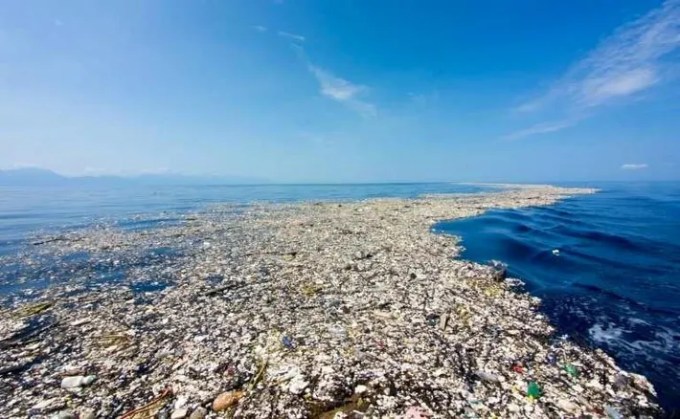
Of course, if the world’s population was the same as it was in the 1960s – about 3 billion – the scale wouldn’t be as acute, but it’s now 8 billion and growing. At least if all that plastic ended up in landfills, it wouldn’t be able to create vast islands of plastic in the world’s oceans (that’s the Pacific). So, the once irrationally despised paper is now making a comeback. So, you might want to hug that tree for different reasons! Or buy paper company stock. By the way, Union Camp later merged with International Paper, which is now the world’s largest pulp and paper company. Their future looks bright.
Copyright 2023, Patrick F. Cannon
 cannonnadedotcom
The road to hell is paved with plastic waste. Even though with good intention we obediently sort it for recycling, most plastic refuse refuses reuse and ends up in landfills. The processes to recycle the stuff in its many types and forms — bottles, wrapping, clam shells, etc. — are costly and the final product has dwindling market value. What’s more, it doesn’t lend itself to being recycled a second time. In contrast, brand-new, shiny plastic is cheap and abundant. So I am stumped every time I go to the store and the cashier (a vanishing breed) asks, “Paper or plastic?” Should I spare that tree or cover the oceans with flotsam and jetsam? Some supermarkets will charge a dime for every paper bag you use. And they no longer accept used plastic bags as they once did. In righteous California, they look at you with scornful approbation if you forget to bring your own shopping bag. And some smaller stores just hand you the items you purchase sans bag to take with you as best you can. Well from now on, paper it is. And if recyclers don’t want it because of food stains or coatings, it will light up nicely on the burn pile in the back!
LikeLike
I’m with you. A t least no scorn here yet, but it may be coming!
LikeLike
I was floored by increase in population from 3,000,000,000 to 8,000,000,000 since 1960 so I called on google to find out how the population increased. According to UN, it reached 1 billion in 1804, 2 billion in 1927, 3 billion 27 years later in 1960. and then a
growth of 5 billion in 63 years. Makes me wonder what’s next, not to mention how many trees will be around and whether we will be able to island hop from plastic to plastic in the oceans.
LikeLike