By Patrick F. Cannon
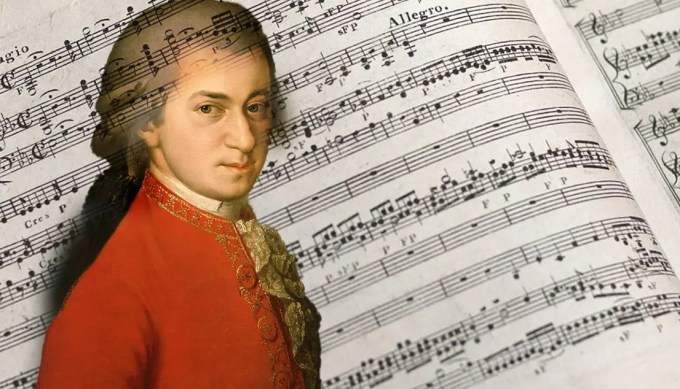
In these grim days, I remind myself that there is joy available. And his name is Mozart. At the moment, I have two CDs in my car that remind me of his genius – one of string quartets; the other, two of his piano concerti (the 19th and his last, the 27th). I let them repeat over and over again as I motor along. While he did occasionally let the dark in – Don Giovanni, the Requiem – I think he found it difficult to restrain the immense joy he felt when he was composing.
Beginning with simple pieces when he was 5 (which his father transcribed), he would go on to compose nearly 800 works before he died at 35. Talk about a work ethic! How many of today’s “serious” composers come close? Aaron Copeland, a fine composer to be sure, managed only about 150, and he lived to be 90. The only American composer who can be compared to Mozart is Irving Berlin, who did the words and music for approximately 1,500 songs in a career that lasted nearly 60 years. (It occurs to me that if you could only listen to the music of Mozart and Berlin, you could survive quite happily.)
Most people’s idea of Mozart comes from Amadeus, the 1979 play by Peter Shaffer, made into a highly-successful movie in 1984, directed by Milos Foreman. It painted Mozart as a goofy genius given to scatological jokes, driven to an early death by Antonio Salieri, a pathologically-jealous fellow composer, brilliantly acted by F. Murray Abraham (who got the Oscar for his efforts). Of course, it was all made up by Shaffer, but so effectively that many people took it as gospel.
What did he die of? At this remove, it’s impossible to say, but I love this one: apparently, he suffered frequent attacks of tonsillitis. Then, in 1784, he developed post-streptococcal Schonlein-Henoch syndrome which caused chronic glomerular nephritis and chronic renal failure, which led in the end to a cerebral hemorrhage. Another theory says he died of chronic kidney disease. Take your pick. People died then of things that are just minor annoyances today.
Another who died young was our greatest composer, George Gershwin. He was only 38 when he died of a brain tumor, a glioblastoma, the same kind of always-fatal cancer that killed Teddy Kennedy, John McCain and my wife, Jeanette. He was almost as prolific as Mozart, composing some 500 songs; several symphonic works, including the famous Rhapsody in Blue; and the groundbreaking opera, Porgy and Bess. You could be forgiven if you preferred to substitute him for Berlin (although to be fair, I should point out that Berlin did both music and lyrics; Gershwin’s brother Ira did most of his).
Of course, you might prefer Bach, Beethoven, Schubert, or Brahms; or Cole Porter, Richard Rogers, or even Lord Andrew Lloyd Weber. The point is: on days when the Arab-Israeli conflict has again boiled over, and the once-reliable Republican Party has descended into an embarrassing anarchy caused by a lunatic leader, we need to tune all of it out, if only for an hour or two, and remind ourselves that true nobility and beauty still exist.
Copyright 2023, Patrick F. Cannon
.
 cannonnadedotcom
As suggested by a friend, you should check out the horn concerti too.
LikeLike
Mozart’s music is a great consolation, a perfect elixir that unfailingly clears the mind. The vast number of people know him only by name, at best from the movie “Amadeus” or maybe as the fellow who wrote the “Theme from Elvira Madigan” (I date myself). But then, classical music is an arcane mystery to most, even with the internet and streaming. Still it manages to shine in unexpected places. For instance, it turns out the gal, a high school grad, who lives somewhere beyond the boonies in a trailer and cuts my hair is a big fan of…..Vivaldi!
An early introduction to classical music for me was the string quartet, a brilliant format that has fallen somewhat into obscurity. The Guarneri Quartet was in residence at Harpur College in Binghamton, NY where I went as an undergrad. I will not forget being erotically smitten when Ruth Laredo joined them in a performance of the Brahms piano quintet (I had a recording of it with them and Rubinstein). There’s something about a woman at a piano, but I digress.
I usually have WFMT on the stereo (when they aren’t doing fundraising drives), or when Candace Agree (whose mother taught piano in Brooklyn) gets eccentric, a commercial-free streaming station, Venice Classic Radio, provides continuous, reliable background music. Haydn (talk about prolific) and Boccherini are current favorites. There’s a wealth of transcendent music (some of it like Mozart’s produced out of personal misery), a gift really. We can only be grateful to have it as a momentary escape from the incestuous, debauched, lying and treasonous Biden clan and its allies who corrupt the fundamental principles of this country and betray us all, God help us. A Mozartian pox upon them!
LikeLiked by 1 person