By Patrick F. Cannon
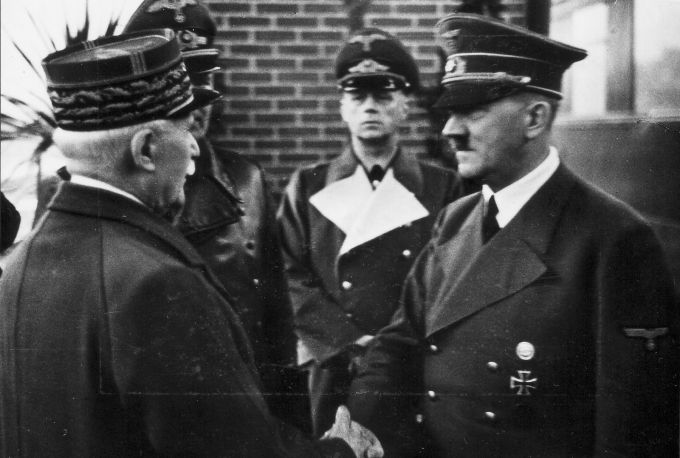
I’m currently reading a book about the 1945 treason trial of Marshall of France Phillippe Petain, who urged in 1940 that his country negotiate an armistice with Germany, and then led the so-called Vichy government in unoccupied France until the Allies liberated the country in 1944.
The book explores how the “hero” of the Battle of Verdun in 1916, and the Commander-in-Chief of all French armies when World War I ended in 1918 – and became a Marshall of France and a member of the French Academy as tokens of his country’s esteem – ended up in a Paris courtroom charged with betraying the very country that had honored him. Why should I care?
My interest in French history is an outgrowth of my spending from June 1961 to July 1962 in the French Atlantic-coast city of LaRochelle, courtesy of the United States Army. I am forever grateful to Uncle Sam for sending me there instead of Alaska, or South Korea, or Eritrea. It is now a World Heritage site, designated for its historic medieval harbor fortifications and charming central city. It was bypassed during World War II, as it had no strategic value, its port being too small for modern shipping.
As it happens, my time in France coincided with the return of Charles De Gaulle to power, the granting of independence to Algeria, and the revolt of officers in the French army stationed in Algeria who opposed it. Because of the unrest, I learned to my dismay that Paris was off limits to US service personnel (the ban was lifted by the end of the Summer, thank God). In addition to finally visiting Paris, I was able to spend time in Orleans, Potiers, and Saint-Nazaire; and eat a lot of really good food, and drink great (and still cheap) wine.
This spurred my interest in French history. Most of us are aware – or should be – that it’s unlikely that we would have prevailed in the Revolutionary War without French money, soldiers, and ships. We were France’s allies in World Wars I and II. And who can forget the American Colonel Stanton uttering the famous phrase “Lafayette we are here” when he arrived on French soil in 1917 with the American Expeditionary Force to help save France as they had once saved us.
A deeper study of French history gave me insight into the more ambivalent relationship they have had with the English. It was the French William the Conqueror who gave English King Harold one in the eye in 1066, starting a series of wars that ended only at Waterloo in 1815. Briefly, the English ruling class always thought they owned France too, so kept going across the English Channel to stake or re-stake their claim. Agincourt is only the best known of 750 years of intermittent wars.
It is against this historic background that back in the 1990s, my wife Jeanette and I were in Paris and decided to take the fast TVG train down to La Rochelle – a trip down memory lane if you will. We had a fine old time visiting my old haunts. One day, we were poking around a shopping arcade when we came upon an art gallery which, among other things, had a series of original watercolors of La Rochelle scenes. One caught our eye – it now hangs in my dining room – and we tried to get the attention of the salesperson, who was studiously ignoring us.
Finally, I was driven to say something like “pardonne moi, can you help us?” For a moment, he looked startled, then brightened and said “You’re American! I thought you were English.”
Typifying the attitude on the other side of the Channel, I recall watching a program on the construction of the Channel Tunnel, now usually known as the Chunnel, I have since gone though it on the Eurostar train from London to Brussels. While it was under construction, citizens on both sides of the Channel were asked their opinions about its potential worth. Most were more or less enthusiastic, except for an elderly Anglican vicar in a village near the entrance on the British side, who when asked whether he was glad to be able to get to France so quickly, responded “why would anyone want to go to France?”
But what of Marshall Petain? Any amusing lessons there? His country turned to him when France was on the verge of total defeat by Nazi Germany in June 1940. He was 84 and had always been a pessimist. He was on trial for treason in 1945 not only for negotiating an armistice with the enemy, but for collaborating with them. An example – the rounding up and deporting of France’s Jewish citizens, most of whom died at Auschwitz. He was convicted and sentenced to death. The sentence was commuted to life in solitary confinement. He lived on until 1951.
Many of his associates weren’t spared. The infamous Laval was shot, and others were shot and even guillotined for betting that Hitler would ultimately prevail. In this case, the joke was on them.
Copyright 2024, Patrick F. Cannon
 cannonnadedotcom
Petain may also have been the one who gave the French their unenviable reputation for cowardice, cheese-eating surrender monkeys. I don’t think it’s entirely deserved, but they have always had an outsized sense of gloire. And they always seem happy to remind others of it.
The country, though, has been blessed with rich, abundant farmland and a climate conducive to the cultivation of high quality produce. I’m not a huge fan of French cuisine — the preparations tend to be too complicated with too many ingredients for my tastes. There is also the suspicion that they learned how to cook from Caterina de’Medici’s cookbook. Francophiles deny it vigorously, but I know one thing. There are many many more Italian restaurants in France than there are French restaurants in Italy (if you can even find one).
Nonetheless, in France you can wander into just about any restaurant and expect a good meal, and maybe a surprise too. That was my experience, at least, on a visit to Chartes. I stopped for lunch at a little place in town with a handwritten menu out front. They had lamb chops, so I ordered them. As I heard them sizzling in the kitchen, my mouth watering, the owner brought me an amuse bouche: a small dish of trail mix!
Quirky, these French. One day they’re patriots, the next day, Nazi sympathizers.
LikeLiked by 1 person
I had many a cheap and good meal in La Rochelle. One place, a kind of working man’s cafe, served only one main dish every day. If you liked the look of it, you went in and paid the equivalent of about $3.00, including wine.
One day in Paris, stopped for lunch and had a sandwich and French fries. The owner claimed they were the best in Paris. He was Italian.
LikeLike
French fries are Italian? I thought they were Belgian!
I’ve wondered if Anthony Bourdain would have killed himself if he had been an Italian chef instead of French. (Depressed Italian chefs usually just get overweight). Unfortunately for Tony, he got mixed up with an Italian woman. Fatal mistake!
LikeLiked by 1 person