By Patrick F. Cannon
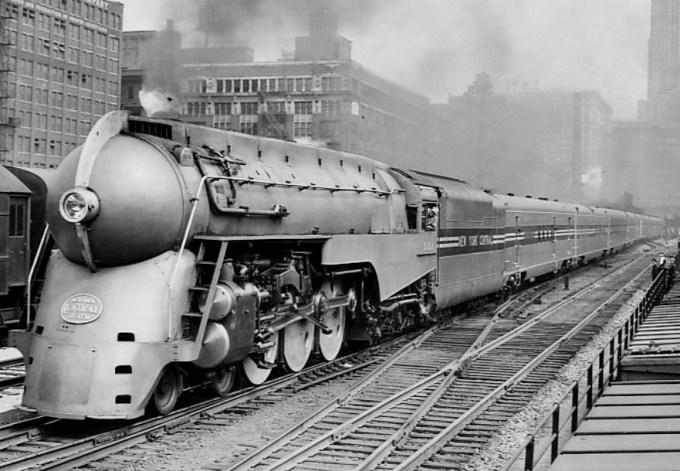
Amtrak’s Lake Shore Limited takes about 20 hours to get from Chicago to New York. It runs on mostly the same tracks as New York Central’s legendary 20th Century Limited, which made the run in about 15 hours in its heyday. I worked for the NYC at LaSalle Street Station from late 1956 until I was drafted in March of 1961.
My first job was in the mail room, and one of my tasks every day was to meet the 20th Century at about 8:30 am, climb aboard the one baggage car and get the company mail pouch, which twice a month held the paychecks for the Chicago office staff. Now how’s that for an important job!
As an employee, I wasn’t permitted to travel in the 20th Century. When I went to New York City to visit my brother, who was stationed in Long Island in the Air Force, I had a roomette on the next train down in the pecking order, the Commodore Vanderbilt, named for the company’s robber baron founder. It was also a sleeping car only train, just a bit less fancy. It took just an hour longer to get to Gotham. As a kid, I took a Pennsylvania Railroad train from Chicago to P:ittsburgh a couple of times to visit family. They were day trips in a coach, but in both cases, “nothing could be finer than dinner in the diner.”
When my children were small, we took the Santa Fe Railroad’s Super Chief to Los Angeles. This was still pre-Amtrak, and the service and food were first class. It took two full days, but we enjoyed every minute. But in the age of jet airplane travel – when flight times were cut in half – most people began to see train travel as yesterday’s technology. And it wasn’t helped when service on Amtrak proved to be shoddy and slow.
Although Amtrak does operate one high-speed train – the Acela service on the Northeast Corridor – most of its trains run on old tracks with numerous grade crossings (and with freight trains given priority!). I recently went to Pittsburg by car with my daughter and son-in-law. From Chicago, it’s about 475 miles. You can easily drive it in 7 hours. The flight time is less than two hours. Amtrak service to Pittsburgh takes about 9 hours, and you arrive in Pittsburgh at 4:00 am!
In a European or Japanese style high speed train, you could do it in three hours or less. My first experience in such a train was Japan’s Bullet Train from Kyoto to Tokyo. The top speed in those days – early 1980s – was 130 miles per hour. The ride was both smooth and quiet. Speeds up to 200 mph are now possible in Japan.
After attending a meeting in Paris in the late 1990s, my wife Jeanette and I took the TGV high speed train to La Rochelle, where I had been stationed in the Army. A trip that took most of the day in the early 1960s, now takes 2-1/2 hours! We had a similar experience in the Eurostar service that runs in the English Channel Tunnel from London to Brussels; and in a high-speed train that took us from Barcelona to Madrid. Flying these distances makes no sense. We saved the airport hassle, and in Brussels our hotel was within walking distance of the train station.
In addition to the existing Acela service on the East Coast, California is building a high-speed system that would connect San Diego with San Franciso and Sacramento. It would have speeds up to 200 mph, but the final cost will be stupendous, and it won’t be finished until 2033 (they hope!).
If you could just improve average speeds to 120 mph by improving existing tracks and signaling, you could get to Pittsburgh in four hours; St. Louis in less than three; the same to Detroit; and about 3-1/2 hours to Minneapolis. I should add that the seats on those high-speed trains were large, with ample leg room! You could even recline them without crushing the knees of the person behind you. And there was adequate room for all your luggage!
A few years ago, I took Amtrak from Chicago to St. Louis to pick up my car, which had been badly damaged during a trip to St. Louis for a wedding. As I recall, the train left Union Station at 7:30 and arrived in St. Louis at about noon. About five hours, what driving at the speed limit would have taken. Coincidentally, the local trolley that took me to the little Illinois town where the body shop was located was in the same transportation center. My cost for both? $35.00.
Of course, I could have flown. That would have meant getting to either Midway or O’Hare, going through security, sitting in a seat designed for jockeys, getting from the St. Louis airport to downtown – well, you get the idea. The lowest one-way fare I found today was $104.
Amtrak doesn’t have to whisk you to your destination at 200 mph – 120 with reliability would do just fine. It would make folks think twice before heading to the airport and experiencing all the hassle and agony that air travel always means. All aboard!
Copyright 2024, Patrick F. Cannon
 cannonnadedotcom
When I grew up in New York in the 1950s as a train-obsessed kid, my imagination feasted on the city’s multi-layered array of rail lines that crossed bridges, went under rivers through tunnels, ran beneath streets and on elevated platforms, covered all regions of the metropolis and extended out to far reaches of the country.
There were of course the great New York Central and Pennsylvania lines, which operated out of Grand Central and Penn stations respectively, but also the New Haven Line, which also ran from Grand Central and the Eire Lackawanna RR that left from the Hoboken Terminal in New Jersey, accessed from Manhattan via the lugubrious Hudson Tubes, tunnels that ran deep under the Hudson River.
Let’s not forget the Long Island RR, “Line of the Dashing Commuter,” or the various New Jersey commuter lines. I didn’t know much about the latter as a kid — New Jersey was somewhere in “the country” — but today they extend all the way to Pennsylvania. Crazy to think that people commute to Manhattan from that distance.
And then there was the NYC Subway system, a marvel in itself, with express and local trains running on a network of three separate lines, the BMT (Brooklyn-Manhattan Transit), IRT (Interboro) and the IND (Independent). They took you anywhere you wanted to go in the city. It was fun to ride the subways.
One Thanksgiving we took Amtrak from Chicago to Pittsburgh, the same overnight train you took. It left Union Station delayed, idled on a side track in Gary forever, and eventually got us to Pittsburgh’s cavernous and deserted station around five in the morning. A miserable, exhausting trip not to be repeated.
Europeans and other overseas visitors are mystified by the lack of prompt, reliable rail transportation in this country. The reasons are obvious: cars, extensive modern highways and plenty of relatively cheap gas. No need for tickets, rigid schedules, limited seating, fixed destinations or — as in Italy — labor strikes and slowdowns. Railroads are expensive to build and maintain. In Europe they are heavily subsidized by high taxes. Who wants that? Collectivist Europeans, evidently.
Still, it would be nice to take a high speed train to avoid the hassles of air travel. We’re flying to Rome in November and plan to make a side trip to Venice. We’ll take the high speed Italo line which covers the 330 mile distance in three hours and 45 minutes. It drops you off right in front of the traghetto stop on the Grand Canal. Cost varies between $40-130, depending on class of service.
Until 1979, Mayberry had rail service courtesy of the Monon Line and, later, the old Amtrak Floridian. No doubt, by the time you got to Florida you were ready for retirement.
The rail bed is now a bike trail.
LikeLiked by 1 person
Doing a European style high speed would be too expensive here, but improving existing tracks and signaling could improve speeds to 110-120 mph, adequate to make you think twice before flying to Pittsburgh. The Floridian now goes through Pittsburg and Washington on its lazy way to Tamp and Miami. Better bring a coffin if you take it now!
LikeLike
A shuttle to Heaven’s waiting room. Track improvements would reduce travel times. Then all you’d need is to find some passengers who weren’t on Social Security!
LikeLike