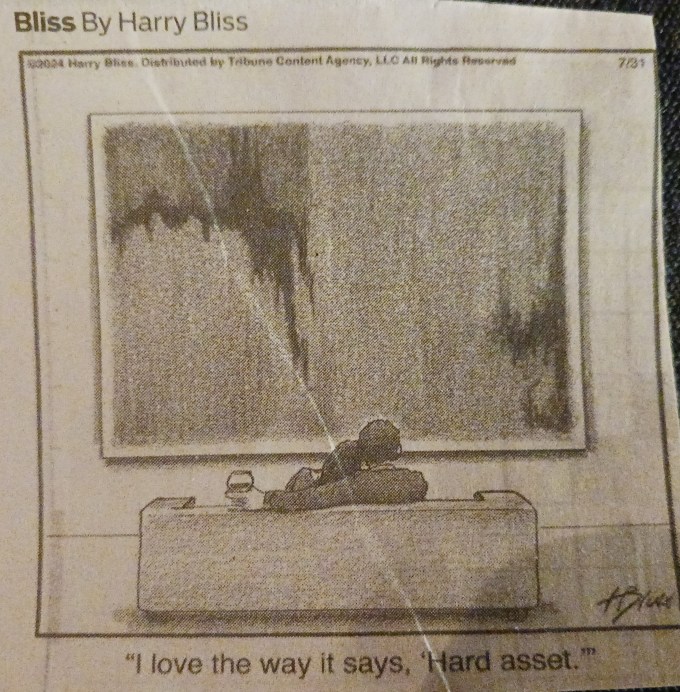
By Patrick F. Cannon
Early in the 20th Century, artists of all kinds were given to issuing manifestos that claimed they were breaking with the restrictive rules of the arts establishment by creating new and exciting art for the modern world. What they were doing – the Dadaists, Surrealists, Expressionists, Social Realists, etc. – were creating new rules. And so it goes.
Written manifestos have mostly gone out of fashion. But unwritten rules do not. One seems to be that art is created not for the enjoyment of the general, literate public, but for – in the case of the visual arts – for the critics and collectors. Realism, or “representative” art as its often called, is relegated to a lesser status. A painter of undoubted talent like Andrew Wyeth may be admired by the general public, but the giant balloon figures of Jeff Koons fetch the big bucks.
I lived in Oak Park, Illinois for more than 40 years, and still live next door. It is the birthplace of Ernest Hemingway and was the home of Frank Lloyd Wright for 20 years. Edgar Rice Burroughs was also a former resident, and many other notables have called Oak Park home. Yet, aside from one portrait bust of Wright in a local park, no statues of any of them grace Oak Park’s public spaces. Nor are any schools named for these most famous residents. It could be that their somewhat checkered pasts have disqualified them. Unlike Washington Irving, who died before Oak Park sprang into existence. New Rules.
Oak Park is, however, the home of a good deal of public sculpture; indeed, its downtown area is littered with it. While a few of them have some whimsical charm, most are bits of metal welded into abstract forms. Most people walk past without a glance, as if they were street lamps. Nowadays, the only sculpture representing real people seem to honor sports figures – in Chicago, Michael Jordon, Ernie Banks. Ryne Sanburg, and Bobby Hull are among those honored.
Abstract artists in general seem to be facing a dead end. What can they do that hasn’t already been done? Can they improve upon – or do something radically different – than Mondrian, De Kooning, Pollack, Kelly, or Rothko? Perhaps they can call upon A.I. to help them out? Abstract artists were and are not now usually willing to discuss the meaning of their work. You decide, they say. I remember listening to a psychiatrist on Charlie Rose’s PBS program (before Charlie got erased) who said he was so overcome with emotion looking at a Rothko color-field painting that he began to weep. He claimed it had nothing to do with Rothko having committed suicide, just the power of the painting itself.
On a recent “CBS Sunday Morning” I was reminded that Andy Warhol’s garishly colored photograph of Marilyn Monroe sold for $140 million at public auction. As it happens, I have a vintage hand-colored photograph of my brother Pete and me, which I guess was taken when he was three and me two. In those days, it was common for photo studios to take black and white photographs and hand color them. Of course, they charged extra for it, but I’m sure our parents thought it was worth the expense. Since I’m sure I could get an excellent copy made, I’d be willing to let the original go to auction. You just never know what it might bring. I’d settle for a mere $14 million.
Copyright 2025, Patrick F. Cannon (and with apologies to cartoonist Harry Bliss)
 cannonnadedotcom
A shrink who weeps before a Rothko painting (is that what they are?) has no business giving advice to other people. He needs help!
My father was a photographer who ran his own studio. He used to colorize portraits by hand as part of his business. We have several of these including the wedding photo of my grandparents. He could even add some hair to a picture if the subject was bald, no extra charge..
I used to think those abstract pieces of public art were part of a traveling exhibit that would pop up here and there. They all look the same. There are a few in Indy. One in particular must have been inspired by Sputnik. Whenever we pass it was say, “Take me to your leader!”
Public art can be whimsical. The Indy suburb of Carmel has, scattered about, some two dozen life-size Norman Rockwell-like sculptures by J. Seward Johnson, Jr. They are mostly of people going about their daily business as if they were residents of the town. There’s a couple standing in the rain:
A woman holding groceries, and an artist painting the street scene in front of him:
Critics may scorn such works as corny, not true art that explores the depths of experience. The sculptures nonetheless have a humanity. What they probably lack, unlike Duchamp’s urinal, is pretense.
LikeLike
If just they could realize it, the human condition is a never-ending subject.
LikeLike