By Patrick F. Cannon
Many years ago, I took a course in auto tune up. You learned how to change spark plugs and points and check the timing with a cool timing light. You could also change your own oil and filter, and a bunch of other stuff. Most cars needed a tune up about every 10- or 12,000 miles. Over time, as electronic, then computerized, systems took over, it became impossible to service your own vehicle.
I had a mechanic once who took new customers only when a current customer recommended and vouched for them. The last time I went there with my Chevvy station wagon, they told me they were closing. I was incredulous – losing a good mechanic was like losing a favorite barber! Why? I asked. They were all getting on in years, and they decided they didn’t want to invest in the computers they would need to service the new cars.
The other day I went for my emissions test. When they first started doing this, they would insert a probe into your exhaust pipe, which would sniff to see if you were emitting noxious gases. Now, they plug into your computer, which tells them immediately if your engine is naughty.
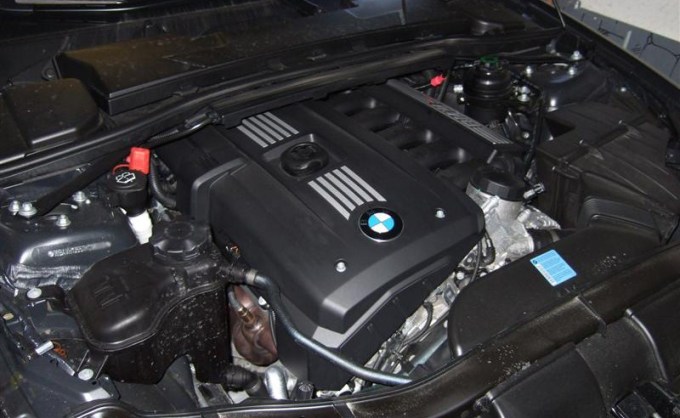
There was a time when you could open your car’s hood and see not only the engine, but all the stuff that went with it – battery, generator, distributer, spark plugs, starter, water pump, etc. In my 3-series BMW, the battery is in the trunk. There is no dip stick to check the oil; you now do it through the computer. When you open the hood, all you can see are the filler caps for the windshield washer and cooling system tanks. The engine is hidden beneath a plastic cover that informs you you’re driving a BMW.
You may not realize it, but all this engine bay covering and general complexity adds to the cost of service. Simply getting to components takes time. The mechanics must move and/or remove stuff just to get to what they need to fix or replace. They charge – in Illinois – about $130 an hour to work on your car, and the clock is ticking while they try to uncover the defective widget.
As it happens, I have an exceptionally fine mechanic, Pete. A week ago, after discovering on a day when the temperature reached 80 that my air wasn’t working, I brought it in. The refrigerant was gone. Pete and his guys tried to locate a leak but couldn’t find one during an inspection of the components they could see, probably because all the refrigerant was already gone. They put new refrigerant in, so the air is working again.
But Pete wants to find the leak if any, so I’m going to bring the car back in three or four weeks, whereupon it will be put on the lift and inspected with infra-red lights and special goggles. In some areas, they’ll have to use a special probe to get at otherwise hidden components. If there’s a leak, they should be able to find and fix it. At $130 an hour, plus parts.
Look, cars are better now. They last longer, they’re safer, they even talk to you if you get lonely. But all that comes with a cost. All an owner can do now is maybe change the oil, if they can find the filter that is.
I had a Volvo wagon back in the early 1970s. It was orange and had a brawny four-cylinder engine. Everything in the engine bay was clearly visible. It had dual SU carburetors. These were ubiquitous in British cars of the period, and Volvo also used them for a time. I loved them. If the engine started running a bit roughly, I could get a regular screw driver and easily adjust them until the engine smoothed out. Now, cars have fuel injectors. They work better, but good luck fixing them (or even finding them!).
Copyright 2025, Patrick F. Cannon
 cannonnadedotcom
Pat, your trip down Memory Lane brought back fond recollections, and a reminder of time’s passage.
I used to do my own tuneups, oil changes, valve adjustments, and tire rotations. I even replaced a leaking radiator and heater core. Now you’re lucky if you can replace the windshield wipers. I wonder what became of my timing light and dwell meter?
Even on my 20 year old WRX half the engine has to be dismantled to access and change the spark plugs. Luckily the job only needs to be done every 60,000 miles.
BMW makes it deplorable to do even consider self-maintenance. Their cars are excellent but notoriously expensive to repair. They are not in Ferrari territory but certainly aspire to it.
If you own an EV, DIY car repair isn’t even in the vocabulary.
A late, former professor colleague of mine recalled the days when one had to crank-start automobiles. He theorized that the invention of the self-starter was prompted by consumer demand of women motorists.
Perhaps the same is true for the demise of the manual transmission. Some studies say about a third of women can drive a stick, but that seems high even for the general population.
Joining the disappearance of stick shifts and manual cranks (starters and windows now) are the once-indispensable item of motoring: paper maps.
I still use them, or at least their Google equivalents. Maybe it’s a sense of direction, but if I know where a place is, I can find it, often even without a map. This ability may have something to do with my learning how to drive in Pittsburgh.
As you know, Pittsburgh roadways pass through a maze of tunnels and bridges, steep hills and deep ravines. The place is as vertical as it is horizontal. Trying simply to go around the block if you miss a turn may end you up on the other side of the Monongahela. What looks like an intersection on a map can often be two unconnected roads, one down in a valley, the other suspended high above. You need to know where you’re going.
A popular solution to getting lost is GPS navigation. I find it an annoyance and a distraction. Maybe it’s the patient, condescending voice of the bot, as if it were explaining the alphabet to toddlers. It takes the fun of discovery out of driving.
I suspect that like automatic transmissions, power steering and brakes, air bags and the infernal array of buzzes and beeps that warn you of potential safety hazards, the GPS has become a regular feature on cars as part of the general feminization of American consumer culture, if the old professor was right.
This trend has also driven technological advancements, made life healthier, cleaner and more comfortable, and generally improved the standard of living. We should take pride in our consumer-driven society. Even if it costs $380, what I recently paid, to change spark plugs. Good thing I no longer drive a V-8!
LikeLiked by 1 person
My son bought the last VW GCI with standard trans. I think a third of women driving standard is an exaggeration. I doubt if a third of men can these days. I drive in Pittsburgh most years, and it’s not for the faint of heart. I usually go through the Squirrel Hill tunnel. It has a sign that says “maintain speed.” Of course, everyone slows down. What they should do is post a sign that says “Slow Down.” That would speed things up. I sonder what it costs to change plugs on a V-12 Ferrari!
LikeLike