By Patrick F. Cannon
Denzell Washington is appearing in the title role in Shakespeare’s Othello on Broadway. Jake Gyllenhaal plays Iago, perhaps the more interesting character. This star power has resulted in ticket prices approaching $1,000! Washington may be our greatest actor, but I think I’ll wait for the movie!
It has been generally assumed that Othello was black, although he is described as a “Moor,” which traditionally meant an Arab from North Africa. They ruled Spain for many hundreds of years, and were not black as we would now describe it. Nevertheless, the part has been played notably and successfully by such African Americans as Paul Robeson, James Earl Jones and now, Denzell Washinton.
I have seen Othello live only once, at the Chicago Shakespeare Theatre with Chicago actor James Vincent Meridith in the title role. He is also African American. On the other hand, many white actors have played the role. Interestingly, the British actor, Ronald Coleman, played an actor playing Othello in the film, A Double Life. In it, life imitates art when Coleman thinks his wife – and costar – is having an affair and actually kills her in the famous final scene. It’s a black and white film, but Coleman simply slightly darkened his skin. He won the best actor Academy Award.
The great Lawrence Olivier unfortunately went further in his film of the play. Perhaps no one was willing to confront the great man, but they should have pointed out to him that doing the role in the same kind of black face that white performers used to don for minstrel shows might not strike the right note! While Olivier gives an impressive performance, it’s nearly ruined by his makeup choice.
By now, it’s common for black actors to play roles that used to be reserved for whites. Just the other night I watched a movie where black and white siblings had the same white parents! While we have become used to this kind of casting, it doesn’t always work in reverse. Even with makeup, Tom Hanks would never be asked to play the role played by Denzell Washington in the film version of August Wilson’s Fences.
In Shakespeare’s time, women weren’t permitted on stage, so female roles were often played by young men. These days, male actors have been known to play women (think Tootsie and Some Like it Hot), and Glenda Jackson famously played the title character in King Lear. In general, actors should be able to play any role. They are, by definition, acting. Despite what activists might contend, you don’t have to be blind to play a blind person. Our old friend Ronald Coleman also played an artist who lost his sight in the 1939 film of Rudyard Kipling’s novel, The Light that Failed.
I saw a clip from the new Othello, which is “modernized” by having the characters dress in contemporary military uniforms, although Shakespeare set it originally in the late 16th Century. I’m never quite sure why this is done. To make the play seem more relevant to our times? Frankly, you don’t make Shakespeare’s themes more universal by putting the actors in modern clothing.
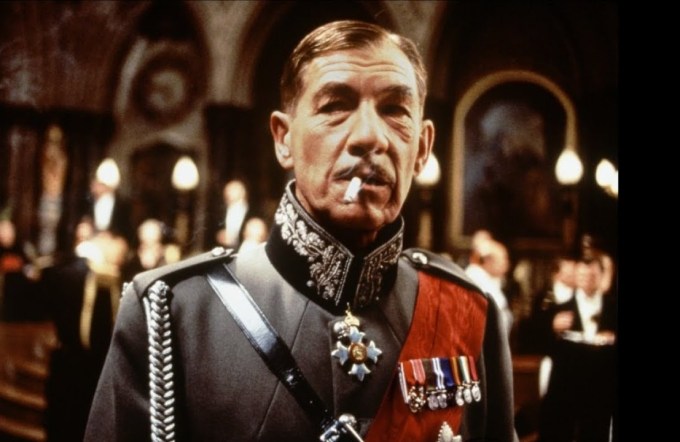
Another example of this is the 1995 film version of Shakespeare’s Richard III, with Ian McKellen in the title role. Here, Richard and his minions are dressed in Nazi-like uniforms. Trying to equate the dynastic wars in 15th Century Britain with Fascism in 20th Century Europe is a real stretch. And while I greatly admire McKellen as an actor, what’s with the mustache?
I can recommend Olivier’s 1955 film version of Richard III. In the climactic battle scene, Richard doesn’t say “A tank, a tank, my kingdom for a tank!” He would happily have settled for a horse.
Copyright 2025, Patrick F. Cannon


There’s certainly fun to be gained by switching traditional ethnic and gender identities in theatre, even though, as we’ve learned over the past several decades of righteous indignation over perceived identities, there’s nothing funny about race and gender anymore.
The Moors (from the Latin Maurus, someone from Mauritania or the ancient Maghreb, basically present-day Morocco) may be an exception as hardly anyone knows who they are or where they come from. George Costanza, in the bubble boy episode of Seinfeld, argued they were properly called the Moops.
There is also a small, fascinating movement of black Americans who claim to be Moorish sovereign citizens who oppose the US government and base, in part, their legitimacy on early depictions of native Americans as African blacks.
There obviously were contacts between the African and American continents prior to the founding of the Republic, as there were between African and Arab populations. So an African Othello is not far-fetched. Theatrical anachronisms, however, are seldom convincing for me.
We recently discovered in the suburbs of Indianapolis a restaurant that serves genuine Neapolitan pizza, the kind you’ll find at Forno Rosso and Spaccanapoli in Chicago. What drew us to the place, however, was its curious name, I Tre Mori, The Three Moors. At first we thought it might have a connection to Venice, but it turns out that the place is run by three Arabs who came to the US via Italy. Who knew Moors could be cast as pizza makers?
Many years ago, during one of our explorations of Illinois, we stopped for lunch at a restaurant called Tipps, I believe, in Savanna along the Mississippi River. To our surprise, they served an Italian menu, and not only that, the various dishes were spelled correctly, even “Lasagne all’uso bolognese.” I asked the waiter if the chef was Italian. “No,” he said, “he’s an American Indian.”
LikeLiked by 1 person
Got to love those Italian chefs! Most now come from Mexico or Central America.
LikeLike