By Patrick F. Cannon
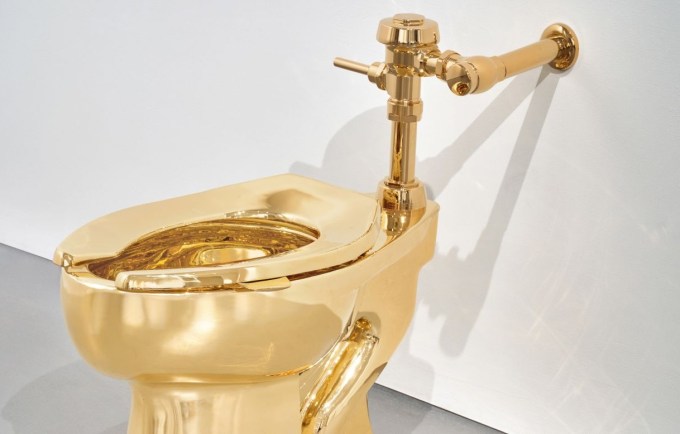
Italian artist Maurizio Cattelan – he of the $6.2 million banana sold at auction last year – is back in the news. Sotheby’s auction house in New York has announced that his solid gold toilet titled “America” will go on the block on November 18 with a starting price of $10 million, which happens to be the current scrap value for the 223 pounds of gold it contains.
Originally created in 2016, it was one of two. The other had been installed in Great Britains Blenheim Palace, ancestral home of the Dukes of Marlborough and birthplace of Winston Churhill. My visit to the palace predated its installation, so I couldn’t do the golden go. In 2019, thieves pried it from the wall, and although caught, it was not in time to prevent the fixture from being melted down and sold.
Prior to adorning a loo at Blenheim, the toilet had been at the Guggenheim Museum in Manhattan. It’s been reported that the museum offered it to President Trump during his first term after he requested a Van Gogh painting for the White House. Knowing his love of gold stuff, it must have seemed a reasonable tradeoff, but it seems not to have worked out.
The toilet is in the great tradition of everyday objects being promoted as works of art. That renowned artist/humorist/charlatan Marcel Duchamp started the ball rolling by exhibiting a urinal as a work of art. Not a urinal he had himself sculpted, but an off-the-shelf item (or one he swiped from a public loo. I can’t remember which). That was about 100 years ago, but the trend obviously has legs.
I first made note of this new avenue for budding artists in the early days of this series in 2016. For you newer readers, and those whose memory is something like mine, I reprint it here in part:
“Is it a Caddy, Daddy?
There was great jubilation at the University of Chicago recently when a work of art that many had feared might have been lost forever was returned to its rightful place on the University’s Hyde Park campus.
Titled “Concrete Traffic,” it was by the well-known German modernist Wolf Vostell (1932-1998). Vostell was a leader in the early days of video art and in organizing the “happenings” that were such a feature of the art world in the 1960s and 1970s. In this case, he took a 1957 Cadillac Coupe Deville and encased it in concrete. Commissioned by the fledgling Museum of Contemporary Art in Chicago (now celebrating its 50th anniversary), it was finished in 1970 and parked in a nearby parking lot. It was there for some time and apparently accumulated numerous parking tickets. Who paid the tickets seems lost to history. As for me, I wondered how they were attached, since there were no windshield wipers. Perhaps the cops taped them on the concrete, artfully one hopes.
Anyway, the sculpture was eventually donated to the University of Chicago, where it graced the campus until moved into storage to make way for the construction of the Logan Center for the Arts. In storage it may have remained – slowly crumbling away – were it not for art historian Christine Mehring. She heard about it and arranged a visit. What she found appalled her. Here was this splendid work of 20th Century art molding away from public view. Hunks of concrete were actually missing, as if it were merely a public sidewalk or something!
It was a challenge, and one that Professor Mehring has heroically met. At a cost of some $500,000, “Concrete Traffic” has been restored and proudly placed in a stall of honor at the University’s main parking garage. You may wonder how it could have possibly cost that much to do a bit of concrete patching. Instead of going to Craig’s List for a local concrete guy, they sought out the experts who had restored the concrete at Frank Lloyd Wright’s Guggenheim Museum in Manhattan. While the niceties might be lost to the layman, there is a significant difference between a concrete conservator and a concrete repairer. The former usually has a beard and charges more. I should mention that the only visible parts of the Caddy are its white wall tires. As you might expect, expert opinion was also sought on the proper tire pressure.
The result, according to Mehring, is a work from an “important transitional period from the happenings in the 1960s to the monumental sculptures and environments of the 1970s.” Since Herr Vostell is no longer with us, his intended meaning is lost to us. Most people think it was an ironic comment on the wasteful consumer culture of America, typified by the land yachts that floated over the (concrete) superhighways that connected our car-mad cities, towns, villages, and hamlets.
Europeans in the 1960s, burdened as they were by astronomical gas taxes, tended to drive around in cars like the VW Beetle and the iconic French classic, the Renault 2CV, which, I recall, had a suspension that consisted of husky rubber bands and tore down French roads at a breathtaking 50 miles per hour.
Alas, there aren’t too many Caddy convertibles of that vintage to be seen here anymore. Those that survive are cherished; many are housed in museums. But, thanks to Professor Mehring and her colleagues, you can at least sense the existence of a 1957 Coupe Deville beneath the concrete at the University’s parking garage at 55th and Ellis. If you want to park near it, it will cost you four bucks an hour. But walk-ins are always free. At the cost of a little shoe leather, you can relive the ironic “happenings” of a bygone era. And wonder, as I have, how they’re going to change the tires when they inevitably collapse under the 34,000-pound weight of German irony.”
So, the gold toilet is just the latest in a lengthy line of everyday objects posing as works of art. Given his lust for gold, I find it hard to believe President Trump passed it up back in long ago 2019. I see a new opportunity now though. Since he’s remodeling the bathroom in the White House Lincoln bedroom suite, maybe one of the president’s unselfish donors can spring for the toilet. Just imagine the thrill of flushing a golden toilet!
Copyright 2025, Patrick F. Cannon


I understand Frank Lloyd Wright had a brother who was a cement contractor, Hank Floyd Wright. It seems he was largely responsible for the many stucco box houses that adorn Oak Park, including the one we lived in. Little did he realize the fame he could have achieved, with but a little attitude and whimsy.
Now it’s too bad Trump turned down the gold toilet offer — a sign of his poor taste in art — even if it was just a loan of that magnificent piece of Cattelan naughtiness. The thing graced the Guggenheim! Tsk, tsk. Such babbittry. A true connoisseur with a refined artistic soul would have grasped its marvelous genius — and immediately decorated the White House with duct-taped bananas, Jeff Koons balloon dogs and the like to epater le bourgeois and troll sophisticated liberal elites till their bottoms were sore. Oh-la-la.
A missed opportunity!
LikeLiked by 1 person
I wonder if gold toilet seats are cold? Maybe that’s why he turned it down!
LikeLike
He wanted a Van Gogh.
LikeLike
Of course he did. Sunflowers no doubt. I actually think they should have loaned it to the White House for a defined period. Why not?
LikeLike