By Patrick F. Cannon
You must be wondering, since I make so much fun of “found object” art, if there’s any stuff I like. Quite a lot as it happens. A common thread that runs through it is this: It can’t be easy to accomplish, and the artist must participate in its creation.
One of the reasons I don’t value Andy Warhol highly is that most of his stuff is just the manipulation of other’s work. The anonymous designer of the Campbell’s soup cans labored in obscurity, yet Warhol copied it on a canvas and became famous. His even more famous paintings and silk screens of Marilyn Monroe are based on a publicity still taken by Gene Korman to publicize the 20th Century Fox 1953 film, Niagara. He neither paid Korman for nor even sought permission for its use. Nor did he ask Campbells.
Andy called his studio the “factory,” and those that labored there did much of the actual work. Jeff Koons is another artist who creates art on an assembly line basis and happily admits that he’s the idea man. “Create giant metal ballon animals,” he decrees, and the factory springs into action. Or “give me a giant puppy covered with flowers,” and one duly comes to life outside Frank Gehry’s Guggenheim Museum in Bilbao, Spain.
Defenders of Warhol and Koons often point out that many of the “old masters” had assistants who did some of the work. If you look at the immense production of Peter Paul Rubens, you know he must have had others do canvas preparation and other background work. But no one doubts that he did the major figures in his voluminous works.
If someone asks me who my favorite artist is, I will have to say I don’t have only one. Among those I most admire are Rembrandt, Michelangelo, Titian, Monet, Caravaggio, El Greco, Rodin, and Valazquez. I also have a grudging admiration for Picasso, particularly his work before World War II. I have been fortunate to see many of their works in museums. Seeing a photo of Michelangelo’s David is a poor substitute for seeing the towering original in Florence. Rembbrandt’s The Night Watch at Amsterdam’s Rijksmuseum is approximately 14×12 feet; and Valazquez’s famous Las Meninas at the Prado in Madrid is 10.5×9 feet. Neither can be given full justice on a 12×9-inch page.
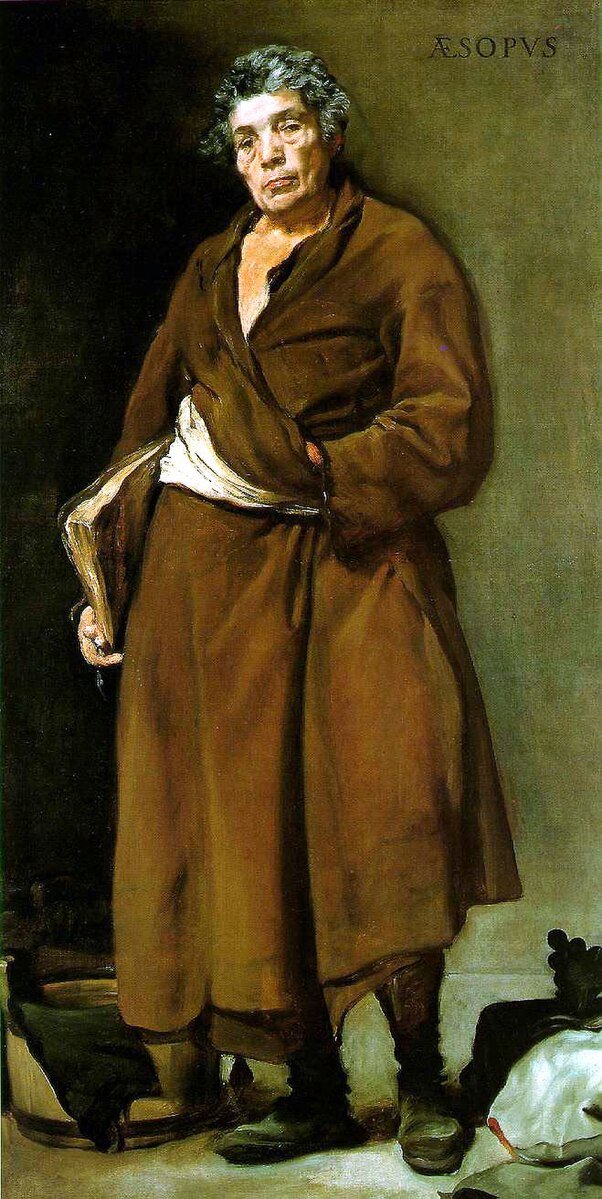
One of my favorite Valazquez paintings is somewhat smaller, his 1640 Aesop, pictured here. I’ve seen it twice, the first time at the Art Institute of Chicago, where it was on loan and exhibited next to Edouard Manet’s 1859 The Absinthe Drinker, which was clearly influenced by Valazquez’s work. Both figures are life size. I saw Aesop again at its usual home, the Prado.
As you can see, Aesop is holding a book of his famous fables. The model is said to have been a beggar that the artist saw many times on the streets. Whoever it was, a lifetime of pain and experience are written on that face. While there may be pain within a color-field abstraction by Mark Rothko, it can only be in the eye of the beholder. Years ago, I heard a physiatrist claim that looking at a Rothko painting had reduced him to tears. He claimed that it had nothing to do with his knowledge of the artist’s suicide. I didn’t believe him.
I don’t suggest that Rothko lacked skill or didn’t work hard. If you look at his paintings, you can see the skill and rigor it took to create his effects. As with so many purely abstract paintings, I’m just not convinced it was worth the effort.
Copyright 2025, Patrick F. Cannon
 cannonnadedotcom
A physician buddy of mine lives outside of town and has a pickup truck. A few times a year we drive to the remote hills and hollows beyond Mayberry to get firewood. One of the people he knows out there cuts stacks of seasoned hardwood that he sells, but also — in keeping with the theme here — has an intriguing concept for an art installation outside his cabin. I call it “Madonna of the Hubcaps”:
I could see this being dismantled and reconstructed in a gallery. Found objects in new contexts. Art fanciers could stroke their chins and study it, ponder the divine presence even in mundane things, the enigmatic contrast between nature and machine, the passing of time, as symbolized by fallen leaves, and the persistence of the infinite.
Of course, I’m not being entirely serious. Modern art criteria would typically expect a greater degree of abstraction and invention: use of exotic materials, shapes, colors and proportions to make the composition more striking and less real. The trick is to make the object in some way memorable, like a catchy commercial jingle. And of course, have some abstract intellectual concept to support it all.
Warhol’s sterile and super superficial silk screens of popular images are dead ends. And as you say, these types of creativity are just too facile. even when kernels of talent and skill are apparent. They simply do not compare to what artists like Velasquez achieved. His portrait of Pope Innocent X, for example, which hangs in Rome’s Palazzo Doria Pamphilj, hits the viewer with striking veracity.
The story goes when the pope saw the somewhat unflattering portrait, he could only say, “Too true, too true.”
They don’t make popes like they used to (thank heavens!). But Weep over a Rothko painting? It’s hard to imagine wanting to see one again.
LikeLike
Warhol as chancer. Too true, too true. Innocent as not too innocent. Too truue, too true!
LikeLike