By Patrick F. Cannon
Many of my readers live in the Chicago suburb of Oak Park. There are few communities with a modest population of about 53,000 that host so many international visitors. It is not only the birthplace of Nobel Prize writer Ernest Hemingway, but the home and workplace of America’s most famous architect, Frank Lloyd Wright, for the first 20 years of his storied career. A litany of other famous Oak Parkers would take up too much space, but it does include Tarzan’s creator, Edgar Rice Burroughs!
It is also famous for resisting the “white flight” that changed many Chicago neighborhoods from all white to mostly black in the 1960s, including Oak Park’s neighbor to the east, Austin. I won’t go into all the details of how sensible integration came to Oak Park, except to mention that the real estate agents agreed not to put “For Sale” signs on their client’s properties, as one tactic to prevent panic selling. They still don’t. Currently, the racial breakdown is (approximately) 63 percent white; 20 percent black; five percent Asian, and 10 percent Hispanic.
I love the place. Even though I now live a block west of Oak Park in Forest Park, I still spend a lot of time there. I belong to one of its clubs, donate to its museums, and volunteer weekly at Frank Lloyd Wright’s Home and Studio. My favorite restaurants are in Oak Park, and I still use its fine library.
I lived in Oak Park from 1965-67 and returned with my family in 1974. I only left in 2016 when my wife and I couldn’t find a condominium that suited our needs. That’s about 45 years. But as much as I love Oak Park, I am aware that it shares with Illinois what I would describe as too much government.
Illinois, with a population of 12.7 million, has 6,930 units of government. New York, with a population of 20 million, has 3,450. With some of the highest real estate taxes in the Chicago area, Oak Parkers pay for the following taxing bodies: Village, Township, Oak Park Elementary School District 97, Oak Park and River Forest High School District 200, Oak Park Library, Park District, and eight other taxing bodies related to Cook County.
In a rational world, the 1,430 townships in Illinois would be abolished, and the 852 school districts reduced by consolidation. The schools in Oak Park and River Forest are now served by three districts, where one could easily do the job. And the Village of Oak Park should take a serious look at the staff it actually needs to serve its community.
Although of course much smaller in population, the Village of Forest Park has the following departments: Administration, Clerk, Community Center, Fire, Police, Health, and Public Works. Like Oak Park, it also has separate Library and Park Districts. But Oak Park has these additional departments: Development Services; Finance; Human Resources; Parking; Neighborhood Services; Adjudication; Communications and Engagement; Diversity, Equity, and Inclusion; Sustainability and Resilience; and Office of Economic Vitality. It also has more than 20 citizen boards and committees.
Oak Park likes to style itself as a “progressive” community. It once even went as far as to declare itself a “Nuclear Free Zone.” For most of its history, it was a bastion of conservative values. In 1940, for example, it gave 80 percent of its vote to Wendall Wilkie over Franklin Roosevelt. In 2024, it gave Donald Trump just 10 percent. That’s fine with me; I didn’t vote for him either. But like so many communities, Oak Park needs to concentrate on the services and infrastructure its citizens actually require.
Despite its simpler government, I find no lack of essential services in Forest Park. In addition to lower real estate taxes, I can get a village auto sticker for $35 instead of Oak Park’s $74. Yearly garbage costs for an average home are about $250; in Oak Park they’re $400. I could go on and on but let me finish with a true outrage. Until last year, Oak Park swept up the leaves homeowners raked into the gutter in the Fall and hauled them away. Now, owners are required to bag the leaves and place them in the parkway for pickup. The bags themselves cost about a buck, but each must have a sticker at $3.25 a pop. Both Forest Park and River Forest still sweep up the leaves.
Here’s the thing. There were five mature trees in the parkway in front of my last Oak Park home. The trees were all planted by the Village; the homeowner has no say in what happens to them. In essence, they belong to the Village. Yet, Oak Park homeowners are now required to pay for the privilege of raking up the Village’s leaves. On the other hand, they don’t have to worry about locally produced nuclear fallout.
Copyright 2026, Patrick F. Cannon


We moved to Oak Park in 1978 from West Rodgers Park. I had taken a job in Oak Brook while Jill was working in Chicago. Since we had one car, we needed a place near the Eisenhower that was also accessible to the CTA. Oak Park fit the puzzle perfectly.
At the time, Oak Park was mocked by Chicagoans as a dull, regressive, bourgeois backwater, a place of broad lawns and narrow minds.
True, alcohol sales were banned, there were probably more churches per capita than in Rome, Italy, and the Women’s Temperance Union fountain at Lake and Oak Park Avenue still worked.
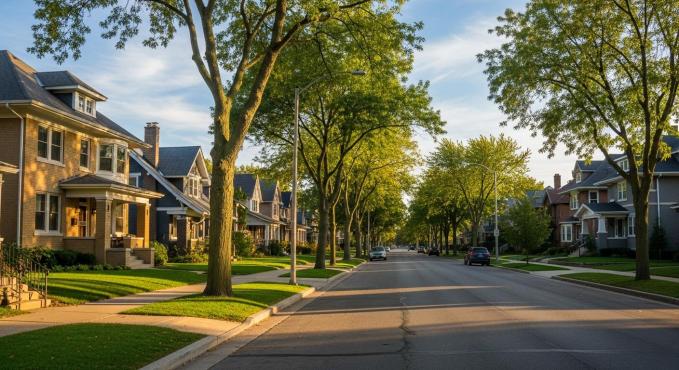
However, we discovered that the lawns weren’t so wide (house lots were compact), and the education levels were higher than advertised. Large, leafy trees lined the neighborhoods, the architecture was impressive and you could reach the Loop in a mere eight minutes, or so they claimed.
And unlike Chicago and most surrounding suburbs, it was integrated. A rare thing in 1978.
We enjoyed living there. Julia’s school was around the corner (no busing for her) and you could walk to shopping. Services were good.
Then Oak Park, proud of its gifts, went progressive.
The old French adage says, the more things change, the more they remain the same.
Not so!
The more things improve, the worse they become.
Take the mess we’re in with rapidly advancing technology.
It’s taken the fun out of driving a car.
Your doctor is now a robot.
And can you be sure your AI girlfriend isn’t lying when she says she loves you?
Progressives can be very nice people but they are fundamentally unhappy. Little imperfections bother them. They see problems everywhere and with determination want to fix them. And the way they do that is through government, if they are not taking to the streets in moderately peaceful protest.
Despite their many virtues, progressives, even if they don’t realize it, are socialists.
Socialism (and its ugly sister communism) is nothing other than big, bureaucratic government, a leviathan with redundant agencies comprising multiple divisions and departments administered by managers, associates, assistants, coordinators, advisors, attorneys and so on to develop, administer and enforce policies and complex regulations.
Socialism is expensive. There are a lot of people to be hired (even more if unions and political patronage are involved) and paid “competitive” salaries. So there must be taxes. Lots of taxes. And fees, like the stickers on compostable leaf bags.
By the time I retired in 2007, the property tax on our modest 1600 sq.ft. stucco box was $1000. Monthly. And steadily increasing.
So five years later, in 2012, we decided to escape to Mayberry, Indiana, aka the promised land. There we purchased a nicer, larger home for much less money. By then, the annual property tax difference was a stunning $12,000 ($15,000 vs. $3000). So instead of paying that monthly $1000 to Cook County, we now had it to spend as we damn well pleased.
Mayberry is a university town and of course progressive (What is it with these highly educated types?). But it’s surrounded by practical, frugal Hoosiers who doggedly keep things in check.
The year after we moved, the state of Indiana ended up with a budget surplus. What did they do? They gave the money back to the taxpayers. In cash.
We got a check in the mail! And about three years ago, they did it again!
Lowly Mayberry isn’t a nuclear free zone but it has good schools, lots of trees, libraries, city services and prompt garbage collection. They don’t pick up the leaves anymore (thank you, progressives!), there is an unending lament about affordability, climate change and homelessness, and they keep looking for ways to reduce automobile use and calm traffic, such as it is.
So in many ways, Mayberry is a lot like Oak Park, only much less expensive.
But it has one thing Oak Park lacks and will never have.
A national football championship.
Hoo-hoo-hoo, Hoosiers!
LikeLiked by 1 person
Congrats to those Hoosiers! Thank God Northwestern didn’t have to face them in 2025.
LikeLike
The Wildcats are a spunky bunch but I stopped rooting for them after they fired Pat Fitzgerald.
LikeLiked by 1 person
Pat got his revenge, An apology and lots of dough. Now he gets further revenge on the gridiron.
LikeLike