By Patrick F. Cannon
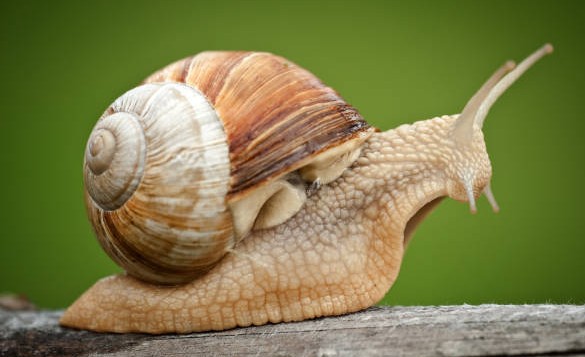
I had dinner the other night with a good friend at a fine French-themed bistro. As a starter, we shared an order of escargot. As my highly sophisticated readers will know, “escargot” is the French word for edible land snails, usually prepared with a garlic butter and parsley sauce. After you eat the snail, dipping your baguette into the sauce adds to the culinary experience.
“Baguette” is the word for the ubiquitous long, skinny loaf of bread the French can’t live without. The typical bistro will also serve something called “steak frites,” which turns out to be small steak with French fries. Most of the menu includes common stuff elevated with French names. I wonder how many people would order “snails in garlic butter sauce,” or “small steak with fries?” What if the menu offered “skinny loaf of bread” instead of “baguette?” How popular would that be?
Anyway, the menu was replete with French names for stuff that could just as easily be described in English. I’m not sure I would like that. Somehow, pate de foie gras sounds better than chopped goose livers; and you can’t deny that moules mariniere has a cachet that mussels steamed in wine with butter, shallots and (again) parsley lacks. As it happens, mussels are on a lengthy list of things I would never have thought of as edible in my youth.
I’ve written about the “meat and potatoes” foundation of my mother’s cooking. The only exotic dish on her regular menu was kidney stew, the recipe for which I have provided in the past. I was also a fan of chicken gizzards. In those days, chickens were purchased at a poultry store, and you got the whole thing, innards and all. As I recall, the liver was reserved for my father. Only the heart had no takers.
My father was born on an island off the west coast of Ireland, Innis Buffin (Isle of the White Cows in English). Now primarily a tourist destination, when my father was born in 1906 the only gainful employment was fishing and raising sheep. As a result, he liked fish. I didn’t because my mother overcooked it, just like she overcooked everything else. He also ate oysters, mainly in something called oyster stew. As I recall, to make it you heated milk and butter and dropped the oysters in when the milk was hot enough. We were not forced to eat what looked to us like boogers floating in wasted milk.
I owe my much-expanded palate to France. The United States Army sent me there in 1961 to a charming city of the Atlantic coast called La Rochelle. Because much of the medieval port survives, and it’s full of charm, it is now a UNESCO World Heritage Site. The restaurants naturally featured seafood. I was taken in hand by two fellow soldiers who had been there for a year or so, happily avoiding Army food by dining on the local seafood specialties. Not wishing to seem unsophisticated, I bravely ate oysters, clams, and mussels for the first time. Oh, and those snails. And I still eat them, although they cost much more now than those days when France was still far less expensive than the US of A.
Of course, I know quite a few sophisticated folks who still will not eat oysters, unable to get past the way they look. Escargot likewise. That’s OK. We live in a world of abundance and people don’t have to eat everything on the menu. But I do think you might try some kidneys.
Copyright 2026, Patrick F. Cannon
P.S. I have decided not to write about Donald Trump for the time being. Most of the people who read these pieces don’t like him any more than I do, so it’s like preaching to the choir. Those who do support him – a steady 40 percent of the voters it seems – have their reasons which now appear unshakable, no matter what he does or says; or more to the point, what I say. Anyway, if I ever write about Donald Trump again, I hope I’ll end with these words: I told you so.
 cannonnadedotcom
“Common stuff elevated with French names” is about as good a definition of French “cuisine” as I can think of. The only thing I would add is, “with prices to match.”
I don’t care much for snails (Italians also eat them), “fwa-gwa,” or that greasy stew they call “cassoulet” that sits on your stomach like a dead horse. But as the saying goes, de gustibus non disputandem est.
France is blessed with rich, fertile farmland (in contrast to Italy, which mostly has granite) and the produce is of very high quality, especially dairy products like cheese and butter.
It’s difficult to have a bad meal in France, even if it’s a simple one like grilled steak with fried potatoes, roast chicken, salad, beans or soup, all mainstays of the French table.
From my limited experience, I find that French food, at least for my tastes, improves as one goes south, specifically into Provence.
Whereas in the north you find things like lobster and mussels, in the south you get seafood preparations like bouillabaisse (“boil at a simmer”) redolent with herbs, fragrant olive oil and spices like saffron and fennel.
It’s a kissing cousin of the Genovese ciuppin (or cioppino as it’s known in San Francisco).
The dish has humble origins as a soupy stew of various rock fish that had little economic value but were a shame to waste.
It was also a way for poor people to use stale bread by soaking it in the broth and adding substance to the dish. The French call this bread “croutons,” a fancy word for crusts.
Would you say the French have lots of crust?
********************************************
P.S. Good that you’ve decided to suspend the Trump bashing, but curing TDS normally requires more than going cold turkey. It’s a multi-step process than involves stop reading the New York Times, Washington Post (as it continues to lose readership) and other DNC propaganda outlets; turning off PBS, CNN, NBC, ABC and MSNBC (or whatever it’s called now) news shows; cancelling subscriptions to Mother Jones, The Nation, Slate, Vox, The Guardian, ProPublica, Politico and the New Yorker; and finally, comparing and contrasting the viewpoints offered by Real Clear Politics, with forays into City Journal, The Federalist, American Thinker and for fun, Mark Steyn Online. Oh, and avoid Fox. It’s a bore, unserious and mostly play-acting to an audience.
It’s a journey, but it can be done! You don’t have to love Trump to avoid hating him.
Good luck!
LikeLiked by 1 person
I agree — the French have more than their share of crust. I agree about cassoulet. All that work for mush. I do look at Real Clear every day, but I think I’ll take a pass on some of the others. I think I’ll watch Bugs Bunny cartoons instead. Or maybe Marx Brothers films; my son gave me a few.
LikeLike
Bugs and Groucho are excellent antidotes to the country’s compulsive emotional agitation. The Tex Avery classics also do the trick.
LikeLiked by 1 person