By Patrick F. Cannon
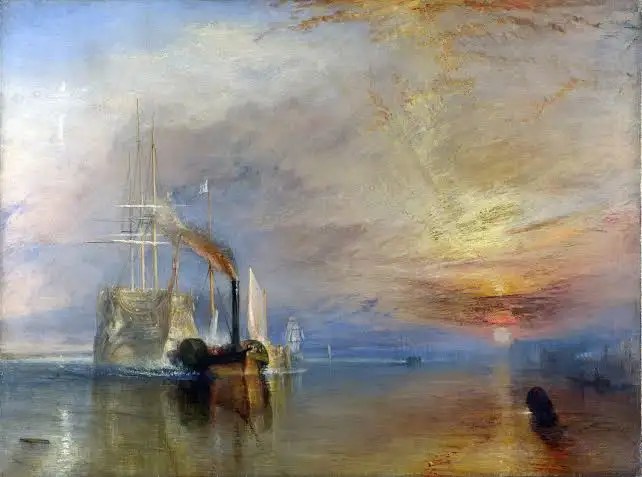
The British painter Joseph Millard William Turner’s 1838 painting, The Fighting Temeraire, which hangs in Britains National Gallery, is widely considered a national treasure. It shows the 98-gun ship of the line, which fought with Admiral Horatio Nelson’s fleet at the 1805 Battle of Trafalgar, being towed by a steam tug to the breaker’s yard. It was the ship that came to the rescue of Nelson’s flagship Victory in the heat of the battle.
When he died in 1851, Turner left the works in his possession to the nation. As a result, Tate Britain, which houses most of the gifts, holds approximately 300 oils and 30,000 works on paper. There are relatively few Turner pictures in this country. The National Gallery in Washington and the Frick Collection in New York have several; and here in Chicago the Art Institute has two significant oils – 1838s Fishing Boats with Hucksters and 1837s Valley of the Aosta: Snowstorm, Avalanche, and Thunderstorm – and several works on paper.
The artist was born in 1775 in London to lower middle-class parents. His father was a barber and wig maker, who would champion his talented son as long as he lived. A prodigy, Turner was accepted into the Royal Academy of Art school at age only 15 and became a full member of the Academy at the unheard-of age of 27. He made a good living, but later in life he became strangely reluctant to sell his work. For example, The Fighting Temeraire never left his studio.
As you can see, a steam tug is towing the massive wooden hulk down the Thames to the yard where it will be broken up. It would have taken the wood from approximately 4,000 Oak trees to build the ship, and much of that wood would have been reused in a variety of ways, including furniture and other domestic items. The most obvious theme is the transition from wood and wind – gifts of nature – to iron and steam, the product of man’s inventiveness. Notice how the old ship travels from the light into the darkness – the smoke from the tug’s stack begins this transition.
Until his death in 1851, Turner became far more interested in atmosphere than accuracy. He painted storms at sea and storms in the Alps, which became more abstract over time. He even had himself tied to a ship’s mast during a gale to personally experience its fury. These later pictures had a profound influence on Claude Monet, who studied them during his stay in London in 1870-71, where he travelled to escape the Franco-Prussian war.
I saw the Temeraire painting at the National Gallery during my first visit to London in 1992. During a later visit, I saw many more Turner paintings at Tate Britain. But what heightened my interest in him was Mike Leigh’s 2014 film biography, Mr. Turner. With the great British actor Timothy Spall as Turner, it concentrates on the final years of the very great but very eccentric artist’s life. The film puts you convincingly into the period and is visually stunning. It’s available for rental on Amazon Prime and other streaming services and is a wonderful introduction to this greatest of all British artists.
Copyright 2026, Patrick F. Cannon


At the end of my junior year abroad, I had a day to kill in London before boarding the student ship (the venerable Aurelia) at Southampton back to New York, and spent a couple of hours wandering the Tate with its Turners. A fitting prelude, I suppose, to a sea voyage.
The Temeraire could today be a metaphor of Britain’s demise as a world power.
LikeLike
Still relevant today!
LikeLike
I enjoyed your appreciation of Turner. If you have not already read it, I can recommend “The Wide Wide Sea” — it’s the story of Captain Cook and his wooden ship ventures around the globe, in search of a trade route to Asia. The ships are as much characters in the tale as the men who sailed and patched them together. Thanks for reminding me of the magical effects Turner created.
LikeLiked by 1 person
If you really want to do a deep dive, you can always read the 20 novels of Patrick O’Brian that chronicle the adventures of Jack Aubrey and Steven Maturin during the Napoleonic Wars. It’s really one novel of some 6500 pages.
LikeLike