By Patrick F. Cannon
The other night I watched a documentary on the life and work of the American painter Andrew Wyeth. I happen to be an admirer, but I was not in the least surprised to learn that his growing popularity in the 1960s was greeted with scorn by art critics. Wyeth was a “representational” or “realist” painter, which was counter to the then ascendent and fashionable abstract expressionism.
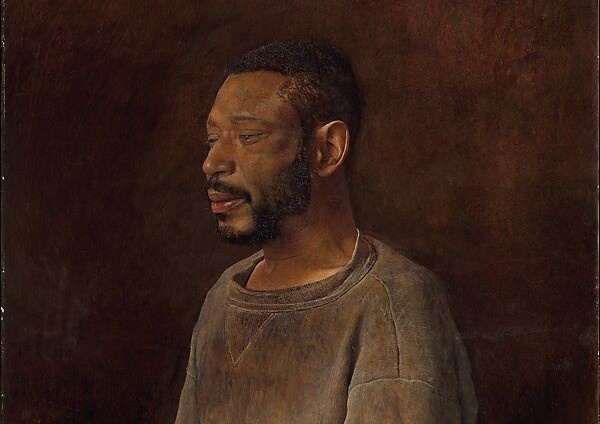
As it happens, Wyeth himself was an admirer of artists like de Kooning, Rothko, and Pollock, but chose to go his own way. He was the son of famed illustrator N.C. Wyeth and grew up in Bucks County, Pennsylvania, north of Philadelphia. He spent his whole life there, and in a Summer home in coastal Maine. He mostly painted those landscapes and his neighbors. One of them is illustrated here.
I don’t envy art critics, particularly during an era when technical skill is thought to be less important. (By the way, I don’t agree that artists like de Kooning and Rothko lacked skill. They were highly skilled, just in service to a different aesthetic.) My objection to many critics – fine arts and otherwise – is what I call the “either/or” approach. If abstract expressionism is right, then representational art must be wrong, or at least irrelevant. Influential critics have the power to “make” an artist.
How else can you explain Jeff Koons, whose giant metal balloon animals and flower-bedecked puppy dogs are taken seriously to the point that someone paid $91 million for a stainless-steel bunny rabbit. Fashion also had a hand in someone paying $87 million at auction for a Rothko; and for a de Kooning selling for no less than $300 million. The auction record for Wyeth is currently $24 million.
I write about architecture, so I have some knowledge about the ups and downs of fashion in building design. For example, I began volunteering at Frank Lloyd Wright’s original home and studio in Oak Park, Illinois in 1975. Many of my fellow volunteers held him in almost cult-like veneration. At the same time, however, architectural educators and critics had relegated Wright and his design philosophy to history. The International Style of Meis van der Rohe, Walter Gropius, and La Corbusier had replaced it in academia and on the drawing boards of major firms, along with its offshoot, Brutalism.
Then came the reaction against spare functionalism called “Post Modernism.” And so it goes. Wright is back on top again, and the landmarks of the International Style are revered. Alas, they don’t seem to be able to demolish brutalist buildings quickly enough, but we may yet regret doing this, just as we should regret losing many of the great buildings of Louis Sullivan, and great landmarks like New York’s Penn Station.
In architecture, as in painting and sculpture, there should be no either/or. There is just the great, the good, and the bad. As for me, I subscribe to the “100 Year Rule.” I won’t be around, but I wonder which of today’s heroes will still demand space on gallery walls or will be relegated to basement storage. In architecture, is it possible to revere both Wright’s Fallingwater and Mies van der Rohe’s Farnsworth House? Of course it is. In their own way, both are great works of art.
Copyright 2026, Patrick F. Cannon
 cannonnadedotcom
I agree. Art isn’t a question of either/or but both/and. However, I think the question goes a bit beyond the representational and the abstract.
The Met in New York currently has an exceptional exhibit of Raphael paintings and drawings, many never before seen in person on these shores.
Raphael, DaVinci and Michelangelo represented the pinnacle of Renaissance art. What placed and still places them as great artists is not the precision of their skill in painting realistic human figures, but rather how they succeed (and I use the present tense intentionally) in forging a human representation (I don’t quite like that word here) with the abstract, or more precisely and accurately, the divine, the ultimate ideal. You see both in one form, miraculously combined.
Raphael in particular achieves an unrivaled perfection in this. If you look, for example at the Alba Madonna (in the National Gallery) what you see is not realism but an abstract idealism in human form. The figures are human but the expression in their eyes and gestures suggest a purity that goes beyond.
His famous portrait of Baldassare Castiglione, author, courtier and diplomat, is different. The painting is a realistic human, exquisitely attired. Castiglione was recognized as a man who perfected humanism, certainly an ideal in its own right, perfection yes but not divine.
Rothko, De Kooning and others attempt to portray the abstract in the material world. The attempts are skillful but there’s no human element. Andrew Wyeth is a master. He paints with granular detail but his figures portray subtle, real human emotions. Realism but also true feeling. Idealism just doesn’t ring true in our modern era.
As for the giant steel balloons of Johns, I wouldn’t wish them on a dog.
LikeLiked by 1 person
The thing about us humans is there are new ones to paint all the time!
LikeLike
True, and sometimes they require two coats.
LikeLiked by 1 person