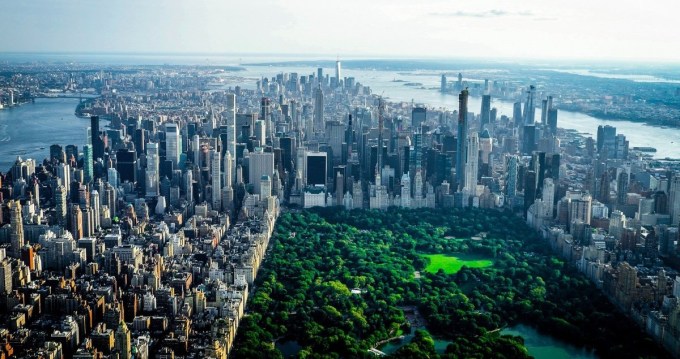
Biggest Apple
By Patrick F. Cannon
Chicago would strike most visitors as a big, crowded city. It’s America’s third most populous with a bit over 2.7 million residents. 12,000 or so people occupy each of its 235 square miles. I’ve lived in the city and surrounding suburbs most of my life, and sometimes the traffic and congestion can be annoying.
Just above it on America’s population ladder is Los Angeles. It’s more spread out at nearly 500 square miles for its population of 3.9 million. Each of those square miles is home for about 8,210 “Angelanos,” as they like to call themselves.
Top of the heap, of course, is New York City. It’s slightly smaller than Los Angeles at 472 square miles, and encompasses five distinct boroughs: Manhattan, Brooklyn, Queens, The Bronx, and Staten Island. With a total population of 8.8 million, it has more people than Los Angeles and Chicago combined. 29,303 people live in each of its square miles.
Although Brooklyn is gaining in popularity among tourists, when most people think of New York, they really mean Manhattan. It has a population of 1.7 million in its 22.83 square miles, each of which is home to 74,782 souls. On an average weekday, add 1.6 million commuters and 750,000 tourists and you have about four million people fighting for their share of the streets and sidewalks. That’s nearly 174,000 per square mile.
Although New York has some complicated real estate laws, unless you live in a rent-controlled apartment, a studio apartment in Manhattan will rent for $3,300 a month; a one bedroom at $4,130; and a two bedroom at $5,500. Rents in the best neighborhoods in Chicago would be $1,750, $2,300, and $3,200, respectively. And from what I’ve read, the Chicago apartments will be larger on average than those in Manhattan.
There are some single-family homes, generally townhouses, but most people live in apartment buildings, which are getting taller and taller. When I first went to Manhattan in the late 1950s, the Empire State Building dominated the skyline. No longer. Now it seems lost among newer skyscrapers, particularly the so-called “pencil” towers that now dominate.
Mostly surrounding Central Park, these ridiculously thin apartment buildings take advantage of anomalies in the building codes to reach as high as 1,550 feet (Central Park Tower); and 1,428 for Steinway Tower, the thinnest with an astonishing height to width ratio of 24 to 1. Many of them are used as a “pied-a-terre” or a home away from the owner’s main residence, usually in another state. Apparently, even the finest hotels aren’t acceptable to very richest among us (or not among us actually). The proliferation of these apartments has encouraged the state and city to propose an added tax on these getaways for out of state billionaires.
Anyway, it’s getting increasingly expensive to live in Manhattan. Frankly, it has become the very definition of “I love to visit, but I wouldn’t want to live there.” While even a visit can be frustrating, where else are you going to find such riches? Take museums for example. While Chicago has the Art Institute and Museum of Contemporary Art (and a few smaller university-related museums), New York boasts the country’s largest art museum, the Metropolitan. Not too far away on Fifth Avenue are the Guggenheim, the Frick Collection, and the Neue Gallery. A bit further south are the Museum of Modern Art and the Whitney Museum of American Art.
As to restaurants, New York boasts four Three-Star Michelin restaurants (Chicago has two). But really, you would be hard pressed to find a block in Manhattan that doesn’t have at least one restaurant, and the sidewalks are full of food carts offering all manner of exotic fare. You could certainly visit Des Moines for less money, but why would you?
And last, but by no means least, you can pay your fare on buses and the subway by just tapping your credit or debit card! No special transit cards or cash. Chicago’s CTA, Metra, and Pace should take note!
Copyright 2026, Patrick F. Cannon


I wouldn’t want to and yet, a lot of people (still) live in New York, besides the handful of individuals who can afford a Manhattan pied-à-terre (and spur the envy of Marxists).
Manhattan, which is mostly ethnically white south of 96th Street — as shown in the aerial photo at the top of the page — is what most people think of when someone mentions New York (or the New York Times, for that matter). It’s as representative of the city as the Gold Coast is of Chicago.
The Borough of Brooklyn, barely visible in the picture, may soon qualify as the country’s third largest city. It has only 60,000 residents fewer than the entire city of Chicago. About two-thirds of its population are of African, Caribbean, Asian or Hispanic descent. Ethnic diversity has ever been Brooklyn’s defining character. (Will the modern immigrant story will be one of upward mobility as in the past, or generational decline on government assistance?)
Not far behind Brooklyn in population, the adjacent borough of Queens has some 2.4 million residents.
Then there’s the Bronx, with 1.4 million people, which is almost entirely Hispanic and Black.
We can forget Staten Island, as most do, as it’s really part of New Jersey.
New York has a curious disparity between the price of its rents/real estate (high) and its income levels (moderate to low). More than half of the city’s housing units are rent controlled or subsidized, which tends to raise the rents of places that aren’t, not to mention taxes. As visitors learn quickly, everything is very expensive in New York. Chicago, at least so far, remains a relative bargain!
It’s been a sad experience to watch my native New York slowly decline. Who in their right mind sings, “New York, New York, it’s a wonderful town” anymore? It had a renaissance under mayors Giuliani and Bloomberg but has suffered from the progressive abuses of recent mayors (De Blasio, Adams, Mamdani). I suppose the same can be said of Chicago (Emanuel, Lightfoot, Johnson), a city I used to admire, take pride in and enjoy.
And then there’s San Francisco, another city I once loved. If anyone left their heart there, they’d be well advised to apply for a transplant.
As for Los Angeles, it’s a disease. The city was always a mirage, shaped by vapors, mirrors, Hollywood tinsel and sunshine. As vain and vacuous as Gavin Newsom, it had little in the way of urban civilization or tradition.
So bring your wallet and visit New York and its treasures. But live there?
Fuggettaboutit!
LikeLiked by 1 person
The worm is beginning to turn in Chicago. Mayor Johnson is on his way out (if he dares to run again). And taxpayers and parents are wondering why we need more teachers for fewer students. If the Chicago Teachers Union had their way, the teacher/student ratiio would be 1:1. In some schools, it’s getting close! This Fall, the school board will be fully elected. I won’t be surprised if CTU backed candidates have to find other jobs.
LikeLike
I’m not initiated in the mysteries of Chicago politics, but I know that the disarray at City Hall represents a rare opportunity for, shall we say, various interests to move in and claim the prize. The prospective candidates look like the usual suspects. Even Rahm is given mention. Chicago needs a Spencer Pratt. Anybody know how to do AI ads?
LikeLike
Not me, but someone does. Will be interesting to see who surfaces. Paul Vallas came close in the last election. In his favor, the CTU hates him!
LikeLike