By Patrick F. Cannon
I may have mentioned one or more of my books in this space from time to time, but I thought I would indulge in a little shameless self-promotion today. I’ve listed just my most recent ones, which are all about Chicago architecture or architects. None of them would have been possible without the photographs of my partner James Caulfield, one of America’s greatest architectural photographers.
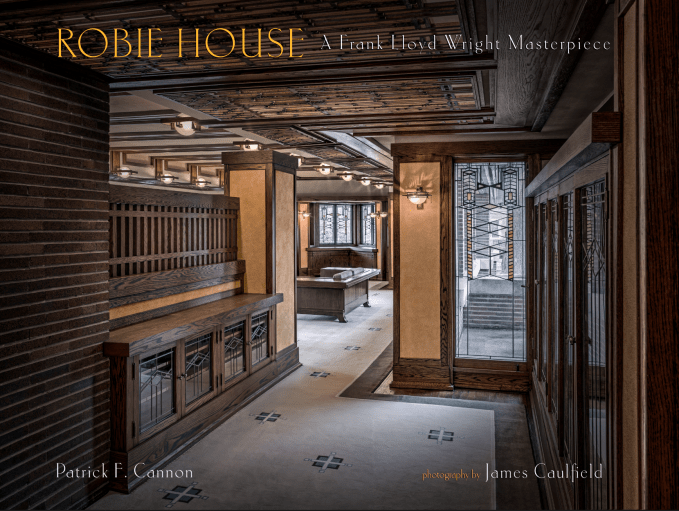
Because he spent the first 20 years of his career in the Chicago area, Frank Lloyd Wright is a persistent presence in our books. Our most recent is Robie House: A Frank Lloyd Wright Masterpiece. It was published by the Frank Lloyd Wright Trust and is being distributed by the University of Minnesota Press. ($34.95, 130 pages) Located in Chicago’s Hyde Park neighborhood, Robie is one of the eight Wright buildings named World Heritage Sites by UNESCO. It is open for tours (www.flwright.org). Here are four more of our books:
Louis Sullivan: An American Architect. Published by the Glessner House Museum; distributed by the University of Minnesota Press. ($49.95, 288 pages). Sullivan was one of the greatest of all American architects, and it can fairly be said that Frank Lloyd Wright, his employee from 1888-1893, learned to be an architect while working with Adler & Sullivan. Sullivan is widely regarded as the father of the American skyscraper.
Frank Lloys Wright’s Unity Temple: A Good Time Place Reborn. Published by the Unity Temple Restoration Foundation; distributed by the University of Wisconsin Press. ($34.95, 120 pages). This is the other Wright World Heritage Site in the Chcaago area. Dedicated in 1908, it was the first modernist religious building in the world. It is also open for tours (www.flwright.org).
At Home in Chicago: A History of Domestic Architecture. Published by City Files Press, Chicago. ($65.00, 364 pages). From the oldest surviving houses to some of the very newest, this is a visual survey of how people have housed themselves in Chicagoland.
The Space Within: Inside Great Chicago Buildings. Published by Pomegranate Communications. ($65.00, 320 pages). For the first time in many cases, this book takes you inside many of the Chicago area’s landmark buildings.
Except for the Robie book, which received a Bronze Medal, all were Gold Medal Winners at the Independent Publisher Book Awards. They also have in common that they were funded by the Richard H. Driehaus Foundation, which does so much to support the arts in the Chicago area. You may be familiar with the Driehaus Museum in Chicago, which contains a rich collection of furniture and decorative arts.
Jim Caulfield and I have now started work on a new book, Chicago by Wright, which will document all the existing Frank Lloyd Wright-designed buildings in the Chicago area. There are nearly 100, making it the largest concentration of the architect’s buildings in the world. It is being published by the Frank Lloyd Wright Conservancy and, once again, is made possible by a grant from the Richard H. Driehaus Foundation. It should be out in the spring of 2028.
All our books are available from the usual online booksellers. But even if they don’t stock them, your favorite local bricks and mortar bookstore should be able to get copies to you in a few days. If you have one, I urge you to support it. But of course, you can probably get a copy of one or more of them from your local library. If they don’t have a copy, hey can usually get one through their local interlibrary loan system. If it’s listed in their catalog, they can get it for you.
Copyright 2026, Patrick F. Cannon


Congratulations, Pat, on your continuing success as an author. My best regards, Dick Bragaw
LikeLiked by 1 person
Thanks, Dick.
LikeLike
If anything deserves promotion, Pat, it’s your books on Chicago area architecture.
They are well-written and researched, informative and beautifully photographed, but they also avoid the huckster-sensationalism many publishers use to sell as many copies as the public can bear.
Out of curiosity, I did a search by author of the local library’s catalog to see if they had any of your volumes.
The result I got was, “Did you mean Patrick Of Cannon?”
Frankly, I didn’t know there was one.
Undaunted, I then looked up books on FLW. There were about two dozen, none of them yours, most with titles designed to snare a reader’s baser interests:
Death in a Prairie House: Frank Lloyd Wright and the Taliesin Murders.
Architecture’s Odd Couple: Frank Lloyd Wright and Philip Johnson.
Loving Frank: a novel.
The Killer and Frank Lloyd Wright: a true story of mass murder in paradise.
Plagued by Fire: the dreams and furies of Frank Lloyd Wright.
And so on.
The curators of Mayberry’s library live lurid fantasy lives, or so it would seem.
And if all that weren’t enough, the catalog has a curious disclaimer:
“We respectfully acknowledge that Monroe County Public Library, in all of its iterations since 1818, was built and exists on land that has been, is still, and will continue to be rightfully occupied and nurtured by the Bodwéwadmik (Potawatomi), Kiikaapoi (Kickapoo), Lënape (Delaware), Myaamia (Miami), and Saawanwaki (Shawnee) Indigenous peoples, among others.“
Among others!
(I don’t think current inhabitants are included.)
But I digress.
During my search, I came across a Sav Cannon. She is a YouTube influencer/content creator who self-identifies as a Republican and dispenses dorm-room wisdom while wearing loose sweat pants and sitting open-legged in front of the camera. (One critic wisecracked she was “cameltoeing the party line.”) She reportedly earns an annual income of $40 million from her social media, cosmetics brand, endorsements and investments.
Just sayin’, Pat, ever consider spicing up old Frank’s work?
“Frank Lloyd Wright’s Robie House: When a house is not a home.“
“The Robie House: How a seminary nearly brought Wright’s masterpiece to ruin.”
You get the idea.
A racy YouTube channel wouldn’t hurt either. I’m sure the old rake’s love life could generate a few clicks. You could merchandise his porkpie hats!
Wright is America’s greatest architect. I’m always intrigued by his innovations, though I find his obsession with geometric shapes and angles often oppressive, and some of his interior spaces unsettling. And I have to confess, I never quite understood how his angular, stacked designs conformed to Nature. But he evidently knew how to stand out and promote himself.
For me, his houses are like New York City: Nice places to visit but I wouldn’t want to live in them.
Good luck with your latest book. I like its title and hope to see it in print.
LikeLiked by 1 person
Good suggestions! Can’t hold those Cannons down!
LikeLike