This Land is Our Land?
By Patrick F. Cannon
It has become commonplace for museums and other institutions to publish a “Land Acknowledgement” statement. Tours at many institutions begin with a version of the statement. Although we’re not in any hurry to give the land back, it’s true that the Chicago area, for example, was once occupied by native American tribes like the Potawatomi, Ojibwe, and Odawa. The Treaty of 1833 effectively moved all of them west of the Mississippi.
If all these acknowledgements make people feel better, so be it. But I sometimes get the feeling that some of my fellow countrymen think that the United States is unique in displacing former populations. In fact, almost no people are where they started. The “native” Americans that we displaced all started somewhere in Asia. The Celts that populate much of Ireland, Scotland, Wales – and significant parts of /France and Spain – moved west from eastern Europe.
And let’s not forget the Huns, Goths, and Visigoths of our history books. Today’s Italians have their blood, as well as Roman. Greek, and no doubt other strains as well. Both sides of my family came from Ireland. There is evidence that Mesolithic hunter-gatherers were there at about 8,000 B.C. The Celts arrived at about 600 B.C. Then came the Vikings, Normans, Scots, and finally the English. None of them came (or gave up) peacefully.
The successful conqueror was the one who managed to organize the new land. William the Conqueror wasted little time after defeating the Saxons at Hastings in 1066 in sending his minions around England to do what was essentially a census of his new subjects and the land they occupied. The resulting “Doomsday Book” still exists, held by the British National Archives at Kew. As was the case in much of Europe, the king assumed that he owned all the land, to be doled out to his favored followers, who in turn divided it among tenants who worked the land but didn’t own it. Some of these vast estates still exist in the UK, although land ownership is much more broadly held.
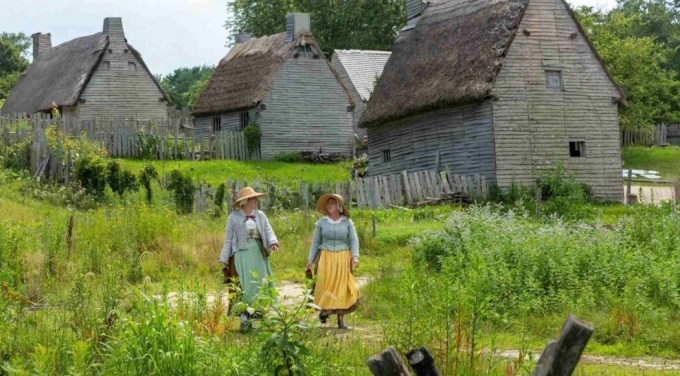
These restrictions on who could own land were a major factor in the emigration of people from the Great Britain and other Northen European countries to North America. What they found was a sparsely populated paradise, with plenty of land to go around. You cleared some of it, and it was yours. Eventually, and inevitably, increasing numbers of immigrants began to move into lands traditionally occupied by native tribes.
Thus began a pattern of resistance, wars, forced relocation, treaties, broken treaties, failed education initiatives – well, you get the idea. It was, as I said, inevitable, but also intentional. To give you some idea of how early the concept of “manifest destiny” took hold, in 1787, the new government of the United States passed the Northwest Ordinance. Even though Native Americans then mostly occupied it, it was assumed that the areas that became the states of Ohio, Indiana, Illinois, Wisconsin, and part of Minnesota was already part of the United States and laid down for future Americans just how they could become states. If you own a piece of land in these states, how it is described (range, sections, divisions, subdivisions, etc.) is a result of the ordinance.
We can’t change the past. We study history so we might learn from our mistakes and try to do better. We need only apologize when we ourselves fail. Which, alas, we continue to do.
Copyright 2026, Patrick F. Cannon
 cannonnadedotcom
Guilt is a funny thing. It can make one feel bad, but also give one a strong sense of moral superiority and an impulse to enlighten others.
After all, if you can feel guilt, it must mean you have a conscience and therefore an obligation to rectify the wrong, no?
Shame on us (or at least the ancestors of some of us who came to this continent) for pushing natives off their living space.
But the displacement of native peoples can also be a rationale for those who favor the warmth of collectivism to argue against private property and individual rights. This land you hold a deed to really isn’t your own. As the song goes, it belongs to “you and me” :
There was a big high wall there that tried to stop me
Sign was painted, said, “Private Property”
But on the back side, it didn’t say nothing
This land was made for you and me.
The government hasn’t yet reached the point where it can confiscate private property except in cases of eminent domain where compensation must be paid, or where tax payments have been delinquent.. And states do levy property taxes. Not coincidentally, the states with the highest median annual property taxes (NJ, IL, CT, NY, CA) are the most predominantly democrat. A few are now contemplating confiscation of financial assets.
And of course China has no private property at all. Its land belongs to Mao and Xi.
The rationale also ties into borders. Proponents of collective ownership of property also favor open borders. In quite a few states, non-citizens and illegal aliens can be eligible to vote.
Europe is a prime example of what happens when borders are opened and countries are globalized. Not only have individual countries lost their sovereignty, but citizens have been subordinated to policies over which they have no control.
There is a bit of irony in the fact that nations such as England, Germany, Spain, Belgium and France, which in the past gloried in the colonization of lands in Asia, Africa and the Americas, are now being colonized themselves, but from within.
What goes around, comes around.
As a side note, you’re right. Italy, thanks to invasions over centuries by people from all parts of Europe, Asia and Africa, has the most varied and complex DNA of any country. My ancestors could have been Genghis Khan and Attila the Hun.
No wonder when the country was unified in 1861, someone quipped, “We have an Italy! Now all we need to do is find some Italians.”
LikeLiked by 1 person
Hey, I forgot the Moors in Italy. Who can forget old Othello! I still get nightmares remembering Olivier playing him as an English minstral!
LikeLike
Funny how Shakespearean characters in Italy, like the Romans in I, Claudius and other productions of the period, all speak with British accents. Maybe the Romans picked it up when they conquered Britain?
The Moorish presence was largely in Sicily where you can still see Arab influence in the architecture.
Closer to home, in a suburb of Indy, Fishers, there’s a pizzeria that serves remarkably authentic Neapolitan pizza. It’s called “Tre Mori” and it’s run by…..three Moors! Here’s Sam Chasmine, one of them:
Whattaya mean “we” kemosabe?
LikeLike