By Patrick F. Cannon
The other evening, I watched a documentary on Chicago’s WTTW on the historic importance of railroads to Chicago. It was hosted by the ubiquitous Geoffrey Baer and covered everything from street cars to intercity passenger and freight trains. Today, the Chicago region still handles more freight traffic than any other area of the country. Although rarely visible to most residents, vast areas are taken up with rail yards.
Although only Union Station via Amtrak handles intercity rail travel now, when I started working for the New York Central Railroad in 1956, there were six downtown stations: Central, Dearborn, La Salle, Grand Central, Union, and Northwestern. Between them, they then were home to nearly 20 railroads. If you were travelling from anywhere east of Chicago to a destination west of the city, you had to change trains. The transfers were handled by the Railroad Transfer Service, whose buses were a regular site on downtown streets.
If you arrived from New York on the New York Central’s 20th Century or the Pennsylvania Railroad’s Broadway Limited and were headed to Los Angeles, you had all day to kill before boarding the Santa Fe’s Super Chief, the Milwaukee Road/Union Pacific’s City of Los Angeles, or the Rock Island/Southern Pacific’s Golden State Limited. Many Hollywood notables would freshen up at the Ambassador East Hotel, and lunch in its famous Pump Room. If you were “A” list, you would get booth #1, with its own white phone! You would also get your picture in the afternoon newspapers!
My first train trip was in late 1945, when my family moved to Chicago from the Pittsburgh area. It was on the Pennsylvania Railroad, then America’s largest, with 26,000 miles of track in the east and Midwest. We left Pittsburgh in the morning and had lunch in the dining car. I remember being impressed with the quality of the ice cream! The train was crowded, including returning servicemen.
We got off the train in Englewood, which was a station shared by the New York Central, Pennsylvania, and other railroads. Located at 63rd Street, it was more convenient for south siders than the downtown Union or La Salle Street stations. My father, who had gone ahead to start his new job and find an apartment, met us. The apartment was at 67th and Merrill in the South Shore neighborhood. Not only was it across the street from Jackson Park, but it was also only three blocks from the 67th Street beach! And, unlike the rivers that surround Pittsburgh, you could actually swim in the water! And this was a true wonder – there were no hills to climb!
I didn’t realize it, but when I started at the New York Central in 1956, rail travel had already begun to decline. Since the end of World War II, commercial airplanes had gotten larger and faster. Then, late in 1958, the jet age arrived. While rail travel was still less expensive for families, business travel moved to the skies. Time is money, after all.
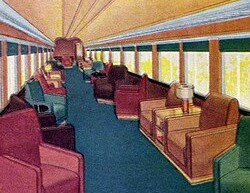
My friend Ed would be interested to know that in 1956, many businessmen still travelled to Detroit by rail. The New York Central had the Mercury, an all-parlor car train. Instead of the usual coach seats, it was equipped with overstuffed chairs and other amenities. It left in the morning and arrived in Detroit at about 2:00, after serving a nice lunch in the dining car. The club car would have assured you of that two-martini lunch!
Amtrak can now get you to Detroit in about five hours, reaching speeds of 110 miles per hour (mph) on some stretches. When and if all the tracks are upgraded, four hours or even fewer would be possible. The last intercity train I took was from Chicago to St. Louis. Again, portions of this line now permit 110 mph, with the fastest train getting to downtown St. Louis in four and a half hours. The ride was smooth and comfortable, and I saw a lot of corn and soybeans!
Super high-speed corridors, which are expensive to build, are not necessary in most cases. Amtrak has been upgrading its equipment in recent years. With speeds of 110 mph the rule instead of the exception, getting to cities like Detroit, Indianapolis, St. Louis, Cleveland, and Minneapolis by rail from Chicago would be a viable option. And not, I should add, subject to the vagaries of mother nature and the indignities of the TSA.
Copyright 2026, Patrick F. Cannon


My last US rail trip must have been in the 1970s, characterized by delays, worn passenger cars and general inconvenience, quite a contrast from 1950s boyhood years in New York when the Pennsylvania, New York Central, New Haven and Erie Lackawanna railroads were still flourishing.
Tracks along main routes may have been upgraded to allow greater speeds but rail travel in the US has a long way to go before it competes with car and air travel.
High-speed trains like Florida’s Brightline struggle to achieve profitability. Nearly two decades after its adoption as a publicly funded project, California’s high-speed rail has become a sad story of poor government planning, mismanagement, regulatory red tape, waste and spiraling costs, now estimated to reach $125 billion to complete, if the project ever is completed.
Rail systems in Europe and Asia run at a loss and are heavily subsidized. But they work. Italy has two high-speed lines, state-owned Trenitalia and Italo NTV, which is operated by a private company. Both hit speeds of 300 km/hour. The Japanese Shinkansen are even faster and sleeker.
High-speed rail in the US sounds like a good idea, especially now with the miseries of airports and crowded, uncomfortable planes. But not all good ideas are workable, as we see in California. Cars and our highway systems are far more practical and economical. You can go where you want, when you want, and it costs less. And flying will always be faster on long trips.
The free enterprise system works best in meeting consumer needs. And with the advent of self-driving cars, even people who can’t drive will be able to reach a destination without depending on often-inefficient public transport.
LikeLiked by 1 person
Callifornia is a poster child for a lot that doesn’t work! High speed rail seems to work in the NY to Wash corridor, but in the short term upgrading existing tracks and equipment seems best. I generally fly to Pittsburgh now instead of driving. If I could get there by train in six hours, I’d consider it (especially if they served good ice cream).
LikeLike
California is ruled by unions. They may be the only ones benefiting from a nowhere-fast train.
I had an ice cream sundae the one time I flew First Class (Pan Am, FRA-JFK) but alas good ice cream on trains is a relic of the past, though there might be vending machines!
LikeLiked by 1 person