By Patrick F. Cannon
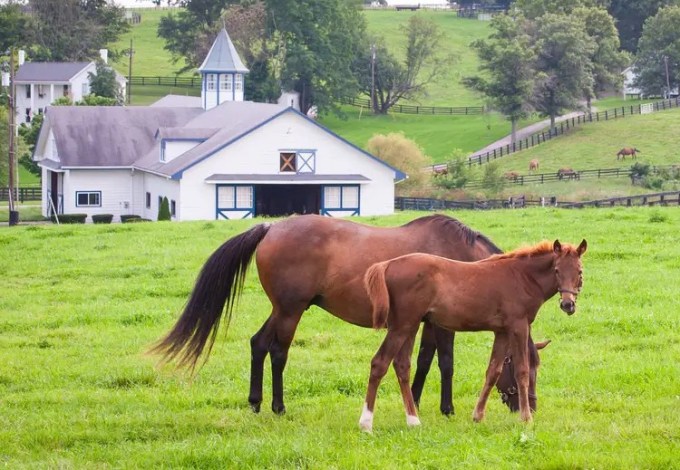
This past weekend, I went to Lexington, Kentucky with my daughter Beth and son-in-law Boyd to go to the races at Keeneland and visit a thoroughbred breeding farm. The Keeneland race track is adjacent to some of the farms, including the historic Calumet Farm. The buildings at the track are constructed of the local limestone, which in the local water is thought to give Kentucky-bred horses strong bones.
The United States leads the world in thoroughbred production with approximately 17,500 yearly births. Horse racing crazy Australia is second with 12,000, followed by Ireland with 9,000. Great Britain, where the breed originated, and France produce about 5,000 yearly each. If Kentucky were a country, it would be tied for second with Australia.
Kentucky also leads the United States in purse money, largely due to income from historic horse racing machines. Other states whose purses are increased by income from slot machines and other forms of gambling include New York, Florida, and Arkansas. California, which was once a major center, is declining because it has no other form of gambling. Many of its major trainers are moving their horses east in search of higher purses.
Illinois, meaning the Chicago area, was once a major center of thoroughbred racing, more than competitive with Kentucky, New York, and California. Only one track remains, Fairmont Park near St. Louis. It was a minor track and remains so. With the closing of Hawthorne Race Course, the Chicago area is without any kind of race track. When I first started to go to the track in 1957, there were four thoroughbred tracks: Arlington, Washington, Hawthorne, and Sportsman’s. Illinois had a thriving breeding program. In 1985, its farms produced 2,535 foals. Last year? 86.
What happened? Pari-mutual betting at tracks was the only form of legalized gambling in Illinois until the Lottery started in 1974. It siphoned off the gamblers who didn’t want to have to think about their bets but were lured by the big paydays. River boat casinos came in 1990. Instead of waiting the usual 20 minutes between races, action was continuous. Land based casinos came in 2019, as did legalized sport betting. And, ironically, race tracks were finally given permission to add slot machines and other forms of wagering.
By this time, Churchill Downs owned both Arlington Park and Rivers Casino in Des Plaines. Widely expected to apply for a casino license for Arlington Park, it did not, deciding it might lure business away from Rivers Casino, which it saw as a safer investment. Churchill was by then a public company, and it acted with its head rather than its heart.
Churchill was widely reviled, but the real villain in the death of racing in the Chicago area was the state legislature. Beginning with the Lottery, the tracks sought the right to compete with it and later with casinos by getting the right to install slots and other forms of gambling to supplement purses. Now in the gambling business itself, the state wasn’t excited about the idea and the corporations who controlled the casinos apparently had better and more generous lobbyists.
Now, you may think I am cynical for thinking our fine Illinois legislators could be swayed by cash or campaign donations. When it no longer mattered, they finally did what they should have done in 1974. So, Churchill sold Arlington Park to the Bears, who demolished the most beautiful race track in America. Hawthorne couldn’t raise the cash needed to add a casino and was forced to declare bankruptcy. So, the thousands of jobs that supported racing in the Chicago area, and the farms that produced many of the horses, are now gone. And ironically, racing is now safer and more honest than it’s ever been, due to the creation of the national Horse Racing Integrity and Safety Authority. And just how many jobs does sports betting provide for Illinois? How about none?
Copyright 2026, Patrick F. Cannon

