
Fashion Forward

By Patrick F. Cannon

One of  the reasons I subscribe to the New York Times online is it’s the only daily newspaper that still covers the fashion world. In its heyday, the Chicago Tribune also had a reporter on hand for the runway shows in Paris, Milan, and New York. Alas, they now struggle to even cover the political shenanigans in Chicago and Illinois.

            It’s always a pleasure to see the pouty fashion models suffering malnutrition for their art. While the female models were always of the bony sort, male models tended once to be more the buff, athletic (tennis not football) types. Like the women, these days they also seem to be sourced from Siberian orphanages. In the real world, meaning Chicago, one rarely sees anyone dressed in the latest couture fashions. Or walking with that strange gait that models use to get down and back on the runways.

            As for me, I was more or less fashion forward in the 1960s. It was the era when one’s business costume consisted of a natural-shoulder suit, button-down collar dress shirt, striped or foulard tie and winged-tip dress shoes. Brooks Brothers would be the ideal supplier. “Preppy” or “Ivy League” were used to describe the look. For some of us, the 1960s are still here.

            I once owned many suits since business decorum demanded it. Now, I own one, but it looks just like the ones I wore for some 35 years. I had it made to measure in 2023, and I was amazed at how much more it cost than  the last one I bought in 2000. I’ve worn it three times, most recently in August 2023 for a family wedding. Oh, and I also own a navy blazer, and on New Years Eve, I wore it and a tie. I just checked my tie supply – all seven are either striped or foulards!

            Those of you who see me occasionally will know that I’m a large fellow. Given the preference for gaunt male models, the only way I would be on fashion show runway would be with a broom. And apparently this  taste for the skinny also applies to the silver screen.

            The ideal male for many years was virile and rugged. Think Gary Cooper. Think Burt Lancaster. Think Clark Gable. Think the recently deceased Gene Hackman. Of course, none of these fellows could have played Bob Dylan, which Timothee Chalamet did with distinction. But his type, lean and dreamy looking, seems to be in the ascendent.

            Chalamet is also one of the young actors who wear the designer clothes you think no real person wears. That’s him there on the red carpet. He appears to be real. I wonder how I would really look dressed the same, but in a larger size? I should seek out the designer and ask if they have it in XXXL.

Copyright 2025, Patrick F. Cannon

Rules, Rules, Rules

By Patrick F. Cannon

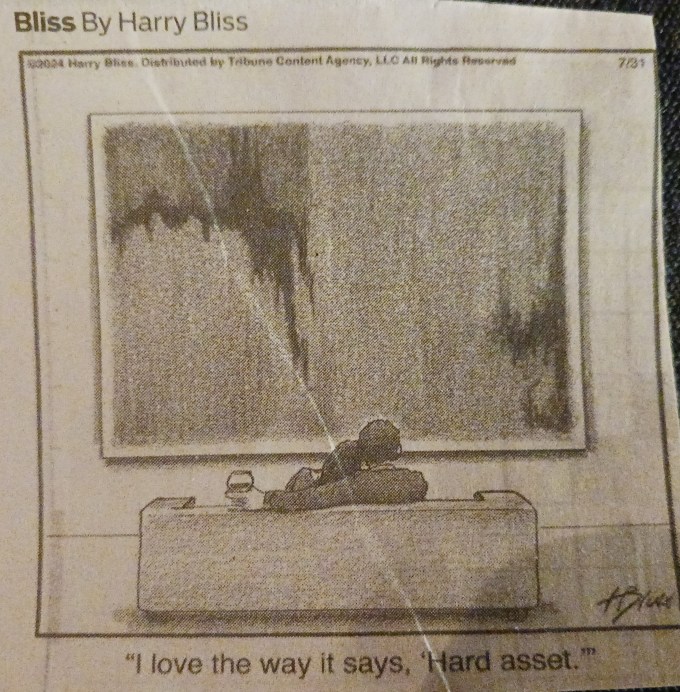
Early in the 20th Century, artists of all kinds were given to issuing manifestos that claimed they were breaking with the restrictive rules of the arts establishment by creating new and exciting art for the modern world. What they were doing – the Dadaists, Surrealists, Expressionists, Social Realists, etc. – were creating new rules. And so it goes.

            Written manifestos have mostly gone out of fashion. But unwritten rules do not. One seems to be that art is created not for the enjoyment of the general, literate public, but for – in the case of the visual arts – for the critics and collectors. Realism, or “representative” art as its often called, is relegated to a lesser status. A painter of undoubted talent like Andrew Wyeth may be admired by the general public, but the giant balloon figures of Jeff Koons fetch the big bucks.

            I lived in Oak Park, Illinois for more than 40 years, and  still live next door. It is the birthplace of Ernest Hemingway and was the  home of Frank Lloyd Wright for 20 years. Edgar Rice Burroughs was also a former resident, and many other notables have called Oak Park home. Yet, aside from one portrait bust of Wright in a local park, no statues of any of them grace Oak Park’s public spaces. Nor are any schools named for these most famous residents.  It could be that their somewhat checkered pasts have disqualified them. Unlike Washington Irving, who died before Oak Park sprang into existence. New Rules.

            Oak Park is, however, the home of a good deal of public sculpture; indeed, its downtown area is littered with it. While a  few of them have some whimsical charm, most are bits of metal welded into abstract forms. Most people walk past without a glance, as if they were street lamps. Nowadays, the only sculpture representing real people seem to honor sports figures – in Chicago, Michael Jordon, Ernie Banks. Ryne Sanburg, and Bobby Hull are among those honored.

            Abstract artists in general seem to be facing a dead end. What can they do that hasn’t already been done? Can they improve upon – or do something radically different – than Mondrian, De Kooning, Pollack, Kelly, or Rothko?  Perhaps they can call upon A.I. to help them out? Abstract artists were and are not now usually willing to discuss the meaning of their work. You decide, they say. I remember listening to a psychiatrist on Charlie Rose’s PBS program (before Charlie got erased) who said he was so overcome with emotion looking at a Rothko color-field painting that he began to weep. He claimed it had nothing to do with Rothko having committed suicide, just the power of the painting itself.

            On a recent “CBS Sunday Morning” I was reminded that Andy Warhol’s garishly colored photograph of Marilyn Monroe sold for $140 million at public auction. As it happens, I have a vintage hand-colored photograph of my brother Pete and me, which I guess was taken when he was three and me two. In those days, it was common for photo studios to take black and white photographs and hand color them. Of course, they charged extra for it, but I’m sure our parents thought it was worth the expense. Since I’m sure I could get an excellent copy made, I’d be willing to let the original go to auction. You just never know what it might bring. I’d settle for a mere $14 million.

Copyright 2025, Patrick F. Cannon (and with apologies to cartoonist Harry Bliss)

Peace in Our Time

By Patrick F. Cannon

On September 30, 1938, when I was six months old and frankly didn’t notice, Adolph Hitler for Germany, Benito Mussolini for Italy, Edouard Daladier for France, and Neville Chamberlain for Great Britain signed an agreement which would cede the German-speaking Sudetenland area of Czechoslovakia to Germany. The latter were not a party to the negotiations. They were given the option of accepting the agreement, or going to war with Germany

            Chamberlain also got Herr Hitler to sign a paper that bound Germany and Great Britain never to go to war with each other. When he got home, he brandished his letter and claimed he had helped guarantee “peace in our time.” Winston Churchill, who had been raising the alarm about Hitler for years, commented: “You were given the choice between war and dishonour. You choose dishonour. You will have war.”

              The Czechs, no longer having allies, chose to accept an agreement they had no part in, and the Germans duly occupied the Sudetenland on September 30, 1938. Now helpless, the Czechs could only watch as the rest of their country was occupied in March of 1939, beginning foreign occupations that would last for 50 years. While Britain and France abandoned the Czechs, they did guarantee to come to Poland’s aid if Germany invaded, which they did six months later. The ensuing World War II caused the death of approximately 70 million soldiers and civilians.

            It appears that initial negotiations to end the current war in Ukraine will be between the US and Russia, with other interested parties, perhaps even including Ukraine, brought in later. When it’s all over, and Russia’s Putin adds more of Ukraine to his former grab of the Crimea, perhaps President Trump will deplane at Andrews Air Force Base, and trumpet for all to hear that he has brought “peace in our time.”    

Copyright 2025, Patrick F. Cannon
Heartless

By Patrick F. Cannon

Business owners and managers are inevitably faced with decisions about staffing. The reasons are diverse: inferior performance, automation, sales decline, changing product mix; and on and on. The Capitalist economic system, which has raised people from poverty throughout the world, can also seem cruel when profits are at stake.

            While I toiled for most of my career in the non-profit world, I still occasionally had to fire or lay employees off. I took no joy in it, since I know firsthand how it was to lose a job and face all the uncertainty that looking for a new job entails, especially when you have a family.

            President Trump – whose only job has been being Donald Trump – has had no such compunctions. His most memorable public utterance has been “you’re fired!” He did it with great glee on the “reality” program that made him famous outside of his native New York. Of course, the people who got fired knew only one of them was going to get hired, just like the missies who appear on “The Bachelor” know only one will get the famous Rose.

            You who read this blog regularly will know that I believe that governments at all levels spend too much money. What we have needed for a long time is a president and Congress that would work together to systematically eliminate wasteful and unneeded programs and the employees who operate them.

            Instead, we have a president who thinks Congress is an annoyance. If  Republican members do his bidding, fine. If not, or they take too much time, President Trump just goes ahead and does what he wants, regardless of any pesky laws that might annoyingly be on the books. I predict that he’s also going to ignore the courts too, in hopes he’s made cowards of us all.

            In case Trump voters haven’t yet noticed, he doesn’t care about you. Just as he doesn’t care about the lives and families of the people he and his deranged accomplice Musk are so gleefully firing. They don’t exist for him as living, breathing human beings who mostly are just doing the best they can in the jobs they’ve been given. It’s easier to think and say that they’re sub human denizens of the “deep state.” Mostly, they just go to work and do what the laws tell them to do. And that’s part of the rub – many of them know their president is guilty of most of what he was charged with, and he hates them for that knowledge.

            Finally, I’ve been getting emails from Republican lawmakers from around the country asking for dough to help them support President Trump in his efforts to “Make American Great Again.” Obviously, they have been given talking points from on high because they inevitably mention that President Trump is donating his $400,000 a year salary. As it happens, he did donate his salary to various entities during his first term. And he can certainly do the same this time since he shamelessly monetized his first term and is going even bigger this time. The lowest estimate of his income during those years totaled about $1.6 billion. Match that, “Crooked Joe!”          

            I don’t doubt that former President Biden’s family parlayed their relationship to make some extra bucks. But did he or his family break any laws? If they did, why didn’t the Republican House of Representatives, with full investigative and subpoena powers for two years, find anything? Anyway, there seems to be no law that prevents a president from using his office to enrich himself. He just can’t accept bribes (emoluments) from foreign governments or potentates. Or will he ignore that part of the Constitution too?

Copyright 2025, Patrick F. Cannon

The Search Continues!

By Patrick F. Cannon

I was watching an interesting program on the Science Channel about the reopening of a four-hundred-year-old mine in England’s County of  Cornwall. It seems the ancient mine, which once produced copper and tin, is now known to contain Lithium, a key element in modern battery production. When the program was over, there was a promo for an upcoming feature on the continuing search for Bigfoot, or Sasquatch, if you prefer the scientific moniker.

            In case you have missed it, Bigfoot is a giant, human- like creature that roams the forests of our great Northwest, often sighted by hiking scientists, but so far never captured. Occasionally, a lucky hiker spots one and takes a murky photo or video of it. They seem to be about 8 feet tall, proportioned like a human (decidedly not like an ape or bear), covered in hair, and looking quizzically at the camera wielder. None, at least so far, has waved, or sauntered over to say howdy.

            You would think, given our modern tracking devices, we would have long since been able to corner one and toss a net over him, but no luck so far. Nor have our friends and fellow scientists in the distant Himalayas, where a similar creature called the Abominable Snowman (scientific name: Yeti) is said to roam. They may be related, but the Yeti has white fur, no doubt a climatic adaptation, like the Polar Bear or the Snowshoe Rabbit.

Failure to catch one of the creatures has not dissuaded the intrepid scientists, who seemingly will continue their searches so long as the Science Channel keeps supporting their efforts. We also have this and other channels to thank for not giving up hope that one day they will capture a life form from outer space.   

Of course, there have been numerous books, movies and television shows that present us with a little green man or two. Who can forget the charming ET? Sometimes they even look like John Lithgow, to fool us into thinking they’re just like us (heaven forbid). I’ve lost count of the number of folks who have been abducted and held against their will in a flying saucer or dinner plate. After hurtling through the cosmos and visiting strange and wonderful planets, the captives are released to warn us to mend our ways or suffer unimaginable woe.

Now, the universe is really big, and its vastness might include planets that can, like ours, support life in some form. Apparently, there are scientists sending messages through the ether in hope someone out there will hear them and respond. I’m sorry to say, so far only silence. I have no problem with them continuing to keep trying if it doesn’t cost too much.

Many of your fellow citizens believe that little green men have managed to reach our planet, and they’re being studied at a remote place in Nevada called “Area 51.” The government claims it’s a secret facility for testing advanced aircraft, but they would say that, wouldn’t they? Or at least according to the conspiracy theorists who have found their own niche on the Science and other “reality” channels. On the surface, the aircraft testing claim seems plausible, but what happens underground?

Could the government be breeding more little green people? If so, to what end? Are they way smarter than us? Could they solve the mystery of what goes on in Donald Trump’s brain? Or explain the popularity of the Avocado? Or – and I know this is a stretch – explain to me what was wrong with the old math?

Copyright 2025, Patrick F. Cannon

t

But Johnny Did it Too!

By Patrick F. Cannon

Maybe it worked for you, but using the excuse “but Johnny did it too” never worked for me when I got caught breaking the rules when I was a kid. But, as we know, the concept dies hard.

            Wrong is wrong, no matter who does the deed. Former President Biden giving a pardon to his son Hunter, and preemptive pardons to the rest of his family, was wrong. His son Hunter was found guilty by a jury of his peers and would almost certainly have had to spend time in jail. Many fathers and mothers have seen their sons do time for breaking the law and would have loved to wave the magic pardon-power wand. No dice for them though.

            Biden also pardoned many who served or were serving long sentences for minor drug offences that under current law would be much shorter. I have no problem with that, or with preemptively giving pardons to former Trump officials who have since gained his ire, among them former chairman of the Joint Chiefs of Staff General Miley, and former national security advisor John Bolton. (In a typical show of vindictiveness, President Trump has also taken away their security details, despite (or because of?) an ongoing threat from Iran.)

            But what President Trump did in either pardoning or commuting the sentences of all 1583 January 6 rioters was also wrong, but on a larger scale, and for more serious offences. Now, I’ve heard people claim those folks were just peaceful protestors. Bullshit. I watched the events live. As it happened. In living color. I saw the police being trampled and beaten. Many of the members of Congress who fled for their lives now pretend it didn’t happen. That tells you all you need to know about today’s politicians. If there is a single Republican politician who has condemned the pardons, please tell me. On the other hand, some Democrats did rightly condemn Biden for pardoning his son.

            It’s past time for eliminating the president’s pardon power. The abuses are getting more numerous and egregious. Our criminal justice system, while imperfect, works well in most cases. To eliminate the pardon power would require a constitutional amendment, a very, very difficult proposition. Of the roughly 11,000 that have been proposed in our history, only 27 have been approved.

            But as the abuses mount, we should at least start the process.

Copyright 2025, Patrick F. Cannon

Money Where Big Mouths Are

By Patrick F. Cannon

Back in August, during my failed run for president, I proposed a few sensible ideas for cutting the Federal budget. It included mandating that every department cut their discretionary budget by five percent a year each year for at least four years. This would force them to decide what was actuallly important for the taxpayer, and what clearly wasn’t. In addition, I suggested that all the food, housing and other anti-poverty programs be consolidated and that those eligible receive only one check.

            Now that Donald Trump is president again and has loosed the likes of Elon Musk and Vivek Ramaswamy on a trembling bureaucracy to force them to cut trillions from the budget, I have an idea which would be symbolic of their sincerity. Since Musk does business with the government, a noble gesture would be for him to discount his bills by a similar five percent! And not only him, but all the other companies who have gotten rich at our expense!

            Let’s take the Department of Defense as an example. Of their total budget of $820 billion, a company like Lockheed Martin pockets $64 billion. Surely, they could afford to give the poor taxpayer a mere $3.2 billion rebate. Raytheon could kick in $2 billion, Northrup Grumman $1.75 billion (I could go on, but you get the idea). You may not be aware of this, but Musk’s Space X alone does nearly a billion dollars a year business with NASA, and he may well have contracts with other agencies.

            Jeff Bezos’ Amazon does business with all levels of government, local, state, and Federal. He has also entered the space rocket business, so no doubt he will be doing business with NASA (maybe he already does). And President Trump’s new buddy, Mark Zuckerberg, is also a major government contractor.

            Now, their wealth is subject to the vagaries of the stock markets, but Musk is the world’s richest man, worth roughly $250 billion; Bezos has nearly $200 billion in assets; and Zuckerberg a mere $180 billion.

            If they put their money where their mouths are, they could set a fine example of patriotism by offering us (our taxes pay for all this) that five percent discount. If they did, how could companies like Boeing, Lockheed Martin, Raytheon, General Dynamics, Northrup Grumman, and the other major contractors not follow suit?

            I’m reminded of the wealthy corporate executives who went to Washington during World Wat II to assist in the war effort. They were of course paid for their efforts – and handsome $1  a year (nearly $20 in today’s dough!).  I’m sure Mssrs. Musk, Bezos, and Zuckerberg are no less patriotic?  

Copyright 2025, Patrick F. Cannon

Times Winged Chariot

By Patrick F. Cannon

It’s interesting that I can remember the lyrics to songs from my youth – even stupid and silly ones – when I have forgotten poems I once could recite. It proves, I think, the theory that musical melody is an aid to memory. The success of music therapy in treating Alzheimer’s patients is only one example.

            I once knew many poems by heart, written by poets as diverse as Shakespeare, Poe, Keats, Coleridge, Whitman, Frost and Eliot. One special favorite was “To His Coy Mistress,” by the 17th Century English poet and politician Andrew Marvell (1621-1678). Here are a few lines from various parts of the 46-line poem:

             Had we but world enough and time,

            Your coyness, lady, would be no crime.

            We would sit down, and think which way

            To walk, and pass our long love’s day…

            But at my back,  I always hear

            Time’s winged chariot hurrying near.

            And yonder all before us lie

            Deserts of vast eternity…

            The grave’s a fine and private place,

            But none, I think, do there embrace.

            Marvel managed to live to 57, which was about 20 years beyond the average life expectancy in England then. He wrote the poem when he was about 30 years old, when he would certainly have lost young friends and relatives to maladies that would now be easily cured. So, the urgency of seizing any chance for love was understandable.

            In the same vein is this short poem by the 12th Century Persian poet Omar Khayyam (translated by Edward FitzGerald):

            Come fill the cup,

            For in the fires of Spring

            Your winter garment of repentance fling.

            The bird of time has but a little way to flutter,

            And the bird is on the wing.

            No matter what our age, it’s a good idea never to lose that urgency. I’ll be 87 soon, and I would hate to wake up in the morning with nothing to do. For example, the essay you’re now reading: it’s number 477 of a weekly series that started in the Fall of 2015,  and when Thursday rolls around, I’d better have one ready – and, so far, I have. Obviously, as Hemingway said about his short stories, “there are some good ones and some bum ones.” But I know every week has a Thursday. Sorry for the bum ones.

            Since 2004, I have always been working on a book. All of them were about Chicago architecture; and have been graced by the great photos of my partner and friend, Jim Caulfield. We are just now starting on number nine, which will explore in detail Frank Lloyd Wright’s Robie House in Chicago, one of the masterpieces of modern architecture. It should be out in the Spring of 2026, when I’ll be 88. Not to worry, though. The historian and social critic Jacques Barzin (1907-2012) published his magnificent work, From Dawn to Decadence, when he was 93 (and published his last work at 99!).

            Finally, and not strictly related, I was reading the obituary of the British novelist David Lodge, who died at 89 on New Year’s Day. I’ve never read any of his books, but something in the obit caught my eye. In one of his novels, the protagonist visits the local registry office to advise them that his father has died. He notices a list on the computer with the heading “Death Menu.” Later, he reflects: “I keep thinking of that header on the registry office computer screen, Death Menu, and wondered whimsically if such a thing were offered, like the a la carte in a restaurant, by the Angel of Death, what one would choose. Something painless, obviously, but not so sudden that you would not have time to take it in,  to say goodbye to life, to hold it in your hand, as it were, and let it go.”

Copyright 2025, Patrick F. Cannon

Steel Town Family

By Patrick F. Cannon

The United States Steel Corporation, once dominant in its industry, has been in talks with Nippon Steel of Japan. Nippon would buy US Steel, invest substantially to modernize its surviving plants, and permit it to keep its legendary name and Pittsburgh headquarters. The merger is supported by most of the politicians where US Steel does business, by economists and by many of the folks in the affected communities. But not  the Steelworkers Union, who don’t trust the Japanese to keep their promises.

Spouting some blather about US Steel being too important to fall into the hands of foreigners, President Biden has nixed the deal, which may well kill it. It’s a perfect example of cutting off your nose to spite your face. Japan, after all, is our closest ally in Asia, and Nippon Steel is prepared to make significant investments in modernizing US Steel’s plants and equipment. By this logic, we should force the Japanese to close their US auto assembly plants, which in 2023 produced 3.7 million vehicles with American workers. And how about those Korean companies that produced 625,000; or our German allies at 350,000? It was a purely political decision by a lame-duck president, presumably to protect the jobs of Pennsylvania union members, in a swing state. How many union jobs were at stake? Four thousand for all plants, in a company that once had 340,000 union members. And it’s debatable how many actually voted for Biden!

            I write about this in the week after New Years because – although now long in the past – my family was intimately involved in the steel industry. My mother’s father, Frank Donnelly, was general foreman – the top operations manager – for the Edgar Thompson Works of US Steel in Braddock, Pennsylvania when he retired just before World War II began. Because of the war, he was called back, finally retiring again when the war ended.  His son, Paul, would eventually hold the same position.

            Paul was the only son. Of my mother’s five surviving sisters (one died young), two were married to steelworkers. Both had trades – my Uncle Jack Rogers was a pipefitter, and Uncle Vernal Goldstrohm, an electrician. I don’t know, but I expect they became tradesmen instead of laborers through family influence. My Uncle Harry Suttman managed a scrap-metal company, which later employed my Uncle John Ratesic. The company existed primarily to feed scrap metal to the local mills. I’m not sure if my Uncle Frank Orzulak worked in the steel industry. My mother even worked for the Navy in the last years of the war testing steel produced for ships.

            In the next generation, only my cousin Jim Goldstrohm and I out of 21 cousins worked for US Steel. He worked at the same Edgar Thompson Works as his grandfather and father, and indeed retired from there. I worked in the 100-inch mill office at the Homestead Works from July to October 1956, when I moved to Chicago after my mother’s death.

            Interestingly, the Edgar Thompson Works survives, even though it was the oldest of the US Steel mills. The only other area plant still operating is the Irwin Works. When I worked at Homestead, US Steel also had mills in Pittsburgh, Braddock, Duquesne, and McKeesport on the Monongahela River (the so-called Mon Valley), and Ambridge and Aliquippa on the Ohio River. The Jones and Laughlin Steel Company also had a major mill in Pittsburgh, and there were numerous other steel-related companies up and down the rivers.

            US Steel reached its peak in the 1950s, as did Pittsburgh. Then, the decline began. American steel companies failed to invest in modern technologies, which European and Japanese producers were forced to do, as their plants had been destroyed during the war. Higher American wages added to the problem. From producing as much steel as the rest of the world combined at the end of World War II, the US is now behind China, India, and Japan in the rankings. As a result, Pittsburgh’s population declined from 677,000 in 1950 to 303,000 in 2020.

            Although I moved away in 1956, I have visited Pittsburgh regularly since then, often to visit my late brother Pete, who loved Pittsburgh with all his heart. But even he left for a short time in the early 1960s when it was nearly impossible to find work. Believe me, the tough times were bad. But the city survived and is now much more livable. You can breathe the air and see the Sun! And the unemployment rate in October was 3.3 percent, below the national average and far below the Chicago area’s 5.8 percent. And the Steeler’s actually win football games on a regular basis! Maybe it’s time to move back?

Copyright 2025, Patrick F. Cannon

Journal of What?

Journal of What?

By Patrick F. Cannon

New Year’s Day or not, I always start the day by reading the Chicago Tribune. Although now just a shadow of its former self, old habits die hard. I’ve regularly read a morning paper for some 70 years, even when I was in the Army in the early 1960s. Among the dailies I’ve started the day with, in addition to the Trib, are the Chicago Sun-Times, Atlanta Constitution, Los Angeles Times, and the Paris edition of the New York Herald-Tribune (when the Army posted me to France).

            Over the years, I’ve always found something to balance the general gloom. New Year’s Day 2025 was no different. In a feature called “People’s Pharmacy,” someone asked if there was any risk of infection from using a bidet. Until I spent the weekend in a hotel in LaRochelle, France with some Army buddies in the early 1960s, I had been unaware of the existence of this sanitary appliance. When I inspected the ensuite facilities in our room, I discovered what looked at first like a toilet without a seat. “What’s this?”,  I asked. One of my fellow soldiers who had been in France much longer than I told me it was a bidet and explained its purpose.

            I was puzzled by this, as in those days the French seemed unconcerned about most body odors. My more sophisticated pal said he thought it had to do with sex. While the French didn’t seem to mind a bit of underarm miasma, they liked their privates to be pristine when they did the naughty.

            As you may know, bidets are catching on in this country. A warm stream of water squirting on your nether regions is both sanitary and somehow pleasurable. New bathrooms are now often equipped with bidets, and you can  have your current toilet retrofitted with a seat that does the same thing for a bit less dough. But are they truly sanitary?

            According to (and I’ve been sneaking up on this!) the Journal of the Anus, Rectum and Colon, it can be a problem, but easily rectified by regular cleaning of the system. I can only imagine what else appears in this eminent journal. But if you’re interested, it’s a quarterly publication of the Japan Society of Coloproctology. While published in Japan, it’s board includes members from around the world. If you visit their web site, I’m sure you can get a subscription.

            I found that you can update your existing toilet with a bidet seat. While a basic model can be had for as little as $150, the top-of-the-line model runs about $400. Since it can be programmed, and heats the water, this might be a wise investment. Of course, you may be the cold shower type. If so, you can save a buck!

            So, Happy New Year! You might want to resolve to read the daily newspaper. Imagine what you might learn!

Copyright 2025, Patrick F. Cannon