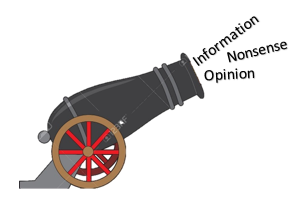
The Rot Spreads

The Rot Spreads

By Patrick F. Cannon

By now, we’re all used to the attack ads that make our political campaigns so amusing. But until recently, I hadn’t realized that our sophisticated techniques had reached into the most remote areas of our great land.

Although not widely known, I was born into modest circumstances in the coal mining community of Dismal Seepage, West Virginia. As a young lad of 12, toiling in the mines taught me the value of hard work. The town itself is so far back in the hills that its current Congressman, the Honorable Rufus T. Firefly, has as yet been unable to find it. At one time, most of its citizens, like me, worked in the mines. Now, most are on welfare. The women spend most of their time gossiping at the Baptist church hall, while the men hang out at the general store, coughing and wheezing.

It’s also the county seat for Despond County, one of the least populated in all of these United States. One of the county elected offices is the Dogcatcher. Now, you may think this is a joke, but I assure you that no office is more critical to the health and well being of Despond’s residents, particularly those who live in Dismal Seepage. While most of the people in the county live in the town, there are some folks who live in even more remote areas, some as far as the Slough of Despond or even the Valley of Despair. They are rarely seen in town, coming in only for Mason jars and rifle ammunition.

Here’s the problem. In their mountain fastnesses, they knew nothing of spaying or neutering. Their mangy barnyard curs reproduce with abandon, but only the strongest survive to battle for table scraps and the odd critter that stumbles into their domain. The rest have to leave to fend for themselves in the woods and hollows. Many, inevitably, end up in Dismal Seepage, where they often confuse the local citizen’s legs for the game they’re used to eating. The mayor disclaimed responsibility for controlling them, claiming that the voracious doggies had come to town from the county. Reluctantly, the county commissioners – all staunch Democrats – decided to act.  By unanimous vote, they decided to create the elected job of Despond County Dogcatcher. They also gave themselves the power – considering the urgency of the situation – to appoint an incumbent until the next election should occur.

Only one name recommended itself – Frank Dassisi, known to many of the “dog whisperer.” Himself the owner of the only purebred dog in town, a big black Poodle, Frank had a way with animals of all kinds, and was the only person in town who had not been bitten by one of the wandering curs. Frank was also the only Republican in town, and agreed to take the job only if he could run in the next election with that label. Desperate, and besieged by scarred and irate citizens, the commissioners reluctantly agreed.

As soon as he was sworn in, Frank began luring the strays into his back yard. He fed and cleaned them and – as if by magic – they became as docile as little lambs. When sufficient numbers were gathered, he loaded them into a county truck and took them to a shelter in Charleston, whence they were shipped as “West Virginia Mountain Hounds” to unwary liberals in Chicago and New York.

The good citizens of Dismal Seepage were finally able to stroll unmolested around town; more importantly, they stopped complaining to the county commissioners. Unbeknownst to the peaceable kingdom, however, trouble was on the horizon. When the next election season rolled around, it seems the chairman of the State Democrat Party, state senator Claghorn, was reviewing the list of candidates in the various counties and noted, with astonishment, that a Republican was running unopposed for Dogcatcher in Despond County. No Republican had ever run for office in that county, much less run unopposed by a candidate from the party of Thomas Jefferson, Jefferson Davis and Rod Blagojevich.

He was soon on the phone (land line, for no cells reached Dismal Seepage), berating County Commissioner Denver for permitting such an outrage! “Is that shiftless son on yours – John is it – still sponging off you?”

“Well, he is between jobs.”

“Put him on the ballot! He won’t need to sponge on you anymore, and we’ll handle the whole campaign.”

Faced with dire consequences if they refused, the rest of the commissioners agreed to put young John Denver on the ballot. Now, as it happens, although Dismal Seepage has a general store, folks actually have to go up the road to the metropolis of Logan (pop. 1800) to get more than milk, bread and Coca Cola. On their way back, they couldn’t help but notice that a long unused billboard had come to life. On it was a picture of Frank Dassisi being hugged by a beaming Donald Trump, with this bold message: Trump and Dassisi will tax your welfare check to build lavish puppy palace! Vote for Denver to stop their grab!

Coincidently, full color mailers turned up in everyone’s mail box. On the cover, there was a picture of Dassisi with his Poodle Fifi, with the caption: How can dogcatcher Dassisi afford a fancy foreign dog? And is Fifi more than just a pet? And are the strays he picks up actually going to good homes, or direct to the Chicago stockyards? What do you think is in those famous Chicago dogs?

Dassisi of course got a mailer himself, and heard about the billboard, which he inspected with disbelief. When he called Commissioner Denver to complain, that wily politician pointed out that he and his fellows had nothing to do with it, were in fact shocked, but were powerless to stop the onslaught. He claimed it was some shadowy group “up in the capital.” Indeed, the small print at the bottom of the billboard and mailer read: Paid for by the West Virginia Animal Protection Political Action Committee, which is solely responsible for its content. Not authorized by any candidate.

Dassisi, suddenly shunned by his neighbors, knew when he was licked and dropped out of the race. Unmarried and retired from the State Highway Department, he took his fat pension and Poodle and moved south to Ashville, North Carolina, where exotic dogs were not unknown.

Young Denver was duly elected Dogcatcher, and as could have been predicted, Dismal Seepage soon went to the dogs.

######

Copyright 2018, Patrick F. Cannon


Don’t Read the Fine Print!

Don’t Read the Fine Print!

By Patrick F. Cannon

I’m sure the television networks and local stations were in near panic mode when tobacco advertising was banned in 1971. No more happy faces extolling the virtues of their favorite brand as they merrily skipped toward an early grave. Could they survive with only detergent, deodorant, cereal and gasoline commercials? Little did they know it, but salvation would eventually come to their rescue.

As often has been the case, the Supreme Court and Federal regulators would take a hand and provide replacements – and then some. Throwing hundreds of years of legal tradition out the window, it was decided in 1977 that the American Bar Association’s Canon of Ethics ban on lawyer’s advertising their services was an unconstitutional limitation on their exercise of free speech. Lawyers who once exhausted themselves by chasing ambulances could now put up a billboard or air a cheaply produced commercial reminding citizens of their God given right to sue! Who in Chicago has not heard that adornment of the legal profession, Glenn Lerner, reminding his listeners: “in a wreck, need a check?”

Now, it’s true that some law firms show a bit more dignity. Instead of showing crashing cars and trucks, they have actual (sometimes) real clients proudly boasting about the millions they got through the exertions of their lawyers; of course, the lawyers rarely mention that they likely got almost half of it, and only take cases they know they’ll win, despite their protestations that they’re champions of the little man.

The docs beat them to the punch, although they have not been quite so aggressive. The Federal Trade Commission (FTC) gave them the right to advertise in 1975, although most – plastic surgeons and sex docs excepted – have mostly limited their advertising to a web site. I should add, however, that hospitals have been extremely aggressive in touting their sterling records, and this of course trickles down to the docs on their staffs.

Dentists have been more aggressive, particularly those who replace your real teeth with false ones screwed into your jaw bones. They tout easy financing, but don’t mention that a full set of chompers might cost you 50 grand.

But the real windfall, particularly for the networks, has been prescription drug ads. I’ve never been quite sure what these hope to accomplish. One supposes the idea is to get the suffering patient to urge their physician to replace their current pills with the latest miracle drug. They may also feed into the significant percentage of the population (are you one?) who imagine, without evidence of any kind, that they must be about to take to their death beds, despite not having even the slightest real symptoms.

Why anyone would eagerly want to take Bombasta, Exultuma, or Fracaraca after learning their scary side effects is beyond me. The Federal Drug Administration (FDA) insists that these ads at least highlight their direst side effects, which might run from a runny nose to instant death. But if you really want to be frightened, ignore the TV ads and look at the print ads. One page will show a smiling patient gamboling on a beach with his Poodle. But do turn the page and read every one of the thousands of words of warning. You might need a magnifying glass and a stiff glass of bourbon. On the other hand, maybe you should just trust your physician to read it for you.

(And then there are election ads, but you’ll have to wait until next week to learn how they have penetrated deep into the mountain hollows.)

######

Copyright 2018, Patrick F. Cannon


That Can’t Be True

That Can’t Be True 

By Patrick F. Cannon

(I thought that this piece, from 2016, was worth repeating; for example, the pandering “Non GRO Project Verified” seals are becoming more common.)

Miami Herald columnist Leonard Pitts recently wrote about how people continue to believe what they want to believe regardless of the facts. I’ve written before about the mistaken belief that crime is on the increase, despite statistics that show a steady decline. He quoted a recent survey that showed that 61 percent of Americans still believe that crime is increasing.

Pitts himself said that he found it hard to believe a recent survey that found a majority of Native Americans weren’t bothered by the name of the Washington Redskins. He admitted he thought the survey must be flawed in some way, despite its being commissioned by the decidedly liberal Washington Post.

The scientific method also continues to be under attack by stubborn groups who simply don’t seem to understand it. As a result, for example, children are contracting infectious diseases that should have been prevented by vaccinations; vaccinations that misguided parents believe are the cause of autism and other maladies. Now, it’s true that some very small number of children will have an adverse reaction to vaccinations (or  any other medication, for that matter), but rigorous scientific studies have shown convincingly that the benefits so far outweigh the risks that further discussion is pointless. But try telling that to the true believers.

Another hot topic among science deniers is Genetically Modified Organisms (GMOs). Despite the fact that numerous peer-reviewed studies have shown no adverse effects from growing or eating them, there is a steady drumbeat to either ban them outright, or force producers to label products that contain them. The European Union, that bastion of bureaucratic perfection, has actually banned them. In my view, this has more to do with a persistent anti-Americanism that any real fear that they would hasten the end of the world. Perhaps our European friends are sick and tired of the undoubted fact that almost every scientific and technical advance seems to sprout first in the United States. Both in Europe and here, the anti-GMO forces are reduced to simple fear mongering. Not “the sky is falling,” but “the sky might fall.”

GMOs are just one of a series of agricultural advances that are helping to feed a growing world population. And while we might pat ourselves on the back for eating organically-grown food, we need to keep in mind that the majority of the world’s population can’t afford that luxury. It may be that organic farming methods will develop in the future to the extent that they will be able to feed the world at a price it can afford. I look forward to that day. In the meantime, I console myself with the fact that numerous studies have demonstrated that organically-raised food has no significant nutritional benefit over the stuff most people eat.

Finally, the most persistent bogus science must be astrology. Shakespeare had it right 400 years ago, when he admonished one of his characters: “The fault, dear Brutus, is not in our stars, but in ourselves, that we are underlings.” I don’t hold out much hope for its disappearance. I read recently that another bogus science, alchemy, had a famous adherent — none other than Sir Isaac Newton. Alas, he never got hit in the head with a golden apple.

######

Copyright 2018, Patrick F. Cannon


A Grain of Truth

A Grain of Truth 

By Patrick F. Cannon

I’ve never quite understood what the phrase “a grain of truth” actually means. Some people seem to think it means that in a loaf of lies there may be hidden just a single grain that, isolated from the rest, could possibly be true, thus making the loaf palatable enough to swallow.

Increasingly, politicians of both parties are counting on us to think that just a little truth is truth enough. Here’s an example from my home state, Illinois. Unless you don’t watch television (in which case, congratulations), you’ve no doubt been told in ads from his opponent J.B. Pritzker that Governor Bruce Rauner is personally responsible for the state’s undoubted fiscal mess. Now, I happen to think that he is about as inept a politician as it’s possible to be, but I also believe he actually tried to put the state on a better fiscal course.

Why did he fail? Could it possibly be that he inherited most of the mess from someone else? And that the “someone else” preferred to keep doing business the same way? From 2003 until he took office in 2015, both the governorship and both houses of the legislature were controlled by the Democratic Party. They still control the latter, which, by the way, is responsible for passing a balanced budget. And the party itself is still controlled by Michael Madigan, a Chicago legislator who has been representing a district of roughly 100,000 souls for 47 years and is the longest serving speaker of any legislative body in the United States.

In the expected tit for tat, Rauner’s ads accuse Madigan and his cohorts of running a “corrupt” government. Using the old guilt by association tactic, he accuses J.B. Pritzker (a fellow billionaire) of corruption by association.  As it happens, Madigan has never been indicted for any crime. He is an expert in gaming the system; a system, it must be said, that he has been largely responsible for designing. Official corruption is an actual crime (as Chicago and Illinois citizens know to their sorrow), so accusing Pritzker of corruption is crossing the line unless he can back it up with facts.

I do know folks who say it’s OK to stretch the truth a little, but only for the candidate they favor. When the other side does the same thing, somehow it becomes dishonest. Now, I do think there are occasions when it’s acceptable for politicians to lie. I’m reminded of Winston Churchill’s statement about World War II that “in wartime, truth is so precious that she should always be attended by a bodyguard of lies.” Despite what many might think, running for office is not the same of fighting a war. So, it’s OK to lie to the Nazis, but to the voters?

Lying by politicians has become so pervasive that one of the world’s most accomplished liars became president of these United States. He continues to lie with abandon, confident that his supporters are satisfied with just the merest grain of truth. When we excuse a candidate who lies about his or her opponent because we agree with some of his or her positions, we have participated in the debasement of our politics.

When was the last time you saw a campaign ad that actually told you what the candidate stood for or planned to do, rather than highlighting the fictional crimes of the opposition?  Are you truly satisfied with just a grain of truth in an army of lies?

######

Copyright 2018, Patrick F. Cannon


History of the World, Chapter 9

Chapter 9 

Science Marches On 

Man has struggled to understand the mysteries of the Universe ever since it began with the big bang some 8,000 years ago. In addition to widespread temporary deafness and the killing off of the dinosaurs, the bang so addled people’s brains that it took some time for true scientists to emerge.

Curiously, good sense reemerged in Poland of all places, with the birth of Nicolaus Copernicus (1473-1543), called “Stash” by his friends. Educated by the Saturine fathers, he was strolling through the countryside one day and noticed something curious. A prodigious walker, Stash noticed that the further away he got from Crackowe (sic), the shorter the church steeples seemed to be. While the good fathers had insisted that the earth was flat, this phenomenon seemed to suggest that the earth might not be flat after all. Whether it was round or perhaps shaped like a watermelon (Stash’s favorite fruit), was still to be determined. It also occurred to him that if the Saturines were wrong about the shape of the earth, could they also be wrong about masturbation?

After an additional year of walking, Copernicus finally concluded that the earth was indeed round, helped along by the undoubted fact that the sun and moon seemed to be round too. He posited the theory that the constant revolutions of the heavenly bodies must have eventually worn them into globes. He tried his theory out with watermelons and pears, but hunger intervened and the experiment was abandoned.

His most controversial theory suggested that the earth revolved around the sun, which ran counter (or was it counter clockwise?) to the established dogma of Holy Mother the Church.  Fortunately for Stash, he died before his theory was published, thus avoiding the wrath of the Inquisition. Ever loyal to their wayward student, however, his former teachers celebrated his life with a Saturnalia.

Galileo Galilei (1564-1642), born in Pisa, then took up the cudgels or was it the gauntlet?  Now you may wonder how he came to have this strange name. When his father took his infant son to be baptized at the Basilica of the Holy Bovine (this was Tuscany after all), the priest naturally asked him what name he had given the little tyke. “Galileo,” responded the proud papa. “Yes, yes,” the holy fellow responded, “but what last name?”

“Well, that’s it padre, my dear son only has the one name.”

“Not permitted, sir, everyone must have two names, according to the prescripts of the church, as spelled out in Chapter 1,101 of Canon Law.”

Reluctantly, the proud papa ventured the name “Galileo Galileo.”

“Nice thought, but Chapter 1,102 makes it clear that one can’t have the same first and last names. Might I suggest naming the little bambino Galileo Galilei? I think I might just be able to slip that one past the Office of the Nomine Patre.”

So that’s the story. Despite the best efforts of the ecclesiastical legislators, however, few people today follow these precepts, preferring to name their children after flowers, rock musicians or mushrooms.

In any event, even at an early age, little Galileo wandered the earth looking skyward. As he often walked into trees, or buildings, or tripped over low walls, he was thought by his neighbors to be something of a menace to navigation. Eventually, they learned to steer clear and go about their business.  After all, this was Pisa, where even the buildings seemed confused.

Despite a good many knocks to the head, young Galileo went on to the University of Pisa, where he studied medicine and everything else that anybody then knew about. The conventional wisdom of those days said that Aristotle had pretty much figured everything out, but the budding genius wasn’t buying that. He had by then read Copernicus, and was beginning to have his doubts about how the heavens actually operated.

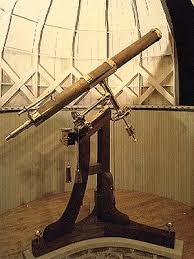
As so often happens in history and Agatha Christie mysteries, another “aha” moment changed the course of the story. It seems Galileo was draining a glass of grappa one day and, looking through the bottom of the glass, noticed that olives on a nearby tree seemed to have gotten larger. When he looked through the other end of the glass, the olives got smaller!  What if, he posited, one could take a piece of clear glass and grind and polish it until it gave a clear, enlarged image? Further, what if one put a series of such glasses in a tube until the image was enlarged many, many, many times?

He was soon hard at work on his idea and mentioned it to a visiting merchant of Venice, who immediately grasped its commercial possibilities. What if one could put such an instrument at the top of St. Marks, and thus get advanced warning not only of hostile fleets, but of the ships of ones competitors? In off hours, one could also get a peek in a neighbor’s bedroom window.

If he’d stopped there, he might have stayed out of trouble, but he began to train his telescope on the heavens above, and his observations convinced him that the despised Copernicus had been right after all and the earth wasn’t the center of the Universe, but a paltry planet spinning around the Sun. Well, this didn’t sit too well with Pope Rictus XVI, who summoned Galileo to come to Rome forthwith to explain why he shouldn’t be burned at the stake, or at least be drawn and quartered.

In due course, Galileo was convicted of “heretical common sense,” and placed under house arrest. This did not prevent his friends from visiting and telling him stories of their travels. To while away the time, he wrote up their stories in a little book he called the Decameron, but wisely used the pen name, Boccaccio, after a neighbor and pig farmer, who couldn’t read and would thus be none the wiser.

The only other scientist of any note until Thomas Edison was born was Sir Isaac Newton (1642-1726 in the old calendar, but 1643-1727 in the new, which most people preferred, since it let you live a bit longer).  He was born at Woolsthorpe Manor in Woolsthrorpe-by-Costerworth, in the county of Lincolnshire (I kid you not). His father died before he was born, and his mother remarried when he was three. Her new husband was an Anglican priest, who apparently took a dim view of young tikes, so mom left little Isaac to be raised by his grandmother.

Apparently, marrying Ma Newton was the kiss of death, because hubby number two soon died, and young Isaac – by then the brightest bulb at the local school – was put to farming the family land. One day, as he was resting under an apple tree from his exertions with the plow, he was rudely awakened from his nap when an apple fell upon his noggin. When his head cleared, he stood up just in time to dodge another apple. Why, he wondered, did the apple fall instead of rising? Thinking, as all scientists are wont to do, that there must be a reason, he began the thought process that would eventually lead to the invention of gravity.

By the way, as a matter of interest, the apple was of the Macintosh variety. This fact was suppressed for hundreds of years, as the English did not want the Scotch to get any credit. They fostered the rumor that the apple had been a Granny Smith, named after a local pub owner. Now you know the truth.

While the glimmerings of gravity whirled about his brain, he realized that he did not yet have enough education to be taken seriously, so he packed a bag and walked to Cambridge, where he was admitted to Trinity College. There he perfected his theory of gravity, invented the science of optics and even found time to come up with that bane of high school students everywhere: the calculus.

His achievements were much honored. He was made a Knight of the Bath, whose rituals still include an annual get together where all the knights gather at a communal bath, drink a lot of ale and frolic in the nude. He became president of the Royal Society and Master of the Royal Mint. It must be this last that led him to experiments in alchemy, which proves that even the smartest people can be as dumb as you and I.

By the way, he’s buried in Westminster Abbey, just next to David Livingstone, who wouldn’t be there at all had he not been found by Henry Morton Stanley. Such are the vagaries of history.

######

(Alas, thus far there is no Chapter 10. Maybe next year.)

Copyright 2018, Patrick F. Cannon



History of the World, Chapter 8, Part 3

Chapter 8, Part 3 (and the end really)

By Patrick F. Cannon

                       Sail on, sail on, sail on

                        Said Captain Chris from his perch on the poop

                        Sail on, for riches await

                        The crew, it must be said

                        Weren’t buying what Chris was sailing

                        And sometimes wished that he were daid

                        (Anon. But one has suspicions.)

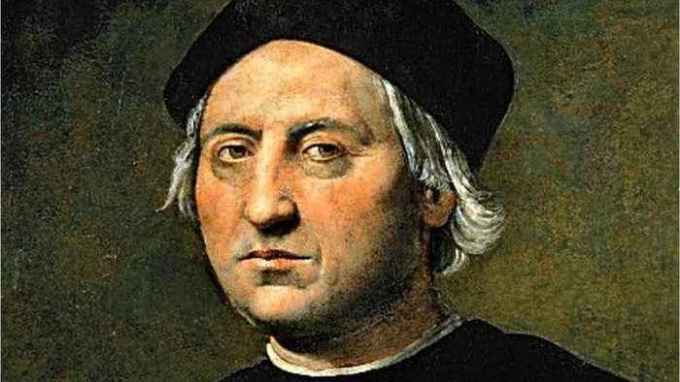
Now that the Portugeezers had established a watery route to India, we can return to Christopher Columbus, who thought he had a better way. Looking at Ptolemy’s map as he often did, he decided it was foolish to go all the way around Africa, when it would be much faster to simply sail west and arrive at the same place.

Being a proud Italian, he tried selling the idea to the local princes first, but most were short of money as they were continually fighting among themselves and having their portraits painted. He then went to France, but soon discovered that the French felt they had already found heaven and couldn’t imagine why anyone would wish to go anywhere else. Columbus pressed on to Spain, where King Ferdinand and Queen Isabella were just about to toss the last Moors out of their country. With the booty they had taken from their retreating enemies, they were flush with cash and looking for new worlds to conquer. Timing is everything and Columbus rang the castle bell just when the monarchs were in a good mood.

They provided cash for three ships and crews, with the understanding that any lands discovered would be theirs, along with most of the gold, jewels and spices. Columbus figured that his share would be more than enough to greatly improve his standard of living, so he was content.

He set sail on August 3, 1492, full of confidence. “If we just keep going west,” he told his crews, “we’re bound to bump into something, most likely Japan.” “OK,” they responded prudently, “just as long as we get paid.”

We have to remember that in those days people who got on ships generally expected them to arrive somewhere other than their port of departure. Nowadays, of course, we’re perfectly content to sail around aimlessly for a week or two and arrive back where we started, just so long as we’re fed five times a day.

As the weeks went by with no sight of land, the crews became understandably concerned, particularly since the late night buffet consisted mainly of hard biscuits and even harder salt pork, washed down with water that was, to put it nicely, a bit cloudy.

When they expressed their misgivings to Columbus, he invariably replied: “Sail on.” This soon became tiresome, and mutinous mutterings became the order of the day. In the event, Columbus was saved, when on October 11 land was sighted. It was an island Columbus called San Salvador. He planted the flag of Spain on the beach, watched warily by a group of naked natives, who wondered why anyone would wear heavy clothes in such a climate.

Columbus himself was somewhat confused at the nakedness of his greeters, having assumed that the Japanese wore clothes just like everyone he had met heretofore. Perhaps Marco Polo had failed to mention it? He asked the natives if he could look around for gold. They didn’t seem to mind, although one must assume that their Spanish was minimal.

No gold was found, so Columbus began wandering around the area. He planted so many flags that the crew was soon busy making new ones. Before he ran out of fabric, he had discovered what is now Cuba (which he thought was China) and Hispaniola. The natives there actually had a few bits of gold, and told Columbus (using sign language?) that the gold was found up in the hills, where it has largely been found ever since.

But fate intervened (as it almost always does) and the Santa Maria was wrecked before they reached the gold. Columbus decided they would need a lot more people and shovels if they were to get at the gold, so he decided to return to Spain, leaving behind 39 men to hold the fort (which they also had to build).

When he returned with many more ships, some empty to hold the expected gold, he discovered that the natives had wised up and killed his men. Setting a precedent that held true for hundreds of years, he enslaved the natives and set them to work digging for gold. They didn’t find much, but did discover that the Europeans returned with a variety of diseases, both venereal and funereal.

The hapless Columbus never gave up, traveling back and forth from Spain to what he continued to think was the Indies. He finally died in 1506, still claiming that he had found the Indies. By then, sadly, he was commonly known as Crazy Chris. Although he never set foot in what is now called the United States, in recognition of his dogged determination, that country established October 11 as Columbus Day. While many are happy to celebrate it as a welcome day off, others believe Columbus should be condemned as a gold-happy native killer. So far, the day off has prevailed.

#####

Copyright 2018, Patrick F. Cannon
 

Chapter 8, The Age of Discovery, Part 2

Chapter 8, The Age of Discovery, Part 2

By Patrick F. Cannon

The record of discovery becomes clearer in the 15th Century, when the remarkable Prince Henry the Navigator appears on the stage. He was the son of King John of Good Memory of Portugal. His father got this name because he never forgot who owed him money, thus making Portugal one of the most prosperous countries in Europe.

If you get your atlas out, you’ll see that Portugal is a long, skinny country. Its coast faces both west and south. Being at the very edge of Europe, its people were forced to look either out to sea or towards Spain. Since mountains obscured the view to a country they didn’t much like anyway, the average citizen preferred the ocean view.

Since his father took care of the money, Prince Henry was at leisure to dream of what lay beyond his narrow domain. To make things easier, he built at castle right at the bottom corner of his country so he could, on alternate nights, dream west then south.

Everyone, of course, knew that Africa existed to the south, but didn’t have a clue how far south it might extend. It did seem a better bet for exploration, since one could hug the coast rather than sailing off into the unknown (except to the Vikings, but they didn’t care any more). Somewhat complicating Henry’s ambition was the indisputable fact that the further south you sailed, the hotter it got.

The timid felt that if you got too far south, the water would get so hot it would boil. While this might permit mariners to catch already-cooked fish, it could also melt their ships caulking, putting the crew “in the soup” as it were.

They also thought, with some logic, that you might turn black. Because they were sometimes seen in North Africa, the Portuguese knew that the peoples who lived in the south were black or at least dark brown. The Portuguese did a lively trade with the English, who were very fair skinned. Since they knew that the Sun rarely if ever shone there, and that they were darker than the English because it often did in Portugal, it just seemed sensible to assume that the further south they went, the darker they would become. Would their friends and relatives even recognize them when they returned?

As he stood on his lofty battlements, it occurred to Henry that these were risks worth taking, particularly since he could afford to send someone else. As it happened, two young worthies named John Concalves and Tristan Vaz came looking for work.

Being careful not to mention the boiling water and black skin theories, Henry convinced them that riches awaited them along the African coast. So off they went, only to be blown west by a storm, ending up in what is now known as Madeira. Deciding to leave well enough alone, they returned. Henry, it must be said, was a trifle disappointed, but decided to make a virtue out of necessity. He sent them back to colonize, thinking to make the island a way station for future explorations.

They took various seeds along, including grapes. Had they not, the now famous phrase “Have some Madeira, my deara” would not have entered the lexicon.

Henry might well have been known as the “Persistent” as well as the “Navigator” (had not the rules been so strict about such things) for he didn’t give up his dream of exploring the African coast.

Each year, his minions set forth, slowly advancing along the African coast. When they reached the farthest west point of the continent, they discovered that the currents met there and created the turbulence that the ignorant had thought was boiling water. This could easily be avoided. Nor did they turn black, although some of them got nasty sunburns.

As they landed along the coast, they found many of the natives trusting and welcoming. As so often happens in history, they turned this trust to their advantage. Luring the natives on board their ships with the promise of an afternoon’s sail, they promptly put them in chains and brought them back to Portugal as slaves. Needless to say, they didn’t turn white.

While Henry was pleased with this new source of income, what he really wanted to find out was whether, if he finally got around Africa, he could go east and find the Indies.

He knew that the Indies existed and were a source of the spices that Europe craved. Had not Marco Polo traveled over land as far as China?  Had not others retraced his steps and set up the famous Spice Roads that permitted him to have his favorite breakfast, cinnamon toast?  But had not the crafty Turks closed the roads to Europeans, creating a monopoly for themselves?

In 1488, Bartholomew Dias actually reached the tip of Africa, which he called the Cape of Storms, changed to the Cape of Good Hope by later tourism authorities. He wanted to press forward, but his crew had had enough and convinced him to turn back. The fits and starts method of exploration continued until 1498, when Vasco de Gama (bloody leg in English) finally got to India. The place he landed was later called Goa, since he left a few men behind to create a settlement, saying: “We goa back, you stay.”

(Next week, Part 3, if you can bear the wait.)

######

Copyright 2018, Patrick F. Cannon
Chapter 8, The Age of Discovery, Part 1

Chapter 8, The Age of Discovery

Part 1

(Author’s note: It’s not my fault that it took so long to discover stuff, but it did result in a longer than usual chapter, so I broke it down into three parts. By so doing, I hope that my readers will not be more than usually annoyed.)

By Patrick F. Cannon

In fourteen-hundred and ninety-two

Columbus sailed the ocean blue

It took so long, it must be said

That his crew would often wish him dead

He finally reached land, but found no gold

While others got rich, he just got old.

Anon. (understandably)

Because Christopher Columbus (or Cristiforo Columbo as he was known to his proud parents) “discovered” the Americas, he has become the best known of the explorers who changed the face of the world between 1450 and 1550 (more or less). This is particularly true in the United States, which would not exist were it not for Columbus. Of course, in China no one has ever heard of him.

But we’re getting ahead of ourselves. After all, Columbus just didn’t wake up one day and decide he’d like to discover new continents.

For thousands of years, people had looked at the heavens and wondered who and where they were. After language was discovered, they pretty much knew who they were, as names became quite common. The smarter among them, Aristotle for example, noticed that the Sun and Moon seemed to be round, and that when the Earth got between the two of them (what we now call an eclipse), it cast a curved shadow. He thus supposed that the earth was round too.

While everyone considered Aristotle a smart fellow for figuring this out, it didn’t seem to make much difference in their daily lives. While rich Greeks might take a boat ride across the Mediterranean to see the pyramids, that was about as far as they wanted to go. Frankly, while they might agree with Aristotle in public (even now, Greeks stick together), they had a nagging suspicion that if they traveled too far they might fall off and end up in Hades or some such place.

We now know this was nonsense. They actually would have ended up in the Sudan, which was bad enough and has often been called a “hell on earth.”

Some Greeks, Alexander the Great for example, were more adventuresome. He went as far as modern Kashmir before turning back. Because he had been a student of Aristotle, he probably was aware that if he just kept going east he would eventually end up back in Greece. While he admired his former teacher, he probably thought: why take the chance? And who can blame him? He had already met his share of Pakistanis and Indians and might have wondered what else might be in store.

Several hundred years later, Claudius Ptolemy was born to a mixed marriage. Because he was half-Roman and half-Egyptian, he was shunned by his schoolmates so had plenty of time for reflection. One of the first “geeks,” he became proficient in astronomy and mathematics and soon had the earth pretty much figured out. Not only did he know it was a sphere, but he knew where all the continents were. He also decided that the place he lived was on the top half of the sphere (human nature at work), which he called North.

Even a lot of knowledge can be a dangerous thing, for it turns out Ptolemy was a little deficient in geometry. He calculated that the earth’s circumference was 18,000 miles, when we now know that it’s almost twice that. As we’ll see, this was to cause a good deal of trouble.

Long before the Portuguese and Spanish began their explorations, legend tells us that the Vikings and the Irish may well have discovered North America. We know that Eric the Red and his relatives and friends settled what are now Iceland and Greenland and may well have pushed further on to Nova Scotia. While their homelands were pretty cold, Iceland and Greenland were even colder, so Eric might have concluded these new areas weren’t really an improvement, especially considering the voracious Polar Bears wandering around. The evidence of their explorations is fairly convincing, but as they didn’t leave any signs behind saying “Eric the Red was here,” some historians have been skeptical.

Ancient Irish sagas tell stories of similar explorations, but are a bit vague, much as your typical Irishman is after a long night at the pub. While they apparently didn’t leave any convincing evidence, no one has ever adequately explained why there are so many Irish in Boston.

(Next week – Henry begins navigating!)

                                                            #####

Copyright 2018, Patrick F. Cannon


A History of the World, Chapter 7

Chapter 7

The Three “Rs” – Renaissance, Reformation and Rugby

By Patrick F. Cannon

(Editors Note: You will notice the curious title of this chapter. The author makes the dubious claim that Rugby was invented in 1567. I have found no evidence to support this claim. Mr. Cannon has generally been scrupulous in his researches, but has failed in this instance, or so it seems to me. You have been warned.)


The most curious fact about the Renaissance is that it originated in Italy but is described with a French word. It of course means “rebirth.” In Italian it’s “rebirtho,” so maybe that’s why the French is preferred.

At any rate, as we have learned, when the Dark Ages dawned, monks had spirited copies of the ancient Greek and Roman texts to Ireland. They had not only protected them, but also made many copies. When the coast was clear, they began travelling to Europe and wherever they went established great universities and bookshops.

By the 14th Century, they had managed to teach the previously loutish priests in Europe to read and write Latin. This strengthened the church, since they could now correspond from country to country with their temporal rulers being none the wiser. As often happens, one of the priests spilled the beans to King Louis the Learned of France, who demanded to learn the ancient tongue (or the distraught priest wouldn’t have one of his own). After that the genie was truly out of the bottle and soon the upper classes were chattering away in the language of the Caesars.

The Irish priests were soon doing a brisk business. Readers were truly astonished to discover that civilizations that were long dead had in fact been more advanced than their own. Instead of slogging through turds and urine in the streets, it appeared that the Romans had invented something called the sewer to carry the smelly stuff away underground into nearby rivers. If they could duplicate this marvel, they could start wearing nicer shoes!

Time passed, as it almost always does, and soon everyone who was anyone was wearing Italian shoes and having their portraits painted.

This preoccupation with shoes and self-image has persisted right up to the present, so we owe a great debt to the Renaissance men. In philosophical terms, this is called humanism. Prior to then, people worried more about what God might think of them; ever after, keeping up with the Borgia’s became an obsession.

The names of the great artists of Italy ring loudly down the ages – Donatello, Michelangelo, Raphael, Brunelleschi and Titian. But we remember only their first names, thus starting a tradition of calling artists by only one of their given names that persists to this day. Who indeed knows the full names of Picasso, Monet, Degas and Dali? Or, in another realm, the full names of Elvis, Brittany and Beyonce? If someone is known by their full name – Andy Warhol, Norman Rockwell, Lawrence Welk – you can be assured that their fame will be fleeting.

The one exception that proves the rule is, of course, Leonardo de Vinci. This was truly a Renaissance man! In addition to painting and sculpture, Leonardo dabbled in architecture, military engineering, poetry, philosophy and backward handwriting. His sketchbooks are full of wondrous things, including what appears to be an airplane. While much of this is amusing in its way, it did prevent Leonardo from doing what he did best – painting portraits of enigmatic young women like the famous Mona Lisa.

Unfortunately, his restless experimenting with new techniques ruined his other famous work, the Last Supper. Not content with the tried and true methods of fresco painting, he experimented with new paint formulations and the great painting began to deteriorate soon after it was finished. While attempts have been made from time to time to restore the work, it’s now very difficult to see who’s eating what.

The other great artist – immortalized by that great modern statue, Charlton Heston – was Michelangelo. He worked on the grand scale. His great David must be two stories high and David’s sex is not in doubt (although, curiously, women did not appear to have genitals until the 20th Century). His other great work is the ceiling of the Sistine Chapel at the Vatican in Rome. Done for Pope Julius II, the paintings best known image shows the finger of God waking up sleeping mankind. For hundreds of years, tourists have stared rapturously up at this stunning work, providing continuing work for street corner chiropractors.

Michelangelo was purported to be the first homosexual. While there is no direct evidence (his not getting married may only have shown good sense), it cannot be denied that the men in his works tend to be muscular and comely fellows, while the women tended to fat. On the other hand, Rubens’ women were certainly chubby and we know he was a happily married man with several children. Since he was also rather more surly than gay, Michelangelo’s sexual preference may never be known with certainty.

Lest we think that the Renaissance was limited to the arts, we should be reminded of the groundbreaking political scientist, Niccolo Machiavelli. In his famous book, The Prince, he laid out the path that politicians have been trodding to this day. While his ideas can be complex (and are written in Italian for some reason), they can be summarized as follows:

+All power corrupts, so you might just as well have as much as possible.

+Elections can be useful, but only if you can control the results.

+It’s OK to kill your opponents, but only if you can blame someone else.

+Damn with faint praise.

+Wage war on the weak; ingratiate yourself to the strong.

+Never give a sucker an even break.

The spread throughout Europe of these and other useful ideas was made possible through the coincident invention of the printing press by Johann Gutenberg. Prior to his invention of moveable type in the mid-15th Century, books were hand lettered by the ubiquitous Irish monks. Now, you could carve letters in blocks of wood and move them around to suit. Once you had set a page in type, you could print many copies without recourse to multiple monks. Because spectacles had not yet been perfected, the size of the letters, and thus the books, tended to be rather large. It took a good man to carry a Gutenberg Bible! The Irish copyists soon became redundant and most returned to Ireland, where they took to the drink.

Had the monks been aware of what was going on in Wittenberg, they might have stuck around. It seems that an Augustinian monk named Martin Luther had gotten fed up with the Roman Catholic Church’s most lucrative fundraising scheme (bingo hadn’t yet been invented) – the selling of Indulgences. Simply put, Indulgences were pardons for your sins. Say you had spent your life whoring, gambling and cheating your fellow man. You could pop around to your local priest, confess your sins, do penance and promise to sin no more. What could be simpler? But what if the penance consisted of wearing sackcloth and ashes and crawling up the Matterhorn on your hands and knees?

If you had the cash, there was a better alternative. Go to the same priest, list your sins and assign a monetary value to each one. Then pay up like a man and wipe the slate clean. Then go and sin some more, and so on. The priest took his cut and sent the rest to Rome. The Pope could then afford to hire Michelangelo to paint the ceiling, thus encouraging the arts. Everyone benefited, which is the essence of economics.

For reasons of his own, Luther didn’t think this system was right. Perhaps he wasn’t getting his share. Nevertheless, he sat down one day in 1517 and soon had a list of 95 Theses (reasons) why the Church had gone astray. Instead of mailing them to Rome – he was a poor monk after all — he nailed them to the door of the local church. Most of the Wittenbergers couldn’t read, so they went about their business wondering who the crazy monk was. But agents of the Pope were soon on to him.

News didn’t travel fast in those days, so it was 1521 before the church leaders gathered for the Diet of Worms (named for the city, not the participants). Poor Luther was condemned as a heretic and excommunicated. One of those who most roundly criticized Luther was King Henry VIII of England. For his support, Pope Leo named Henry “Defender of the Faith.” Later, he had cause to regret this.

Not for the first time (or presumably the last) the Church misjudged public opinion. It turned out that only the wealthy few could afford to buy indulgences. The rest were tired of crawling on their hands and knees up stone staircases and decided to support Luther. Being simple people, they called themselves Lutherans instead of Anti-Indulgencers. It’s just as well, since few people would want to belong to a church call the Anti-Indulgencers, Missouri Synod.

Soon, others got on the Luther bandwagon and began to protest against the abuses of the Roman church. Indeed, there were so many protestors that the general term Protestants was coined to describe them, although each retained their own special name. Thus, the followers of John Calvin became knows as Calvinists. Less successful was Johannes Bigams, who espoused plural marriage. To this day, Bigamist has a naughty connotation.

It must be said that support for the Reformation was not entirely religious in nature. As usual, princes and other nobles saw an opportunity for feathering their nests by seizing church property. When Henry in England got wind of this, his anti-reformation zeal began to cool.

What really brought him around, however, was the Pope’s refusal to grant him a divorce from his first wife, Catherine of Aragon, who had not given him an heir. Henry, it must be said, had never quite understood how some Italian in Rome could possibly be smarter and more powerful than he (and have more money) and decided that the Church in England needed a leader closer to home, and one who wasn’t adverse to divorce, namely himself.

He granted himself a divorce and married Anne Boleyn in 1533. Alas, she didn’t do any better than Catherine and was executed in 1536. He kept trying though and had six wives in all. Shakespeare immortalized Henry’s hapless quest for the perfect wife in his play, The Merrie Wives of Windsor. His many marriages and their expense may have hastened his seizure of Church property, which he accomplished with the Act of Supremacy in 1534. While some of the abbeys still stand in England, most have been converted into expensive country hotels.

With creativity flourishing in the arts, and people happily killing one another over religion, it might seem that little time was available for other amusements. Nevertheless, in precincts remote from the great centers of art and religion, young men were busy inventing amusements that have, in our day, assumed greater importance than either art or religion – sport.

Although the Olympic Games had fallen victim to Roman prudery, to be replaced by the clothed brutality of the Coliseum, young men in more primitive regions kept the sporting flame alive. After battle, for example, the winners often beheaded the vanquished, then would choose a likely head and toss it around for amusement. In Asia, with horses more available, they would toss the head around on horseback until one of the warriors reached an end line, by which time the head was somewhat the worse for wear. Another fresh head was usually available and so the game would continue. The man who tossed the head over the end line was called the “chucker,” a term still used in a modern variation called polo.

In Europe, only the nobles could afford to keep horses and indulge in the sport of jousting. The lower orders enjoyed watching the matches, but their sporting spirit was confined to placing a bet or two. Then one day in 1567 at a small school in the English village of Rugby, one of the lads came upon a pig’s bladder, left behind by the schools butcher. Being naturally curious, he picked it up and noticed that one could blow into one of the tube like appendages and capture the air within.

He tied the tube into a knot and happily threw the pigskin bladder into the air. His fellow students gathered round and soon were cheerfully throwing the pigskin back and forth. There were 22 of them, and being English they soon had things organized. The headmaster, a divine named Dr. Arnold, codified the rules and they have changed little since. One is permitted to run with the ball, kick it and throw it to ones teammates. Holding the ball has its dangers, since your opponents can tackle you. Although it’s unclear just why it’s done, every so often the referee takes the ball and has all the players grovel in the mud together for a bit, then throws the ball under them, whereupon the running, kicking and tackling begin anew.

Rugby was invented by the sons of the upper and middle classes, and was thought to be a gentleman’s game, despite the mud, but a variation was made available to the lower orders. Now called “football” (or soccer by ignorant Americans), it did not permit players to hold the ball and run with it. One could hit it with ones head or kick it. No tackling was permitted, since it was thought the poor were too weak and undernourished to stand the punishment.

Modern games such as American football, ice hockey, field hockey, La Crosse, and kick-the-can are familiar derivatives. Meanwhile, down the road at Eton College, the more intellectual students there had taken to whacking rocks about with small tree branches called “crickets.” Eventually, one of the boys would throw a rock to his fellow Etonian and he would hit it back. Due to their intellectual prowess, the boys soon made up rules that remain puzzling to this day.

Not to be outdone, over in the former colonies in North America, young men invented a variation called baseball, and made sure that the rules would be as incomprehensible to Englishmen and Cricket was to them.

Sport’s relationship with history is well known. Cricket gives us a good example. When the English expanded their Empire, they brought the game with them. Initially, the natives were as puzzled by it as Americans still are. Eventually, they began to catch on. When the Australians, Indians and Pakistanis actually beat teams from the mother country, it was considered that they were finally intelligent enough to govern themselves. And while the English later had second thoughts about this, it was too late.

And who can forget the Duke of Wellington’s remark that the Battle of Waterloo was won “on the playing fields of Eton.” Perhaps Napoleon was not so much defeated as confused.

(Next week – we’re discovered!)

#####

Copyright 2018, Patrick F. Cannon


A History of the World, Chapter 6

Chapter Six

The Middle Ages

By Patrick F. Cannon

We historians constantly strive to keep things simple. When the profession was struggling to come up with a handy name for the period between the Dark Ages and the Renaissance, one of our brighter luminaries (Carlyle, as I recall) said: “You know, it was a period midway between the birth of Christ and this very day, so why not call it the Middle Ages?” So there it is. What could be simpler?

Of course, like much of history, this may well have to be reevaluated in the future. Imagine the historian of the 30th Century. He asks himself why everyone calls the Middle Ages the Middle Ages when to him the Middle Ages would have been the 15th Century, which we now know as the Renaissance. One could of course get bogged down with such questions; so we must let the historians of the future do what we ourselves do today – change history to suit the needs of the times.

Such questions aside, when did it begin? Most competent authorities believe the Battle of Hastings was the true beginning of the Middle Ages, since it isn’t easy to think of anything important happening before 1066.

William the Conqueror, by the way, wasn’t always known as William the Conqueror. He started as simple William, Duke of Normandy. He often walked the beaches of his realm and wondered what lay beyond the horizon (actually, on a clear day he could see what lay there; it was England). As a young lad, he had heard tales of the strange goings on over the water and determined some day to extend civilization to the heathens there. When he heard they didn’t speak French, the die was cast.

Offering the usual incentives of plunder and free land, he gathered an army and set sail in 1066. After a trouble-free passage, he landed on the coast, which seemed the most sensible approach. King Harold, who had just defeated Tostig and Harold Hardrada (no relation) of Norway, soon learned of this new threat to his throne and turned to face the new invaders. The two mighty hosts met at Hastings. The Normans prevailed and Harold was killed in the battle. His son, known as Childe Harold, escaped and went into exile.

Harold was the first known victim of that well- known truism: always avoid war on two fronts. Poor Harold (as he’s come to be known) really can’t be blamed, since he simply wasn’t aware that William was on his way. When he found out, flush with his victory, he coined what has become a very popular British expression – “Bloody Frogs!”

It took William a few years to conquer the entire country. This was greatly facilitated by the construction of the Tower of London in 1067. When the Saxons rebelled in 1070, they chose as their leader Hereward the Wake, with predictable results. After their defeat, the Saxon nobles disappeared into Sherwood Forest, where they subsisted for the most part by robbing the rich and getting rich themselves. One of their numbers, Robin of Locksley, actually shared a bit of his ill-gotten gains with the poor and has been famous ever since, if more or less unique.

Relations between the Normans and Saxons improved somewhat under Richard I, who is known as the Lion Hearted. After returning from the Crusades (and a spell of captivity for ransom in Germany), Richard pardoned all the Saxons, making Robin Earl of Locksley. Other of his followers were handsomely rewarded as well. Friar Tuck became Bishop Tuck, and Little John became Big Bad John.

After the Lion Hearted died, his Brother John was crowned King and it rather went to his head. He was soon taxing all and sundry and generally making a nuisance of himself. In due course, the Barons had had enough and forced John to sign the Magna Carta (Big Letter) at Runnymede in 1215. This famous document limited the power of the King and enabled the Barons to get some of the spoils for themselves. Later Kings were quite annoyed that John had signed the letter, so his name was never used again in polite society. If his name had been Henry, then presumably there would not have been a Henry VIII, which would have changed the course of history.

A word perhaps needs to be said about chivalry. Since high born women of the time were not encouraged to have sex before marriage, their suitors were forced to worship them from afar (even if they got close, they often discovered the infamous chastity belt, or “iron maiden” as it was sometimes called). Naturally, they comported with women of the lower orders, but spent most of the rest of the time mooning after the remote maidens. Some swains composed poems and simple ditties. If they were brutish illiterates (as was often the case), they would hire a wandering poet/troubadour to do it for them.  A real highlight for them would be when their lady threw them a hanky (unused, one would hope) to tie to their lances before they lumbered into battle. This was considered a good luck token, but it appears to have worked only half the time.

Knights and nobles were always looking for opportunities to shine. Thus, when Pope Urban appealed to the Christian rulers in 1096 to free the holy places in the Holy Land (actually, Jerusalem and its environs), they jumped at the chance. Richard the Lion Hearted was foremost among them. Despite taking forever to get there, they finally rescued the holy places in 1099. Then, as now, killing your enemies in great numbers only made the holy places holier.

Alas, the Muhammadans had their own holy places in Jerusalem and seethed at their loss. They recaptured Jerusalem in 1187 under the mighty Saladin. Not to be outdone, the Christians set out on another crusade. When it didn’t work out, the children of Europe decided to take things into their own hands and 30,000 of the little tykes set out on the Children’s Crusade. It wasn’t anything like a Disney movie and the children who weren’t killed were sold into slavery.

But their noble sacrifice shamed their elders into trying again in 1228. They were successful, but were tossed out again in 1243. Had they persisted, the next crusade would have been the seventh and might well have succeeded once and for all, but they had lost count and suffered the consequences of faulty math. Not for the last time, history was the victim of politicians who couldn’t add.

Now that they had given up fighting the Muhammadans, the Europeans naturally took to fighting among themselves. While we might think that the six years of World War II was quite long enough, the English and French fought what has come to be known as the 100 Years’ War. One might quibble and point out that the wars actually lasted 107 years, but we can certainly agree that there was a certain animosity between them.

(Some might say that some of this animus persists. When the Channel Tunnel was

being built in the 1980s, an English clergyman was quoted as wondering why anyone would want to go to France at all, much less quickly.)

Alas, the rest of Europe behaved little better than the English and French. Most of Germany and Italy were carved into little Duchies and Principalities, which were endlessly squabbling among themselves. One of the consequences of so many petty states, particularly in Italy, was that the market for paintings and other decorations greatly expanded, since even the most petty prince wanted to grace his castle with pretty pictures, including one of himself. Artists who once didn’t have enough work to bother perfecting their talents all of a sudden were working overtime. One of them, Giotto, noticed one day that the people he was painting didn’t much look like the paintings themselves and was determined to do something about it.

While he was fiddling with noses and perspective, to the north a lusty young priest named Martin Luther had just about had it with the church’s main source of income – the selling of indulgences. And in the Celtic areas of France, Scotland, Wales and Ireland, the more sporting of the young men were inventing a new game to while away the cold and rainy days. In case you haven’t figured it out for yourselves, the Three Rs – Reformation, Renaissance and Rugby – were looming over the horizon.

######

Copyright 2018, Patrick F. Cannon