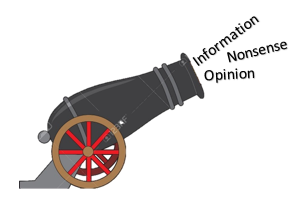
Slipping Through the Cracks

Slipping Through the Cracks

By Patrick F. Cannon

I was reluctant to comment again on gun control, but for what it’s worth, I think one could argue that assault weapon and bump stock bans would be worthwhile, if mostly symbolic. Do you really need an AR-15 to hunt deer or elk? The bolt- or lever-action long guns that have traditionally been used for this kind of hunting are more than adequate – you could even argue that they are better suited for hunting than an assault-type rifle.

Beyond that, what other “meaningful” gun legislation could we pass? We already have background checks and waiting periods, although they might well be tightened. We have registries that prevent felons and others from buying guns. If we’re worried about a particular gun owner, we can contact law enforcement. What we can’t do is eliminate human fallibility.

In the case of Parkland High School, the FBI had received tips about Nikolas Cruz, but failed to follow up. In the Sutherland Springs, Texas church shootings, the Air Force had failed to add shooter Devin Patrick Kelley’s felony court martial conviction to the national registry. As a result, he was able to pass a background check. In both cases, new laws would have been meaningless. What was needed were people doing what they were supposed to be doing. The strict enforcement of existing laws and regulations would actually have prevented many of the mass shootings.

Schools around the country need to have better security.  Many already lock their entry doors after the school day begins; visitors then must go through a security check before gaining access. Sadly, this needs to be done universally. Classroom doors should also be locked on the outside, a simple precaution that could have saved lives in some school shootings. Again, no legislation is needed, only common sense local action.

Don’t expect the National Rifle Association to change its attitude any time soon, unless there’s a mass exodus of its individual members. This has not happened, and we should also keep in mind that the NRA also represents gun manufacturers, who are not likely to voluntarily go out of business.

Even if they did, it’s estimated that Americans already own more than 300 million guns, and the courts have consistently upheld their right to “keep and bear” them. Unless through some miracle — that I can’t imagine ever happening – the Second Amendment is changed or repealed, the courts will continue to be wary of arbitrarily limiting the sale of firearms.

There is no question that weapons like the AR 15 make mass shootings more lethal, but we should keep in mind that the overall murder rate is half what it was in 1980. And for those of you who live in Chicago, there are 24 cities in the US with higher murder rates. Of course, none of this is going to console those who have lost loved ones to guns, but we should try to keep this emotional issue in some perspective.

Instead of picketing the NRA, we should be making sure that our schools have adequate security measures in place; that the FBI and other police agencies are doing their jobs; and that a national registry that is all inclusive is up and running. We can no longer count on our legislatures to do anything meaningful, much less the right thing. But as taxpayers we can demand that the people who work for us earn their pay.

######

Copyright 2018, Patrick F. Cannon


I’m in Florida, and You’re Not

I’m in Florida, and You’re Not 

By Patrick F. Cannon

Retired people with some money often flee places like Chicago during the winter to warmer climes like Florida or Arizona. As it happens, I have spent a week or so at a time in Florida for many years, so have become something of an expert on all things Sunshine State. As you read this, I am basking in that advertised sunshine.

I find people have many misconceptions about Florida. For example, that the state is actually owned by the Walt Disney Company. This is nonsense; just most of it. Quite near Disney World, however, is one of Florida’s most historic attractions, the deservedly famous Gatorland Zoo and Jumperoo.  Here you may find Gators aplenty, supplemented by a smattering of Crocs and Caymans. The entrance to the theme park is a state landmark – a giant Gator’s mouth. Inside, in addition to the park’s portal, is a museum shop with a riot of Gator-themed kitsch. But the real reason to visit is the amazing Jumperoo.

At stated times throughout the day, zoo attendants climb to perches over pools of Crocs and extend plucked raw chickens over their lair. The hungry reptiles oblige by leaping into the air to snatch the chickens, whereupon the admiring crowd cheers! As it happens, they don’t actually leap, but use their long tails to rise to the bait. In any event, a family of four can visit this historic attraction for only $100, instead of the minimum of $400 a day for Disney World. After all, which represents the real Florida?

Speaking of Crocs, there is a common misconception that the state is crawling with them. Nonsense! I drove up the center of Florida once and saw mostly citrus groves and cattle ranches. So, you have to go where there is abundant water to find them. As it happens, these are the same areas of the state that appeal to tourists. I have myself seen many of the monsters at their leisure, often when addressing a golf ball with my trusty three-wood. While they rarely attack people, it is well not to leave your dog unattended.

As you might expect, snakes can be seen from time to time. Most are not poisonous, but it would be prudent to familiarize yourself with those that are before tramping through one of the many nature preserves that are one of the glories of the state. By the way, the local snakes not only inhabit the terra firma, but can often be seen hanging from trees. And if you tour the Everglades, you will find that they are infested with Boa Constrictors. While not native to Florida, it appears that snake fanciers have carelessly let them loose, with predictable results. The dog warning also applies here. They can also be a nuisance on the roads through the Everglades, especially at night, when they lie across the pavement to cool off. Many a car’s suspension has come to grief as a result.

Finally, one should say something about hurricanes, or “huricanoes” as Shakespeare called them (see The Tempest). Tourists who come for the high season (November-April) generally need not be concerned, as most of the hurricanes lay waste to the state between July and October.  Even then, in some years they give Florida a miss. And really, the only people who travel to Florida in the summer months are parents, who couldn’t afford to bring the kids to Disney during the high season. You see, it’s very hot and humid in the summer, and the bugs – a problem all year really – are particularly active when the Sun is high and the monsoon arrives.

Many people of means own winter homes in Florida, and are called “snowbirds” by the locals, who loathe them because they clog the restaurants and attractions and drive up prices. They often stay long enough to claim residency, since taxes are much lower than are those in northern cities like Chicago, New York and Pittsburgh. Your tax attorney will advise.

On the other hand, you might prefer the desert, in which case…

######

Copyright 2018, Patrick F. Cannon


Is the Emperor Naked Again?

Is the Emperor Naked Again? 

By Patrick F. Cannon

In 1837, Hans Christian Andersen published a little tale titled “The Emperor’s New Clothes.” In it, two tailors had been commissioned to sew up some new duds for the Emperor. They dithered and had done nothing when the day came to deliver the expected finery. They showed up at the palace anyway and somehow convinced the Emperor that his new outfit was invisible.

Proving as dimwitted as most royalty (and politicians for that matter) have been throughout history, the mighty one was soon parading around his domain with his magical invisible clothes. Fearing his wrath, his subjects wisely kept their mouths shut; some may even have thought that they were the only one who couldn’t see the product of the Emperor’s talented tailors.

Then one day, when the all highest was parading through his capital, a little boy, who had perhaps been away at summer camp when the invisible clothes had first made their appearance, looked aghast when his highness came into view, and was heard to yell rather loudly, as young boys will, “look, the Emperor has no clothes!”

Thus was the illusion shattered. Soon, others in the crowd took up the call. While the Emperor himself realized they were right, he just kept on going as if nothing had happened. In our own time, we might think of leaders who also double down even when proven wrong.

Anyway, I thought of Andersen’s classic tale when I read Steve Johnson’s piece in last Tuesday’s Chicago Tribune about the Art Institute of Chicago’s acquisition of Marcel Duchamp’s “Bottle Rack.” If you didn’t read Johnson’s article, I should tell you that a bottle rack – one is pictured above – is a kitchen appliance used to dry bottles. Nowadays, similar racks are sometimes used to dry infant formula bottles.  Duchamp’s bottle rack was once common in France, where they were used to dry wine bottles, after which they were brought back to the local wine shop to be refilled with “Vin Ordinaire,” (just like some folks now refill bottles of expensive vintages with Carlo Rossi’s best, recork it and foist it off on the unwary wine snob).

Duchamp (1887-1968) apparently bought his rack at a Paris department store. To move the story along, at some point he signed it and it ended up in the possession of American POP artist, Robert Rauschenberg (1925-2008), who was in a position to appreciate it, since two of his best known works are three panels painted white; and a drawing by fellow artist Willem De Kooning, which he erased and framed.

Before you get the idea that Marcel only bought stuff and signed them, you should know that one of his famous works is “Nude Descending a Staircase.” (1912), which hangs at the Philadelphia Museum of Art. If you’re unfamiliar with it, it is a cubist rendering of a presumably fetching lass doing what the title describes. While you might think it odd, you can’t deny that it’s not only complicated, but well executed. But it seems to have worn Duchamp out, since he soon took to taking utilitarian items like bottle racks and signing them.

His most famous work in this vein is, alas, lost. Called “Fountain”, it was in fact a urinal, which he signed “R. Mutt, 1917.” As Johnson’s article reminds us, it was declared the most influential work of art of the 20th Century by a panel of 500 art critics and experts (one wonders what came in second). Copies do exist – the Tate Gallery in London has one – but it wouldn’t of course be worth what the original, if found someday, would fetch.

(Let me interject a question here. Duchamp’s urinal and bottle rack were appropriated; i.e., they were the work of someone else. Should not their original designers get some credit here? How about the designers responsible for the originals that Andy Warhol used as the basis for his famous Campbell’s soup can and Brillo box? I sense injustice here, but can art and justice co-exist?)

As a long time member of the Art Institute, I would love to know what they paid for the sadly second-best “Bottle Rack.” Someone estimated that it might be worth at least $12 million, but others thought the museum would have had to pay even more, since it was coveted by many others around the world. Be that as it may, it can now be seen in a third-floor gallery of the Modern Wing.

If you would like a similar work in your own home, I found a bottle rack for sale on the Internet for $16.99. While it only has three tiers to Duchamp’s five, you can of course buy a pair for $33.98 and still be ahead of the game! I would be happy to sign them for you for a small fee. Oh, and if your taste runs to urinals, the men’s bathrooms at the Art Institute are lavishly equipped.

In the meantime, I think I’ll contemplate the enduring wisdom of Hans Christian Andersen.

#####

Copyright 2018, Patrick F. Cannon


Goodbye, Democracy

Goodbye, Democracy 

By Patrick F. Cannon

In case you’ve been busy and haven’t noticed, democracy is dead in Illinois and in many other states. With the primary election season here in full swing, you are very likely to have little choice of who to vote for, whether you take a Democratic or Republican ballot.  But “very little” choice in the primary turns into almost no choice in the general election come November.

Why is this? In Illinois, the district maps were drawn by the Democratic majority after the 2010 Census. Because they could, they drew the map to ensure that as many Democratic lawmakers as possible – both state and Federal – would have so-called safe seats. It’s called Gerrymandering, after Governor Eldridge Gerry of Massachusetts who signed a bill in 1812 that ensured that his party (the then Democratic-Republicans) would have as many safe seats as possible. One of the districts was said to resemble a salamander; thus “Gerry-mander.”

Now, I live in the Illinois 7th Congressional District. Its shape rivals – indeed perhaps surpasses – Gerry’s salamander. It runs from the Chicago lakefront out to Hillside along a fairly narrow band. It includes downtown Chicago and a portion of the lakefront from North Avenue on the north to 47th Street on the south. On its journey to Hillside, it passes through West side neighborhoods including Garfield Park and Austin; then the suburbs of Oak Park, River Forest, Maywood, etc.; and also manages to pick up bits of  Westchester and La Grange Park.

In drawing the district, the Democrats made sure it was majority African-American, with a sprinkling of liberal Democrats for good measure. For example, the folks in Oak Park – where I lived for more than 40 years – gave some 80 percent of their votes in the last Presidential election to Hillary Clinton.  The Congressman since 1997 has been Democrat Danny Davis (an African-American) who is now 77 and sees no reason to retire. He is essentially unopposed in the primary and will be unopposed in the general election come November. I’ve met him and he’s an amiable, grandfatherly type who has never voted counter to the wishes of the party, and the rest of the Illinois congressional delegation does precisely the same. Oh, and by the way, if the Illinois Republicans had been in power in 2010, they would have done exactly the same.

The only really fair way to redistrict a state would be entirely by contiguous districts of equal population, regardless of race or any other factor. To suggest this is to invite horror.  One man or woman, one vote, has been replaced by the notion that African-Americans or Hispanic-Americans must be represented by one of their own; if not, they have been disenfranchised! This supposes that only in this way would minorities be represented. In fact, if contiguous districts of equal population became the norm, there would still be majority minority districts in Illinois and many other states with significant minority populations.

Unfortunately, the state courts have long enshrined identity politics, and the Federal courts have traditionally shied away from becoming involved in what has historically been left to the states. There are some signs of life. Ohioans managed to pass a referendum reforming the redistricting process, joining a dozen or so states that have already established a non-partisan commission of some sort. In Illinois, over 600,000 signatures were collected to put the issue on the ballot, but the petition was rejected by the state courts as unconstitutional. I will only note that the Illinois Supreme Court is elected and is majority Democrat.  God bless them, a group called Change Illinois is trying again. I even gave them some money. I guess hope springs eternal!

Of course, even if redistricting is taken away from the majority party, the resulting commissions are likely to still indulge in tailoring their maps to ensure that some votes count more than others. Perhaps a less complicated issue is term limits. You either have them or you don’t. Some states have indeed established term limits at the state level; again, Illinois has always found a way to quash efforts to do so here. As it happens, polls have consistently shown that 75 percent of American voters want term limits at all levels.

By the way, to amend the Federal Constitution, both houses of Congress would have to approve the amendment by two-thirds vote, and then send it to the states for ratification. Three-quarters of the states would have to ratify within seven years for the amendment to become effective. Don’t hold your breath for members of Congress to vote to eventually lose their jobs.

So, when you go to the polls in November and discover you have no choice, please shed a tear for the slow but steady erosion of democracy in Illinois — and the country too.

######

Copyright 2018, Patrick F. Cannon


This and That

This and That 

By Patrick F. Cannon

I was inclined to write something this week about the decline of political ethics in our Federal Republic, but then I thought: aren’t people just as tired about reading about it as I am? Instead of stating the obvious yet again, here are just some random thoughts about this and that.

On Monday, the Chicago Tribune devoted more than a half page of its sports section to an article from the Washington Post decrying the lack of diversity in the American team at the upcoming Winter Olympics. I guess its own short-handed sports staff was too busy covering the Super Bowl (or should I say the Big Game as advertisers who aren’t licensed by the NFL do) to express its own outrage. I can’t recall reading similar articles about the lack of diversity in the National Football League and National Basketball Association, but perhaps I missed them.

One of my pet peeves is the journalist who simply counts numbers, not what may be behind them. Could it be that African-Americans prefer to play basketball rather than hockey? Do they see football or track and field as a better entre into a college education than figure skating?  That doesn’t seem to matter. By golly, if African-Americans make up 13 percent of the population as a whole, then they should be 13 percent of any profession or pastime, regardless of their interest. Then, of course, we have our Hispanic neighbors, who now make up about 18 percent of the population. Why aren’t they on the ski slopes? Whether they want to be or not?

I see the Chicago Teachers Union, that paragon of virtue, is now attacking State Senator Daniel Biss, who is seeking the Democratic nomination for governor of Illinois. They’re running ads pointing out that he voted for a bill that would have changed pension laws to make them more sustainable. Now, as I recall, the bill was also supported by the Pope of Illinois politics, Speaker Madigan, and thus the Democratic leadership generally. At the time, I thought it was a cynical gesture, since Madigan fully expected the heavily Democratic court system to find it unconstitutional, which it duly did. The CTU has singled out poor Biss because they know he occasionally thinks for himself and has actually had the gall to support charter schools, and they’ve been told that J.B. Pritzker will do as he’s told. Is it any wonder I think public employee unions were a bad idea?

Back to the Tribune, also on Monday. Dahleen Glanton, who is African-American and from the South, had a column that rekindled a memory. She admits she has never lost her Southern accent, which occasionally causes some problems, in this case during a trip to Viet Nam and Thailand. It seems the folks there were used to hearing more typical American accents, and were confused by her regional twang. She got ice instead of rice, and room service delivered high tea instead of the extra room key she wanted.

In my case, my first trip to the South involved a train ride form Chicago to Miami. I was then working for the New York Central Railroad and going to Northwestern University part time. Because I could get a free pass, I decided to escape the winter and bask for a bit in the Florida sun. Now, the trip involved one train from Chicago to Atlanta on the Illinois Central; then on the Atlantic Coast Line from there to Miami. Seeking to while away the time between trains, I found a bar in the Atlanta depot and ordered a beer. I saw in a sign that the beer was 50 cents, which I duly gave to the young bartender when he returned with my Dixie and a glass. Then he said something that sounded to my Chicago ears like “that’ll be a peony.” Not having that particular flower right at hand, I said “what?”  He thereupon repeated something like his original plea. I still didn’t have the required flower, so was about to ask again for clarification, when a kindly stranger down the bar took pity and said to me: “It’s the sales tax; he needs a penny.”

Not too long after that trip, I was drafted and spent both basic training and signal school in Georgia – Fort Benning near Columbus and then Fort Gordon near Augusta. After five months, I got so I could almost always make out what the locals were saying. It was many years later that I was in Atlanta again, this time on business. Many of the locals I dealt with then seemed to be from somewhere else.

An exception was two upper middle-class ladies who worked conventions and trade shows to keep busy. They were true Southern Belles, who sounded much like Vivian Leigh as Scarlett O’Hara in Gone with the Wind. During a quiet time, they urged me to see a local diorama, which as I recall had something to do with Sherman’s march to the sea. To them, the good general’s depredations could have happened yesterday. The civil war would never be over in their minds. They reminded me of William Faulkner’s famous quote: “The past is never dead. It’s not even past.” True for them, and for so many more, and not just in our South.

######

Copyright 2018, Patrick F. Cannon


Good Old Days, My Foot!

Good Old Days, My Foot! 

By Patrick F. Cannon

When you reach a certain age (i.e., when you get as old as me), you are apt to receive e-mails from contemporary friends and relatives forwarding content extolling the “good old days.” Now, the “good old days” are defined as that halcyon era of our youth when perfection had been reached. Ever since, we all know, the world has gone to hell in a hand basket (which must confuse the devil no end. Does he recycle them?).

Leaving aside cultural considerations for the moment, for which opinions are subjective anyway, let’s just look at a few areas that might be of interest. While most people would argue the opposite, crime rates are generally lower than they were in 1956, the year I graduated from high school. The murder rate, which did peak in the 1980s, has returned roughly to where it was then. This is not to say that murder is not a problem in some cities, but in the majority of the country it remains a rare occurrence.

While the clamor sometimes suggests the opposite, race relations and opportunities for minorities continue to improve. In 1956, we had no civil rights or voting acts. When I served in the Army at posts in the South in the early 60s, I could not go out to dinner in town with my African-American friends. When I returned to Chicago in 1963, there were still restaurants, clubs and other establishments that would not serve African-Americans. Although they didn’t experience this kind of discrimination, women too have increasingly assumed their rightful places at the top tables.

I won’t belabor a point I’ve made before, but while the US poverty rate has been fairly consistent at about 15 percent over time, programs like Medicaid, food assistance and the earned-income tax credit have made being poor far more bearable than formerly. And though it seems President Trump has missed the point with his unwise raising of tariffs on washing machines and solar panels, freer trade generally has significantly reduced abject poverty around the world.

In general, what we buy now is both better and cheaper than it was in 1956. In that year, it would have cost you $495 to get a 21 inch RCA table model color television. In today’s money, that would be $4,500. For $495 now, you can get a 50 inch UHD 4K HDR LED Smart TV (I’ll leave it up to you to sort out what that all means).  It will come on immediately, and you never have to fiddle with a bunch of knobs to get a decent picture. And if you can’t afford even $495, you can get a high definition television for less than $200, the equivalent of $22 in 1956.

You could get a very fine refrigerator then for about $400, which equates to about $3,700 now. You can certainly spend $3,700 for a fridge today, but for about half that you can get one that’s much larger than the 1956 model, will have a large freezer and make and deliver both ice cubes and filtered water at the touch of a button. Oh, and it will use much less electricity to do it all, as will the clothes washer and dryer that doesn’t cost you $4,500 now, but about $1,500.

Now, your new car will cost you more than it would have in 1956, even adjusted for inflation. But it’s not the same car, is it? For one thing, it’s safer in an accident. The death rate per 100,000 population was 22.48 then; it’s 11.59 now. On average, adjusted for inflation, gas costs about the same, but the average car now gets 24.8 miles per gallon instead of 14.5.

I had a driver’s license in 1956, but didn’t buy my first car until 1963.You could then expect to get a tune up every 10,000 miles or so, and get no more than 30,000 miles on a set of tires (and be lucky not to have the occasional flat tire in the meantime). If you could afford it, you traded in your car after three or four years because you knew rust would soon begin to appear. And when you had your oil checked at the gas station, you were never surprised when you needed to add a quart. The typical new car warranty was 12 months or 12,000 miles; for my current car it is 48 months and 48,000 miles and it’s by no means the longest available.

In purely material terms then, things are much better than in the “good old days.” But everything isn’t hunky dory. In my view – again it’s subjective – the vulgarization of the culture has been consistent and continuous. Popular music is a good example, but it’s not the only one. I keep reading that we’re in some Golden Age of television. Golden Age of zombies?  Golden Age of gratuitous profanity and nudity? I recently saw a documentary on the current “fine” art market that was depressing for two reasons: the treating of art as mainly a commodity; and the obvious pandering of many artists anxious to feed the system.

Civility is no longer the norm, particularly in our political life. And our President isn’t the only leader who seems to ignore the lessons of history and proven science. But I console myself with the realization that I can get in my technologically-advanced car, turn on the navigation system and set it to “get away from it all.”

######

Copyright 2018, Patrick F. Cannon


The Mighty Pen

The Mighty Pen 

By Patrick F. Cannon

We have all heard the expression: “the pen is mightier than the sword.” This is a dubious proposition. You may recall that Errol Flynn as Robin Hood did not reach for his trusty Mont Blanc when he lost his sword in the course of his epic battle with the Sheriff of Nottingham, played by the expertly dastardly Basil Rathbone. No, he summoned up his handy dagger to fend off the flashing blade of the vile sheriff until he could regain his own sword. Then the issue was not in doubt. Who can forget the anguished look of shock on poor Basil’s face as he was run through yet again as a perennial cinema villain? No wonder he embraced the role of Sherlock Holmes when it came along.

Back to the pen. Now, it’s certainly true that words have had the power to move the currents of history; and that, until recently, those words have been generally struck upon paper by pens. Who can forget the Magna Carta and our own Declaration of Independence? But one could also argue that the hordes of Genghis Khan, Tarras Bulba, William the Conqueror, Napoleon and Adolph Hitler were little dissuaded by the pleas of their victims, no matter how elegantly expressed. And while these philosophical discussions of the relative merits of the pen versus the sword might be of some interest to political scientists, it is the pen itself that interests me.

I’m afraid my researches have not revealed the actual inventor of the pen as we now know it. As is so often the case, its development was a progression of fits and starts. As you should know if you have been reading my History of the World, the earliest writings were mere scratchings upon rocks by other rocks. Indeed, they couldn’t properly be called “writing” as such, since they were mostly little pictures that must have had some meaning to the brutes who incised them.

Eventually, as we know, these pictographs (as they came to be known) were developed into more sophisticated symbols by the Egyptians, which we now call hieroglyphics. They soon tired of chiseling away, however, and eventually discovered that their hieros could be scratched upon any handy surface by dipping one of the reeds that grew so copiously on the banks of the Nile into the dye that they were already using to adorn their faces.  It was then only a matter of time until they discovered that other plants could be ground up and turned into Papyrus.

Having made Egyptian chiselers redundant (the first instance of this continuing phenomenon), the new technology soon spread across the known world. It’s difficult to imagine poor Homer having the patience to chisel the Iliad and Odyssey on the rocks that so annoyingly dot the Greek countryside. He almost certainly would have been reduced to writing limericks, the tweets of the day.

It is to the Roman Garrolus Quilus that we owe the invention of the feather-quill pen. Poor Quilus was laboring away transcribing Caesar’s Commentaries when an Eagle flew over and shed one of its feathers directly upon his manuscript. In one of those “Ah Ha” moments that changed the course of history, Quilas noticed that the feather’s end looked a good bit like the plant reed he was using. He dipped it into his ink and noticed immediately that the good bird’s feather was sturdier than the reed and imposed a finer line.

Perhaps the Dark Ages had something to do with it, but no great advances were made in pen technology for some hundreds of years. For a long period, only the Irish monks used them as they labored to copy the entirety of Western Civilization, meanwhile raising chickens for both Sunday dinner and pen quills. These amazing hooded men labored for only the greater glory of God and all the stout they could drink.

The invention of movable type by Herr Gutenberg may also have had a hand in slowing pen development. Significant advances awaited the Industrial Revolution, which came too late to save poor Edward Gibbon. The composition of his The Decline and Fall of the Roman Empire is reputed to have caused the death of some 5,000 Passenger pigeons, whose pen feathers were highly valued.  Is it any wonder that these noble birds soon became extinct?

With the Industrial Revolution and advances in metallurgy came the metal nib and soon after, the fountain pen (based on the suction theories of Sir Isaac Newton). In the mid 20th Century came the ball point pen, which didn’t need refilling and could even write under water and in outer space. Of course, fountain pens are still made and are highly valued by collectors and the better class of business executive, who like to have one or two expensive examples scattered about their desks to add some tone, even though they may not even have ink in them.

I see that cursive writing is once again going to be taught in our schools. In my day, one learned the Palmer Method with a fountain pen under the watchful eye of a stern Dominican. This happy trend should keep pens of all types in use, if only for “to do” and shopping lists, and perhaps the occasional billet doux. Or is love perhaps as old fashioned as the quill pen?

Copyright 2018, Patrick F. Cannon


Parking in the Park

Parking in the Park 

By Patrick F. Cannon

I see that they have made some changes to the plans for the Obama Presidential Center/Library/Museum that will be built in Jackson Park in Chicago. As my readers may know, I am not a fan of the ever-increasing scale of these monuments. Obama’s is estimated to cost $500 million now, but don’t be surprised if it ends up even higher. To be fair, construction money is being raised by private donations. The people of Chicago, Cook County and the State, however, will be on the hook for “infrastructure” improvements, which could well add hundreds of millions to the cost.

One positive in the new plan – parking is being moved underground, much as it was many years ago at the neighboring Museum of Science and Industry. But the complex is still being largely built on once sacrosanct park land. This makes it all the more confusing that Friends of the Park (FOTP), the organization formed to protect our sacred parks, has decided not to go to court to prevent the complex from being partially built on park land; what’s more, a park designed by the legendary landscape architects Frederick Law Olmstead and Calvin Vaux, who are most famous for their Central Park in Manhattan.

(One comment about the design: if it’s going to be in the park, then it should be as unobtrusive as possible. None of the structures should be above the tree line. The tower, or do they call it a Belvidere? has actually gotten taller in the redesign.)

As you may recall, FOTP was mainly responsible for preventing the proposed George Lukas’ – he of the Star Wars franchise – Museum of Narrative Art from being built on a parking lot just south of Soldier Field. Their reasoning had to do with the ordinance that decreed that the lakefront be “forever open and free.” As they saw it, this privately-funded museum was a completely different proposition than the privately-funded Art Institute, Field Museum, Shedd Aquarium and Adler Planetarium. Perhaps FOTP should change its name to Friends of the Parking Lot?  At any rate, Lukas eventually tired of the delays and decided to build his museum in Los Angeles.

While I think former President Obama – a truly historic figure whose political career began in Chicago – should get his complex in Chicago, Jackson Park is not the best location. The argument that it will spur economic development is spurious. The community directly west of the site, Hyde Park, is home to the University of Chicago and is decidedly not in need of any economic development; if anything, it may be overdeveloped. Indeed, some 200 UC professors have signed a petition urging that a new site be found.

If you want to find a site that would spur development, you need only ride the CTA Green Line from Oak Park to 63rd and Ashland in Chicago. Keep your eyes open along the way and you’ll see any number of sites (many of them already vacant and owned by the city) where economic development is actually needed. Speaking of 63rd and Ashland, does not Englewood need development more than Hyde Park?

But it really isn’t about economic development, is it?  Former President Obama wants his complex in Jackson Park because it’s the most attractive physically; and in a location where access would be considered relatively safe for out-of-town visitors. It will also be just down the street from the Museum of Science and Industry, forming its own “museum campus” with that busy venue. Of course, if you want to be near the ultimate museum campus, there is that parking lot just south of Soldier Field…

Copyright 2018, Patrick F. Cannon


Hail and Farewell

Hail and Farewell 

By Patrick F. Cannon

Orin Hatch, born in the old Pittsburgh of smoke and fire like yours truly, has announced he’s retiring from the Senate after serving seven terms representing Utah. When he fades into the lobbying sunset, he will have been the longest serving Republican in history.

In 1976, he ran against incumbent Democrat senator Frank Moss, who had served for a mere three terms. Nevertheless, Hatch ran as a strong supporter of term limits, promising he wouldn’t overstay his welcome.  One supposes he decided that 42 years was the proper limit for him, even if Moss only deserved three.

Now, Hatch has had a decent record in the Senate. He was great friends with Ted Kennedy, despite having little in common politically. Perhaps their greatest collaboration was to pass legislation to provide expanded health care for young children. On most matters, he voted as you would think any loyal Republican would.

Had he left after five terms, he wouldn’t have been among the first to openly support Trump’s candidacy. I confess I was surprised when he did so. As a Mormon (all of Utah’s congressional delegation are Mormons), I would have thought Trump’s record of marriage infidelity and heroic locker room boorishness would have caused Senator Hatch to recoil in horror. Instead he put partisanship ahead of principle.

Permit me a moment of cynicism. Would Hatch have endorsed Trump if he had already decided to retire after this term was up? I notice that the President’s most vociferous critics in the Republican Party are members who won’t be seeking reelection.  Or did he decide to retire now in embarrassment at what his endorsement has wrought?  Had Hatch actually believed in term limits, the President would have been some other Utahn’s problem.

Although I understand the arguments against having term limits, I don’t find them compelling. What have the experience and wisdom of our current legislative leaders – at both the Federal and state levels – given us? Have they really solved the health care problem? Immigration? The deficit?  Has any important legislation been passed on a bipartisan basis?

If we had reasonable term limits – on the Federal level, I would suggest six terms for the House and three for the Senate – none of the current leadership would still be in office. We would have said a fond farewell to Nancy Pelosi, Paul Ryan, Chuck Schumer and Mitch McConnell; and to their tired ideas and rhetoric. Most of the Illinois delegation would be gone too, including the Senate’s preeminent attack dog, Dick Durbin.

For Illinois, I would suggest four two-year terms for House members and three four-year terms for Senators. I believe this would sweep the current leadership clean. Maybe fresh leaders could actually try to solve the state’s serious fiscal problems. If their political ambitions weren’t satiated, the departed could always run for statewide or Federal offices. Maybe the voluble Durbin could be replaced by the taciturn Madigan?

Of course, I’m under no illusions that the politicians are going to impose term limits on themselves. In Illinois, as you may know, they have done everything they can to prevent a term limit initiative from appearing on the ballot. They do this, of course, because they know that it would easily pass, as it has in 15 states thus far. In Illinois, just a little democracy is considered quite enough.

Copyright 2018, Patrick F. Cannon


The Way You Look Tonight

The Way You Look Tonight 

By Patrick F. Cannon

I was reading the Chicago Tribune the other day and – don’t ask me why – I started reading an interview with a singer/songwriter of apparent fame. I got as far as his contention that the times were too serious for romantic ballads before I moved on to the cartoons. Somehow, Mr. Boffo always restores my temper.

As even a cursory examination of the works and opinions of contemporary American artists and critics should tell you, Donald Trump has cast a pall over the country, or at least those parts of it left of center in politics and the arts. Even works created long before President Trump was even born seem somehow to comment on his curious methods of governance. I recall one denizen of the Hollywood intelligentsia who immediately increased her visits to her therapist when he was elected. By the way, I also think he’s a disaster, but one that we’ll survive much as we survived James Buchanan, Warren Harding and Bill Clinton.

Back to ballads. Recently, I was watching Swing Time, a Fred Astaire and Ginger Rogers movie of 1936. All of their movies had similar plots, designed to make it possible for them to sing and dance with some plausible excuse. Here are some of the lyrics of one of the songs:

Some day, when I’m awfully low

When the wind is cold

I will feel aglow just thinking of you

And the way you look tonight

The music here was by Jerome Kern, with lyrics by Dorothy Field (extra credit for you if you started humming the melody). When this romantic ballad was popular in 1936, Hitler had remilitarized the Rhineland; Japan was waging an undeclared war in China; Italy had conquered Abyssinia; the Spanish Civil War was beginning; and unemployment here was 17 percent (it’s about four percent now).  Oh, and the safety net of Social Security would not begin paying any benefits until 1940.

Yet, somehow, the spark of romance hadn’t died. Here are lyrics from an earlier year (1923) by America’s greatest songwriter, Irving Berlin, who, like Cole Porter, wrote both music and lyrics:

What’ll I do when you are far away

And I am blue

What’ll I do…

When I’m alone with only dreams of you

That can’t come true

What’ll I do

Again, extra marks for humming along. By the way, a Google search for these songs will let you listen to versions by people like Fred Astaire, Judy Garland, Willie Nelson, Frank Sinatra, Tony Bennett (hale and hearty now in his 90s), Linda Ronstadt and even Rod Stewart. Good old You Tube!

By contrast, here are some of the lyrics from Ms. Taylor Swift’s little ditty, “Look What You Made Me Do”:

I don’t like your little games, don’t like your tilted stage

The role you made me play of the fool, no, I don’t like you

I don’t like your perfect crime, how you laugh when you lie

You said the gun was mine, isn’t cool, no, I don’t like you (Oh!)


But I got smarter, I got harder in the nick of time

Honey, I rose up from the dead, I do it all the time

I’ve got a list of names, and yours is in red, underlined

I check it once, then I check it twice, oh!

Ms. Swift, who is now 28 and thus full of wisdom and experience, despite her only advanced education being a wish to be famous, also penned these unforgettable lines:

She’s not a saint and she’s not what you think

She’s an actress, She’s better known

For the things she does on the mattress

Soon she’s gonna find stealing other people’s toys

On the playground won’t make you many friends

She should keep in mind, She should keep in mind

There is nothing I do better than revenge

These lines are from her song “Better than Revenge.” Far from longing for her lost love, as in the Berlin song, she is looking to get even. One wonders why she continues to seek relationships with men who seem bound to betray her. Is she a glutton for punishment, or simply an artist looking for inspiration? Of course, she’s by no means alone in her self-involved rants. The current pantheon of popular artists of both sexes has created a new culture of complaint. A good example of how far away we’ve gotten from any kind of romantic impulse is a recent survey that reported that 25 percent of women think a man complimenting them on their looks is committing sexual harassment, as does a single man offering to take an unmarried woman out for a drink.

I must say that I’m in complete agreement with the Lerner and Lowe song that declares “I’m glad I’m not young anymore.”

Finally, I don’t mean to suggest that no good songs are being composed. Broadway is still producing new musicals, although original movie musicals are rare. Many of them have good and even great songs, but they have a limited audience and rarely appear at the top of any charts. Before the rock and roll era, many of the hit songs came from Broadway and Hollywood. No more.

I often wish that young people would broaden their tastes to include the great American music of the past, but I increasingly think this is a vain hope for a generation a majority of which can’t even name the three branches of government. In this, they are more like President Trump than they think.

######

Copyright 2018, Patrick F. Cannon