Chicago’s Island Paradise

By Patrick F. Cannon

The other day, a friend mentioned visiting Jackson Park’s Wooded Island. Just south of  the Griffin Museum of Science and Industry, the island was conceived by park designer Frederick Law Olmstead as an oasis of tranquility in the midst of  the bustling 1893 Columbian Exposition. In  the event, it became home for the Japanese government exhibit, including the famous Ho-o-den temple complex.

            It and the Griffin Museum building were among the few structures to survive the fair. Over the years, the Ho-o-den deteriorated but was restored in the 1930s with Depression-era public works funds. During World War II it was destroyed in a fire that may have been caused by anti-Japanese feeling caused by Pearl Harbor and other events.

            After my family moved to Chicago’s South Shore neighborhood in late 1945, Wooded Island became part of our (my brother and neighborhood kids) Jackson Park playground. We lived across from the park’s golf course. A short walk through the trees were the 7th hole fairway and the short par 3 8th hole, whose tee shot was over a stream. We got a set of basic golf clubs the next Christmas, and I’ve been a duffer ever since.

            Also nearby was the Jackson Park Yacht Harbor, home of the Jackson Park Yacht Club on one side and the Coast Guard station on the other. This and the adjacent inner harbor were part of Olmstead’s original park design. For us, in addition to the neat boats moored there, there was the hulk of a replica Santa Maria, sailed from Spain with the Nina and Pinta as part of Spain’s exhibit at the 1893 fair. It sat near the club, and we managed to get aboard once, only to be chased off by a club employee! The club is still there, but the hulk is gone.

            Near the club house was and is the La Rabida Children’s Hospital. Although much expanded now, it was once housed in a replica of Spain’s La Rabida Convent, also built for the fair. We used to bring our used comic and other books there as donations. Although most of the patients were being treated for rheumatic fever, they also had polio patients. Some were in iron lungs. When I hear anti-vaxxers rail against vaccines, I wonder if they’ve ever seen pictures of a kid in one of them?

            Another favorite playground was the (now) Griffin Museum of Science and Industry. In those days, entry was free! Well, almost free – you did have to pay 10 cents to go down to the coal mine! It’s still there. And I think you did have to pay 5 cents to see a silent comedy in the Nickelodeon. I also remember a giant heart you could walk through; planes hanging from the ceiling; a huge model train layout (there’s a newer one now); and a Bell Telephone exhibit where you could see yourself on TV! Oh, and a lower level with wonderful ship models.

            Wooded Island is in the lagoon just south of the museum. As I recall, there were still some leftover ruins from  the fire; otherwise, the island was unkempt and unloved. Of course, we thought it was great. You could pretend you were in Sherwood Forest, a jungle, or the wild west. Kids made up their own games in those innocent days. In the winter, we prayed for snow! There were forts to be built and snowball battles to be fought!

            Now, thank goodness, the island has been transformed as a nature preserve, with native plants, flowers, and a Japanese garden. It’s a birder’s paradise, with approximately 250 species having been identified, both permanent residents and migraters in Spring and Fall. Paved paths circle the island, with other paths providing access to the interior. Unfortunately, the view from the island to the West has been marred by the construction of  the Obama Presidential Center, built in park land and whose tower I hereby christen “The Sore Thumb.”

            It’s an interesting comment on Chicago that former President Obama got his center on actual park land, and the Bears will likely not get their new stadium on what is now a parking lot. Go figure.

Copyright 2024, Patrick F. Cannon
The Need for Speed

By Patrick F. Cannon

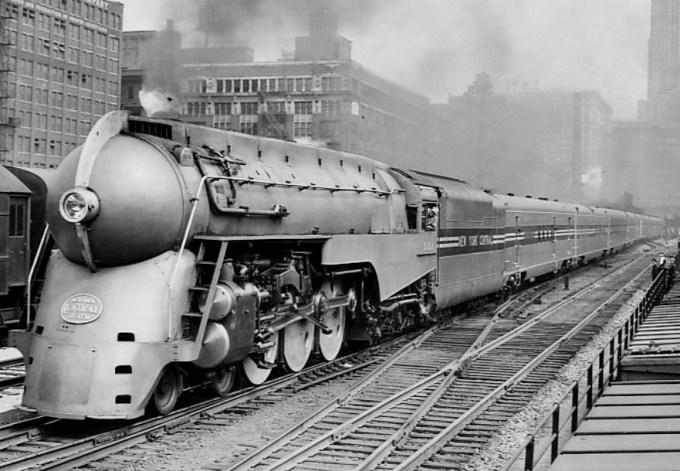
Amtrak’s Lake Shore Limited takes about 20 hours to get from Chicago to New York. It runs on mostly the same tracks as New York Central’s legendary 20th Century Limited, which made the run in about 15 hours in its heyday. I worked for the NYC at LaSalle Street Station from late 1956 until I was drafted in March of 1961.

            My first job was in the mail room, and one of my tasks every day was to meet the 20th Century at about 8:30 am, climb aboard the one baggage car and get the company mail pouch, which twice a month held the paychecks for the Chicago office staff. Now how’s that for an important job!

            As an employee, I wasn’t permitted to travel in the 20th Century. When I went to New York City to visit my brother, who was stationed in Long Island in the Air Force, I had a roomette on the next train down in the pecking order, the Commodore Vanderbilt, named for the company’s robber baron founder. It was also a sleeping car only train, just a bit less fancy. It took just an hour longer to get to Gotham. As a kid, I took a Pennsylvania Railroad  train from Chicago to P:ittsburgh a couple of times to visit family. They were day trips in a coach, but in both cases, “nothing could be finer than dinner in the diner.”

            When my children were small, we took the Santa Fe Railroad’s Super Chief to Los Angeles. This was still pre-Amtrak, and the service and food were first class. It took two full days, but we enjoyed every minute. But in the age of jet airplane travel – when flight times were cut in half – most people began to see train travel as yesterday’s technology. And it wasn’t helped when service on Amtrak proved to be shoddy and slow.

            Although Amtrak does operate one high-speed train – the Acela service on the Northeast Corridor – most of its trains run on old tracks with numerous grade crossings (and with freight trains given priority!). I recently went to Pittsburg by car with my daughter and son-in-law. From Chicago, it’s about 475 miles. You can easily drive it in 7 hours. The flight time is less than two hours. Amtrak service to Pittsburgh takes about 9 hours, and you arrive in Pittsburgh at 4:00 am!

            In a European or Japanese style high speed train, you could do it in three hours or less. My first experience in such a train was Japan’s Bullet Train from Kyoto to Tokyo. The top speed in those days – early 1980s – was 130 miles per hour. The ride was both smooth and quiet. Speeds up to 200 mph are now possible in Japan.

            After attending a meeting in Paris in the late 1990s, my wife Jeanette and I took the TGV high speed train to La Rochelle, where I had been stationed in the Army. A trip that took most of the day in the early 1960s, now takes 2-1/2 hours! We had a similar experience in the Eurostar service that runs in the English Channel Tunnel from London to Brussels; and in a high-speed train that took us from Barcelona to Madrid. Flying these distances makes no sense. We saved the airport hassle, and in Brussels our hotel was within walking distance of the train station.

            In addition to the existing Acela service on the East Coast, California is building a high-speed system that would connect San Diego with San Franciso and Sacramento. It would have speeds up to 200 mph, but the final cost will be stupendous, and it won’t be finished until 2033 (they hope!).

            If you could just improve average speeds to 120 mph by improving existing tracks and signaling, you could get to Pittsburgh in four hours; St. Louis in less than three; the same to Detroit; and about 3-1/2 hours to Minneapolis. I should add that the seats on those high-speed trains were large, with ample leg room! You could even recline them without crushing the knees of the person behind you. And there was adequate room for all your luggage!

            A few years ago, I took Amtrak from Chicago to St. Louis to pick up my car, which had been badly damaged during a trip to St. Louis for a wedding. As I recall, the train left Union Station at 7:30 and arrived in St. Louis at about noon. About five hours, what driving at the speed limit would have taken. Coincidentally, the local trolley that took me to the little Illinois town where the body shop was located was in the same transportation center. My cost for both? $35.00.

            Of course, I could have flown. That would have meant getting to either Midway or O’Hare, going through security, sitting in a seat designed for jockeys, getting from the St. Louis airport to downtown – well, you get the idea. The lowest one-way fare I found today was $104.

            Amtrak doesn’t have to whisk you to your destination at 200 mph – 120 with reliability would do just fine. It would make folks think twice before heading to the airport and experiencing all the hassle and agony that air travel always means. All aboard!

Copyright 2024, Patrick F. Cannon