By Patrick F. Cannon
By executive order, President Trump – who has only a limited facility with it himself – declared English as the “Official Language” of these United States. Congress has never done the same. A future president could well issue an executive order cancelling Trump’s and making French the official language. Just kidding!
Whether official or not, everyone who lives in the United States does or should speak English. For new arrivals, mastering it should be a high priority. While you may be able get along with Spanish (for example) in some neighborhoods, you would not be able to get more than a menial job unless you know and speak English.
English speakers are fortunate in many ways. While French and Italian may sound sweeter to the ear, it is far more useful to speak English. More people around the world have English as a second language than any other. I spent a year in France in the army, and at the end of 1963 I could speak passable French. It was more important then, particularly outside Paris. I have been back to France several time more recently, and although any facility I once had with French is long gone, I have been able to get along with English only, and not just in France.
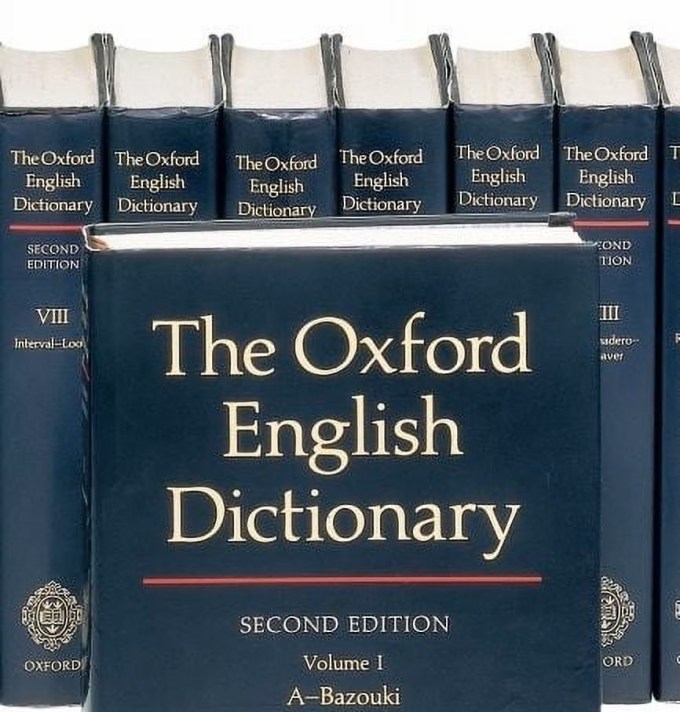
Because it is so willing to accept new words, often from other languages, English dictionaries include far more words than those of other languages. The Oxford English Dictionary includes some 600,000, while America’s Merriam Webster Unabridged has 470,000 (they have fewer obsolete words than Oxford)
In contrast, the Academie Francaise – the guardian of the French language – accepts only about 100,000, although a more widely used dictionary lists about 150,000. To their consternation, French is no longer the language of diplomacy; and scientist around the world communicate in English. After Russian, more people have read Tolstoy’s War and Peace in English than any other language. Why is this?
One explanation is simply that the United States became the dominant world power because of and after World War II. But even before then, American movies and popular music had become dominant. While great films had been made in Europe since the beginning of the art form, Hollywood films gained the largest audiences. I remember being in Paris when one of the Star War’s movies had just been released, and seeing long lines at one of the city’s largest theatres. And, of course, the famous British bands of the 60s (who spoke a similar language) like the Beatles and Rolling Stones happily admitted to the strong American influence on their music.
Let me finish with a personal experience. When I worked for Lions Clubs International, I was responsible for its magazines. I had direct supervision of the American English and Spanish editions but also had supervisory responsibility for the 20 plus others. We had a Danish edition, and the editor was an amiable and charming man, who spoke perfect English as well as Swedish, German, and French. When he was in those countries, he of course spoke those languages, but everywhere else English was the most useful. As he once told me” “There are only 6 million Danes. What are the chances of finding a Danish speaker in Italy?”
Well, English is a splendid language. Now, if we could just teach our young people to write and speak it properly. And our politicians too!
Copyright 2026, Patrick F. Cannon


A few years ago, I met a Danish fellow in Pittsburgh who spoke fluent Italian, albeit with a few diacritical marks and ligatures. He had worked for a company in Italy and found that his Danish, to no surprise, was of little use there. When he moved to the US, he adapted to English.
Spanish as an official US language came about during the general goofiness of the 1970s, a period that introduced bellbottom pants, wide lapels and even wider neckties, avocado-colored refrigerators, tangerine shag carpeting and Jimmy Carter. In the drug-induced haze that filled the country, it only seemed natural that public signs and communications also be in Spanish. After all, most of the drugs came from Mexico and Colombia. Por espanol oprima el numero dos! Far out, man! Little did we then expect that this little annoyance would blossom into DEI and the DNC.
We can thank the British Commonwealth and especially American free enterprise for English’s world dominance as the common language for commerce. Every school kid in Europe and Asia studies it. It hasn’t quite caught on in Latin America, but that may change now that American-style democracy is emerging as a political force in all its major countries, with the exception of Mexico. Our underpaid and resentful media may belittle Trump for his plain speaking, but the message of freedom and prosperity sounds good to our Spanish and Portuguese-speaking neighbors.
Generations of immigrants took pride in learning English as Americans. They neither wanted nor needed a condescending, patronizing cadre of government nannies treating them like tired, poor, huddled masses, though many of them, like Somalis in Minnesota, saw this as a tailor-made opportunity for get-rich-quick fraud.
We were founded as an English-speaking country and should remain so. Similarly, I think the Catholic Church should return to its universal language of Latin. The mass in English, like English opera, sounds so bland, flat and prosaic. The open vowels and spare phrases of Latin convey the mystery of the divine in sounds that English cannot replicate. And by gar, if Latin was good enough for Jesus, it’s good enough for me!
LikeLiked by 1 person
The Latin mass? Really? At least, the protestants got that right. Or, is everyone supposed to learn Latin? Or just mumble “etcoum spiritu tuo?”
LikeLiked by 1 person
Loved the Latin mass. But I’m a Latin! It loses a lot in translation. English makes the ritual even more of a secularized social event. Would Bach’s Mass in B minor make more sense if sung in English? You don’t need to learn Latin to feel its power. I remember when et cum spiritu tuo was first rendered as “and also with you,” which completely changed the meaning of the dialogue with the priest. (The old joke: the priest has trouble with his microphone and says aloud, “There’s something wrong with this thing” and the congregation replies, “And also with you.”). They eventually got around to translating it as “and with your spirit.” But I suspect most parishioners still have no idea what the dialogue means. At least with Latin, you need to make an effort to find out, or if not, at least appreciate it as a mystery.
LikeLike
As usual, people who want to understand, do. And it’s easier in English. And of course the Latin mass is available I was an alter boy and learned the Latin responses, and did know what they meant.
LikeLike