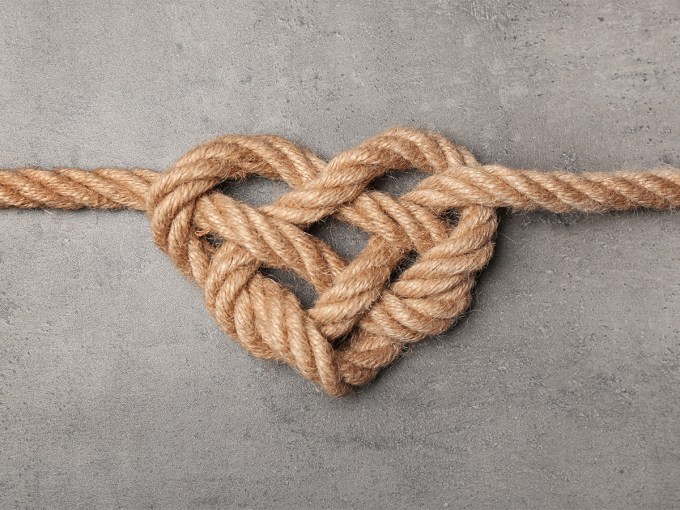
Knots to You!
By Patrick F. Cannon
As my faithful readers know, last week I favored them with a history of the necktie. Wishing only to bore you to a reasonable extent, I didn’t explain the various methods of actually tying the colorful fabric swatches. Nor will I now. But it did get me to thinking about knots in general.
For most of us, our first experience with knots comes when we learn how to tie our shoe laces. As it happens, I was rather advanced in this regard, having learned the useful skill well in advance of entering the first grade. I should mention that the school in question, St. Thomas in Braddock, Pennsylvania, did not offer kindergarten. (Braddock is a steel town near Pittsburgh. It was and is the home of the Edgar Thompson Works of US Steel. As it happens, it was the first area mill – started by Andrew Carnegie in 1872 – and is now the last survivor in the area.) The good Catholics of Braddock no doubt associated kindergarten with the very few Protestants in the area, who were mostly their hated bosses at the mill.
I’m afraid my knot education did not advance further for many years. Many young men learn the ropes as Boy Scouts. I avoided this, and for good reason. It seems my brother Pete – a go-getter if there ever was one – became a Scout. We were then living in the South Shore neighborhood of Chicago, and his troop embarked on a Fall camping trip in some nearby woods. Poor Pete failed to consult the calendar and see that the camping trip coincided with Halloween, always a favorite holiday for greedy youngsters. His consternation when he arrived home the very next day was memorable.
I was sifting through my swag when detailed by my parents to accompany Pete on his hapless quest to extend Halloween one more day. You can just imagine the reaction of the local householders when we showed up at their doors. One was shocked to hear adults using such language on little tykes! Anyway, the Boy Scouts were knot for me.
Other than the bow and square knots, I’m afraid my knot repertoire is somewhat limited. Perhaps if I had served in the Navy instead of the Army, I would have learned all about the Knotical Knots. On a trip to Los Angeles, I took the family to Disneyland, but ran out of time before we could visit that other City of Angels attraction, Knots Fairy Farm.
You should not be surprised to discover that there is a web site for knot devotees; it even has a “Knot of the Day.” When I visited, the featured knot was the Flat Overhead Bend, which I’m sure comes in handy on the tennis court. According to this refuge for the have-knots, the basic knots are the Overhand, Figure 8, Half Hitch, Square, Slip and Sheet Bend. Of these, I believe I have accomplished the Square and Slip, but I can’t be certain.
The knot is also celebrated in song and story. Who can forget Hamlet declaiming: “To be or knot to be?”, or that enduring classic ballad by George and Ira Gershwin, “They’re writing songs of love, but knot for me.” And of course there’s the famous Forget Me Knot, which one can’t remember how to untie. I could go on and on, but you probably would rather I knot. Anyway, I’m heading for Knots Landing, for obvious reasons.
Copyright 2021, Patrick F. Cannon




 cannonnadedotcom