Unasked Questions

Unasked Questions

By Patrick F. Cannon

Indulge me while I tell you a story. Before I retired 20 years ago, I was the manager of  communications for the largest association of its kind in the world. As such, over the years I hired dozens of writers, editors and graphic artists. Although I occasionally had to hire a senior manager, most of these hires were for entry level jobs. Most applicants were graduates of journalism schools, or schools with public relations majors.

            These kinds of hires are handled quite differently today, but in those days the personnel department would sift though the sometimes hundreds of resumes we would receive and send me candidates whose education and background actually fit the position. Although we didn’t keep records of this, I would guess that 75 percent were from women, based solely on the names. I almost never received a resume from an African-American. Obviously, we didn’t ask what race the applicant was, but having lived in Chicago and its suburbs most of my life, I had a feel for both typical names and addresses.

            We got very few, so I was pleased to get a resume from an applicant who was a likely African-American, and a male to boot.  Both his cover letter and resume were well written; and when he came in for an interview, he was just as impressive. Because I thought it was important for the association to have more African-Americans (we had numerous Hispanics and Asians), I talked my boss into letting me offer him a couple of thousand dollars a year more than was usual. But he got a much better offer elsewhere and we lost him.

            Over the years, we employed three major PR firms to do some of our work. They made even more concerted efforts to hire qualified African-Americans, but I recall only seeing two over the years, one of whom worked on our account. The reason was simple: journalism and public relations programs at colleges and universities were simply not attracting many African-Americans. Those who did major in these areas were snapped up by news rooms and agencies hungry to prove they valued diversity in their organizations. Many became adornments to their professions.

            So, my response to articles on the lack of diversity in industries and professions has always been to ask this simple question: how many qualified minority candidates are denied jobs only because of their race or national origin? What we get in articles and features instead is: African-Americans are 13.4 percent of the US population. Why aren’t 13.4 percent of screenwriters, or directors, or sound technicians, or set decorators (to take only the movies as an example) African-American?  That’s it – the implication being that racism is the only reason. They never ask the obvious next question: how many are denied jobs they are educated and otherwise qualified for simply because they’re African-American?  Or women? Or Hispanics?

            One article you won’t see – if non-Hispanic whites comprise 60 percent of the population, why aren’t 60 percent of NFL and NBA players white? Or 60 percent of jazz musicians, or pop singers? While your died-in-the-wool racist hates to see any African-American succeed, most people accept the fact that African-Americans both want to do these things, and indeed excel at them.

            Since I’ve actually read and studied our history extensively, I fully realize how racism has stained it. I also know that, beginning when President Truman desegregated the armed forces in 1948, progress has been made in redressing the balance. To deny this is to deny the struggles of so many African-Americans and, yes, whites of good faith, to eliminate institutional racism. For example, the dropout rate for African-Americans has gone from 15.2 percent in 2010 to 7.9 percent this year. Last year, the unemployment rate for blacks was 5.5 percent; it was 14 percent in 2000.

            My son suggests the reason that obvious next question is rarely asked is simply because news organizations do not permit their reporters to ask them, lest asking will somehow be seen as racist. I presume this is their thinking (if one can use that word): if 13.4 percent of the population is black, then if 13.4 percent of civil engineers aren’t black, then it must be racism that is keeping them from getting their share of the jobs. It never seems to occur to them to discover how many blacks want to be and are educated as civil engineers, but are not hired because of their race.

            If reality did intrude into today’s journalism, pointing out the low numbers of blacks in a branch of engineering that provides the most jobs, has a median income of nearly $90,000 a year, and is projected to grow at a steady eight percent a year, might encourage young African-American men and women to consider this profession. Or not; that’s their decision.

            Regrettably, we live in an era when too many news organizations believe they must advocate rather than report the news impartially. They need to learn that being “woke” isn’t the same as being awake.

Copyright 2021, Patrick F. Cannon

Do You Shift for Yourself?

Do You Shift for Yourself?

By Patrick F. Cannon

Last week, I wrote about the now rare wringer clothes washer, and mentioned that you could still actually buy one. This week, I thought I’d write about another archaic throwback – cars with manual transmissions. Although it gets more difficult every year, you can still get one.

            Of the 19 cars I’ve owned in my lifetime, six had manual transmissions: two VW Beetles, a Volvo station wagon, Fiat sports coupe, Ford Escort hatchback, and a Ford Probe GT (my favorite). Before I owned my own cars, I occasionally drove some friend’s beater, which almost always had a three-speed column shifter. I learned to drive on one of these. While in the army, I regularly drove a ¾-ton truck; a few times a 2-1/2 ton truck; jeeps of various vintages; and even an International Scout, which was used for guard duty at Fr. Erwin, California. All, of course, had manual transmissions.

            As far as I can recall, the first car with an automatic transmission I ever saw was in a pristine Pre-World War II  Oldsmobile sedan that picked us up when we were hitchhiking to caddy at the Edgewood Country Club near Pittsburgh. This would have been in the early 1950s. While automatic transmissions were more widely available by then, they were still an expensive option. They also provided poorer gas mileage, and took longer to accelerate than a well-handled car with a manual transmission.

            Automatic transmissions are now standard equipment and none of the above is true. To provide maximum flexibility in today’s generally smaller engines, 8-speed transmissions are common, but as many as 12 are available. Some have various modes, depending on how you’re driving. Most common would be “economy” or “sport.” The latter would delay shifts for maximum acceleration. My BMW can be shifted manually by moving the shifter to the left; you can then shift through five speeds at any RPM point you choose. I rarely do this, as most of my driving is done on level terrain, on expressways and city streets.

            While I concede there is a certain pleasure in driving a sporty car with manual transmission on an empty road, this happens so rarely that it’s not worth the trouble of constantly shifting gears in city driving. If I had the extra dough, and the room, I confess I would like nothing better than to have a Morgan Plus 6 (look it up) to tool around the hinterlands of New England of Appalachia (or even parts of Illinois).

            Even the most sophisticated race cars – Formula 1 – do not require the driver to tramp down with his left foot on a clutch pedal to change gears. He (there are no women currently) simply uses a steering-wheel-mounted paddle to change gears, a system that is also becoming available on passenger cars. As with most systems on cars today, all of this is controlled by computers.

            Speaking of computers, who would actually wish to return to the days of the regular tune up? In the “good old days,” you would bring your car to a mechanic every 10,000 miles or so for a required tune up, which consisted of changing distributer points (again, if you’re a youngster, look it up), installing new spark plugs, cleaning and adjusting the carburetor, changing the oil and filter, greasing running gear and suspension components, and adjusting the timing with a gadget called a timing light. When you picked up your car, you would expect it to run once again like a fine watch.

            I once took a course to learn how to do all of this myself, but never really used the knowledge because my next car had computerized systems. People who own and cherish classic and collector cars often still have and use these skills. Of course, some day most cars will be electric, and have no transmissions at all. We’re also told they will drive themselves. While I don’t miss shifting gears, that’s where I think I might draw the line. I can just see Comrade Putin directing his minions to cause chaos on our highways (or at least more than we already have).

Copyright 2021, Patrick F. Cannon

Be Thankful, For Goodness Sakes

Be Thankful, For Goodness Sakes

By Patrick F. Cannon

I’ve had the occasion recently to do the laundry. As most of you know, this consists of putting a load of dirty clothes in an automatic washer, adding detergent and other stuff, pressing a few buttons, and wandering off to muse on the state of the world. Some kind of bell or buzzer will eventually signal that the machine has done its duty; whereupon you toss the damp stuff into a dryer. While that’s doing it work, you might peruse the morning paper, or just stare out the window.

            The clothes and other stuff that emerges rarely needs the touch of an iron. When I buy clothing, I always make sure it says “no iron” or “permanent press.” We own an iron, but it spends most of its life in lonely isolation.

            When my mother did the laundry, she rolled the wringer washer up to kitchen sink, filled it with water and soap, put in the clothes and turned it on. It had an  agitator much like a top loading automatic washer now has, which would thrash away until the load was clean (hopefully). You have to trust my memory here, but I believe the next step was to toss the whole mess into clean water to rinse the soap out; or maybe the soapy water was drained out and replaced by clean water, the machine then thrashing away again to rid the load of soap residue. And I’m not quite sure when and how they were used, but the process included bleach and something called “bluing,” both of which had some role to play.

            But wait, we’re not done, since the whole mess had to be run  through the wringers, two rollers that squeezed the excess water out of the clean laundry. After that, the still damp mess had to be dried. In warm and dry weather, this could be done on an outside clothes line. Ideally, if you had a back yard, most of it could be hung out to dry at one fell swoop. In cold or rainy weather, the basement or attic was pressed into service; that is, if you had one or the other. If you lived in an apartment building, other places needed to be found. Have you ever been to Europe and seen clothing hanging from front windows on various contraptions?

            (Just so you know, in 1946, a wringer washer cost about $50; that would be about $720 today, about what a basic automatic washer would cost today. You could actually buy a new wringer washer now for about $1,000. Go figure.)

            By the way, this process in a large family took most or all of the day. I recall that Monday was usually “wash day” and Tuesday was “ironing day.” Think about it. Two days of the week were taken up with dealing with the dirty laundry. If you had money, you could avoid all this. A truck would appear and pick up your dirty laundry; a day or two later, your clothing and other items would reappear, washed, ironed and neatly folded. On Monday, these housewives could have their friends over for bridge; on Tuesday, do a bit of shopping at Marshall Field’s and have lunch in the Walnut Room.

            Right up to my retirement, I did take my dress shirts – which I wore every day for nearly 40 years – to the laundry. Initially, these laundries were run by Chinese families. More recently, Korean families seem to have taken over this business. If you’re a masochist, you can still have your shirts starched.

            I am reminded of a scene in the movie, Master and Commander, based on the novels of Patrick O’Brian. Set during the Napoleonic Wars, the hero is British sea captain Jack Aubrey, played by Russell Crowe. In one scene, he is shown a model of a new American frigate, which is constructed in a new and novel way. He studies in in detail, then exclaims: “What a fascinating modern age we live in!”

            Even in a simple task like doing the laundry, it certainly is. Consider yourself lucky.

Copyright 2021, Patrick F. Cannon

Rat a Tat Tat

(This piece was originally published in late 2016. How much has changed? One thing: I have since fired a gun, with my son, at a shooting range.)

Rat a Tat Tat

By Patrick F. Cannon

My son Patrick has a small collection of firearms, which he showed to me during a recent visit with him in Florida. He keeps them locked away, but enjoys going to the shooting range to see if he can hit the broad side of a barn. On at least three occasions, I’ve tried to join him, but fate has always intervened. Most recently, there would have been an hour wait for a firing position, an hour we didn’t have.

            I was particularly interested in firing two in his collection, a Browning .45 caliber semi-automatic pistol, and an M1 Carbine. When I was in the Army, I had occasion to qualify with both, as well as the standard infantry weapon of the time, the M1 Garand; and the submachine gun affectionately known as the “grease gun.”  I qualified with the Garand (used during World War II and Korea) as a “Sharpshooter” during basic training. Only “Expert” was higher, so I did OK.

            I ended up in the Signal Corps in La Rochelle, France. There I was issued a Carbine, with which I qualified at a former German Army indoor shooting range, which was near one of their submarine pens at La Pallice, the port just south of La  Rochelle. The pen, by the way, was the site for the film Das Boot, and is still there, the roof pockmarked by Allied bombs that never penetrated.

            In mid-1962, I was transferred to another signal company and sent to Ft. Irwin, California, in the middle of the Mojave Desert. It was combat support company, and I worked in a signals van. I was issued with both a Browning .45 and a grease gun. The idea here, I decided, was that if the Ruskies broke into the van, you would grab your grease gun and pull the trigger, with the hope that you would hit something, if only the ceiling. The pistol was reasonably accurate at 25 yards. At the same distance, you were lucky to hit the target at all with the grease gun.

            In any event, when I qualified with it in the late summer of 1962, it was the last time I ever fired a gun. I don’t own one, and have no wish to own one. If I did, I’m sure I could pass a background check, as would my son, who is what we could call “a responsible gun owner.”

            If you’re good at math, you may have noticed that I haven’t fired a gun in 54 years, which makes me just as qualified as anyone else to comment on gun control. By the way, I learned that roughly 40 percent of Americans own guns, and 20 percent own 65 percent of them. Like my son, many Americans own multiple guns. I don’t want to get bogged down in statistics, but most murders are committed with guns, with the actual firearm murder rate fairly consistent at about 3.6 per 100,000 population.  The majority are committed by criminals against other criminals. And while our murder rate is not the highest in the world, it is high compared to the countries in Western Europe, for example.

            Recent mass murders have brought these issues to the fore – who should own guns, and what kind? The members of the legendary National Rifle Association (NRA) largely agree that background checks are appropriate, but their supposedly elected leaders, personified by their doctrinaire front man, Mr. Wayne LaPierre, fear that any kind of control will lead to a mass confiscation of guns from everyone except the police. The only thing more absurd than this contention is that some people believe it.

            You may be surprised to learn that many people in countries like the United Kingdom actually own guns. To do so, they must apply for a license and pass a background check. They must also state a reason, which might include hunting, sport shooting or even, in rare cases, self protection. Just like a driver’s license, they have to renew from time to time. I imagine if you’ve committed a felony since getting your license, renewal might be a problem. By the way, in a recent year the gun murder rate in the UK was 0.06 per 100,000.

            The following sensible proposals would no doubt bring the braying LaPierre out of his stall spouting righteous indignation:

  • All gun owners to have a background check before receiving a permit to own firearms. The permit to be checked against a data base by any seller, including at gun shows. All sellers and re-sellers would have to be licensed.
  • Those not eligible for a permit should include felons, and people diagnosed with a specific mental illness, such as schizophrenia.
  • No one on the “no fly” or terrorist watch lists could get a permit, although they must be told the specific reason they are on either list, and have the right of appeal. There are too many instances of US citizens being on one or the other of these lists in error, and having extreme difficulties in getting their names removed.
  • Background checks must be thorough, with at least a full week permitted to complete them. It’s difficult to think of any valid reason for needing a firearm sooner.
  • I suppose it makes sense to ban assault rifles, if only because they can accommodate large clips. If that can’t be done, perhaps it might be sensible to ban clips that hold more than 10 rounds. Since automatic weapons are still banned, target shooters and hunters can make no convincing arguments for larger clips. Does it really take more than 10 rounds to kill Bambi?

I’m afraid I have no hopes that any of this will pass at the Federal level. And any immediate effect is highly dubious, since it’s estimated that 340 million guns are already floating around the United States. Any impact of tighter regulations would take decades to be felt, and would have little immediate effect on the illegal trade.

In any event, while the Republicans might support some meaningless symbolic gesture to mollify the public, their fear of the NRA will prevent anything meaningful. After all, this is the party whose leaders are lining up to support Donald Trump, forcing one of the most respected conservative voices, columnist George Will, to leave it after more than 40 years. He won’t be the last. Nor should he be.

                                                ####

Copyright 2016, 2021, Patrick F. Cannon

Melting Pot

Melting Pot

By Patrick F. Cannon

When a friend was over the other day, the question of mandatory national service came up. Both of us agreed it would be good idea, one that forced young people of all races, religions and national origins to come together for one year of public service of some kind.

            When I was drafted into the Army in 1961, the armed services were the only form of national service; the Peace Corps would come later (and of course it was voluntary). In the two years I served, I lived in close proximity to people of all races, and from all parts of the country. If you’ve seen any World War II movies, you may have noticed that the cast almost always included a Jew, Hispanic, Native American, New Yorker, Southerner, as well as the usual White middle-class fellow from somewhere in Middle America, usually the hero. That’s what my Army looked like, except it did include African-Americans, who served in segregated units until 1948.

            Coming from Chicago, and before that Pittsburgh, African-Americans were no mystery to me; my best friend in high school was black. But I can tell you that many of my fellow soldiers had never met a black man, much less lived with one. Imagine that you’re a young, largely uneducated kid from some remote valley in Appalachia and suddenly you find yourself living next to not only young black men, but strange sounding fellows from Brooklyn? In the four barracks I occupied in my two years of service, I served with all of them and more.

            There was no draft lottery in 1961; unless you had an exemption, you were likely to get drafted. If I had been going to college full time; or been married with children; or had flat feet or a bum ticker, I might have avoided the draft. Quite a few young men opted to join the National Guard instead. They only served for six months, but were subject to being recalled to active duty, which many discovered to their dismay during the horrible years of Viet Nam. And, of course, I served with many young men who actually enlisted for three years, some intending to make the Army their career.

            Over my two years of service, which ended in 1963 before Viet Nan heated up, I lived with an average of 200 men. All, except for sergeants, lived in open common areas. We showered and shaved together, and the toilets were in open areas. Privacy? Not a chance. Yet, during all of this, I cannot recall a single physical fight in a barracks. Arguments? Sure.

            While not complete, a list of my Army friends would include a farmer from Indiana; a banker from Queens (New York); a college educated son of a Southern Illinois blacksmith, who planned to carry on the family’s business; the college dropout son of the export manager of the Ford Motor Company; the heir to a rich tobacco farmer in North Carolina (who sent him cash every month); and a black kid from Chicago’s South Side, who had enlisted to escape gang life.

            The likelihood of a young man or woman from Winnetka, or Scarsdale, or Beverly Hills, or Shaker Heights, having to live and work with the kind of people I did in the Army is remote. They will graduate from elite public or private high schools and go on to Ivy League or other elite colleges, and come to believe that their world is the world as it should be. They will be like Pauline Kael, the late film critic for that journal of the upper middle classes, the New Yorker, who was shocked when Richard Nixon was elected president, since she knew no one who had voted for him. Substitute Donald Trump for Nixon.

            Would it open young minds to have served for a mandatory year with young people of different backgrounds from different parts of the country? I believe it would. Some would choose the military, but most would likely choose some other form of national service. There would be no exemptions, other than medical; and no favoritism.

            In 1945, there were some 16 million Americans – mostly young men – in the military, out of a population of 140 million. When they returned to civilian life,, they created the most prosperous society in the history of the world. They swelled the ranks of civic, veteran and social organizations. They worked together to build and even create communities. What they learned in the military – that victory only comes with common effort – they transferred to civilian life.

            Regrettably, the civic and fraternal organizations that thrived after World War II are now largely on life support. “Us” is now the “other.” You have only to look at our politics to see the effects of this national estrangement. National service might not be the only path to a better understanding among races and classes, but it would be a start.

Copyright 2021, Patrick F. Cannon

Those Who Trespass Against Us

Those Who Trespass Against Us

By Patrick F. Cannon

Despite the admonition in the Lord’s Prayer to forgive those “who trespass against us,” the country seems less and less to be in a forgiving mood. And making a mistake and saying you’re sorry; well,  it just doesn’t work anymore.

            This is a curious trend in a nation that once thought of itself as a Christian bastion. Christ himself forgave sinners left and right – including those who were killing him. “Forgive them Father, for they know not what they do.” He also preached redemption. If you owned up to your sins, and promised to “go forth and sin no more,” presumably you would be forgiven. This concept is the basis of the Roman Catholic sacrament of penance, or “confession” as it’s more widely known.

            Although I don’t now believe in the divinity of Jesus Christ – or any other god for that matter – I was raised Catholic, and entered the darkness of the confessional many times to own up to my sins. My list was usually pretty predictable and pathetic. Swearing. Disobeying my parents. Stealing a candy bar. No murder, no grand larceny, no cheating at “go fish.” The priest, a stand-in for Christ, would absolve you of your sins, but only on the condition that you were truly sorry and would at least try to “sin no more.” That you were urged to go to confession at least once a week tells you all you need to know about the Church’s expectations on the latter.

            I’m 83 years old now, but let me assure you that I was not always the tolerant and forgiving fellow I am now. To give just one example, I once thought homosexuals were the worst kind of perverts. But like so many other ingrained prejudices, it didn’t long survive my actual acquaintance with gay men and women. To my amazement, I discovered they were actual human beings, subject to the same hopes and fears as the rest of us. I would also have been appalled at mixed-race marriages, until I met and became friends with more than one such couple.

            But what if I were judged today on what I thought 60 years ago? Would I be publicly shamed? Would my books be removed from bookstores and library shelves? Would my house (condo really) be picketed by an angry mob? While it may seem absurd to suggest such things at my age, how many careers have ended for younger men (almost always men) whose only sin was to have said or believed something counter to the current orthodoxy?

Just in the last few weeks, two prominent men have lost their jobs because homophobic, racist or sexist remarks they made on social media became public. They may sincerely repent, but I doubt if it would help their cause, even if they were sincere. Corporations now live in fear of their “woke” customers and constituents.

                There is a difference between speech and action. A comedian can insult gays and perhaps lose some of his or her audience; but if another comedian plies women with drugs to eliminate their resistance to his sexual advances, he has broken the law and should be prosecuted. But even if you are convicted of murder, Christianity teaches that you can gain salvation if you truly repent. How many people actually believe that anymore? And how many remember what Jesus said to the crowd gathered to stone an adulteress?  “He who is without sin among you,” he said to the mob, “let him cast the first stone at her.”

Copyright 2021, Patrick F. Cannon

This is It; I Promise!

This is It; I Promise!

By Patrick F. Cannon

I know. You’re sick and tired of me harping on how politicians of both political parties use redistricting to rig the democratic process in their favor. You have my solemn promise that this is the very last time – at least for this year – that I’ll point out that they do it to insure that they keep their jobs and stay in power, much like Putin does in Russia (and Stalin did before him).

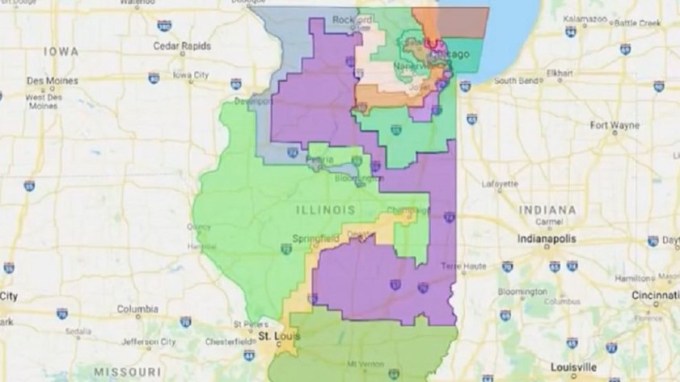
            The map above is the latest outrage. Since it was designed by the Democratic Party, it should result in a Congressional delegation for the next 10 years from Illinois of 14 Democrats and 3 Republicans, instead of the 13 Democrats and 5 Republicans at present. If you’re a math wizard, you’ll have noticed that Illinois has lost a seat because it lost population for the first time in its history.

            The Democrats have no shame; nor do the Republicans who do the same in states where they control the map. They’ll ignore the complaints of groups other than the Republicans who feel they’ve been shafted. In Illinois, African-Americans have already claimed they’ve been under represented. No doubt we’ll hear from other groups in due course, Hispanics for example. They’re actually split in two – Puerto Ricans and Mexican Americans, with little love lost between them. And who knows? Maybe White Illinoisans will wake up some day, realize they’re in the minority and demand equity.

            (It should be noted that on Tuesday, a three-judge panel for the Federal court for the Northern District of Illinois declared the map formerly approved for state legislative districts was unconstitutional, not because it was partisan, but because it was not based on final Census figures. It will be interesting to see how the legislature and Governor Pritzker, who signed off on the map, will spin this. I’ll be shocked if any “new” map results in significant changes.)

             All of this will continue so long as we separate our fellow citizens by race, ethnicity and voting history. The Founders – those poor discredited saps – actually believed in the concept that “all men are created equal,” even if they fell short in implementing it. They would be bemused and confused to discover that many now believe that African-Americans, for example, can only be properly represented by another African-American. Ditto Puerto Ricans, Mexican-Americans, and, presumably, Whites.

            As it happens, I’m White (too white to go out in the sun without sunblock). My state representative, LaShawn Ford; state senator, Kimberly Lightford; US congressman, Danny Davis; and Cook County commissioner, Brandon Johnson, are all African-Americans. This doesn’t bother me in the least; as far as I know, they’re doing decent jobs. What does bother me is that their districts are configured so that they can’t lose. When I go to the ballot box, I have as little actual choice as a citizen of Russia. No credible Republican candidates ever appear on my ballot.

            In my view, “voting rights” should be limited to just guaranteeing that no arbitrary barriers should be constructed to prevent American citizens from voting. These rights should not extend to insuring that racial and ethnic minorities should be in districts where they are the majority of voters. Nor do I believe that requiring a form of identification is a real barrier. In Illinois, you must register to vote. When you do vote, all you need do is give your name and address. You are required to sign a form, but who believes that the signature is ever validated?

            Dividing the state into equal contiguous legislative districts – both Federal and state – is easily done by an impartial computer program. Better a dumb machine than the kind that has a vested interest in retaining its power.

Copyright 2021,  Patrick F. Cannon

Can I See Your License?

Can I See Your License?

By Patrick F. Cannon

If you live in Illinois, or any other state for that matter, you are required by law to have a driver’s license if you want to legally operate a motor vehicle on public roads. That doesn’t mean you can’t drive without one. It’s certainly possible to learn how to drive and decide not to bother learning the Rules of the Road and taking the driver’s test required to get one. And if you’re very careful and very lucky, you might get away with it. But what if you get in an accident and the cop asks for your license? Or you run a stop sign? The fact is that most people get a driver’s license without considering whether or not it’s an infringement on their freedom.

            And it’s amazing how many licenses are required to make the world work (and fill government coffers). Now, you may live in a perfectly nice but nondescript house. You imagine it was just one of many similar houses in your subdivision, but if you went down to the village, town or city hall and looked up the original building permit, you would find that it likely lists the architect. Why? Simply because the law stipulates that a licensed architect sign the plans. Even if your carpenter cousin Joe – talented though he may be – designs your house, the permit won’t be approved until a licensed architect signs off on his plans.

For more complicated buildings, a licensed structural engineer may also be asked to sign off. Then, if the building falls down – and this occasionally happens – the authorities know where and who to investigate. I don’t recall off hand it happening in this country, but elsewhere architects and engineers have gone to jail or even been executed for their failures.

When you go to see your physician, you can ask to see his or her license, since they must have one to practice medicine. If they have been granted one, it means they have – at a minimum – graduated from an accredited medical school, served internships and residencies, and passed required exams. This doesn’t guarantee that they will be brilliant or have a pleasing bedside manner, but it does suggest at least a basic competence. If you practice medicine without a license, you’ll almost certainly end up in jail.

While lawyers don’t have to have the same kind of competence, they do at least have to graduate from law school and pass the bar exam. It’s hard to believe, but even the knuckleheads who leer at us from highway billboards are licensed to practice law. You also need a license to sell booze or weed, or start any business. The rest of the list is long, and includes acupuncturists, barbers, funeral directors, auctioneers, nail technicians, public accountants and pawnbrokers, and – well, you get the idea. Like the driver’s license, you could try to do these jobs without a license, but why take the chance?

The state also mandates vaccination against specific diseases for school children (at all levels) and those who teach and otherwise interact with them. This is yet another example of the state limiting people’s freedom to do whatever they want in favor of a greater public good. As a result, scourges like smallpox, measles and polio are no longer annual concerns for parents. And when finally approved for younger children, the state will be within its rights to mandate Covid-19 vaccines as well. Other institutions and corporations are also within their rights to mandate vaccination as a condition of employment, as the courts have endlessly upheld.

(Religious exemptions are, of course, possible. But I find it interesting how many people have suddenly found the Lord.)

Yet, there are still people who say forcing them to get vaccinated is an unamerican attack on their personal freedom. Apparently, the concept of the greater good doesn’t apply to them. If their refusal to accept science and common sense affected only them, it would be harmless. But it doesn’t. It has killed people, including themselves. I recently heard a doctor tell of a patient who denied he had Covid, despite being gravely ill. As a result, he refused treatment. He died with his illusions intact.

Copyright 2021, Patrick F. Cannon  

Just Wondering

Just Wondering

By Patrick F. Cannon

            I’m a faithful reader of the Sunday Chicago Tribune. There was a time when it took most of a leisurely Sunday morning to get through, but that was when it was privately owned. Now, with shareholder profit uppermost, it barely takes an hour. It still includes a real estate section which, among other things, includes a report on high value residential transactions. It’s amazing how many of these involve sports figures from the city’s major teams (Bears, Bulls, Cubs, Sox, Blackhawks); and how many of them involve selling at a loss.

            Now it’s true that we occasionally get someone like Ernie Banks, Ron Santo, or Walter Payton who spend their entire career with one team and live their lives out in the Chicago area, but more often than not a player will be traded or leave in free agency after just a few years. Yet, for reasons which are incomprehensible to me, they think nothing of spending multi-millions for a house or condo of a size they don’t really need.

I’ve often wondered if they do this to keep up with their teammates, who seem to need seven bedrooms and seven bathrooms, a wine cellar and a six-car garage for their stable of Bentleys, Land Rovers, Escalades and Lamborghinis (all declining assets). Of course, if you’re making $15 or 20 million a year, why worry about losing two or three million on a house sale? Of course, sports figures aren’t the only folks who over buy. I know of one Chicago billionaire who owns something like seven homes spread around the country and overseas. If you’re wondering why, maybe he just hates to make hotel reservations, or is afraid of bed bugs.

While I’m making fun of sports figures, let me wonder when it became OK to be “bush.” Now, for those of you too young to know what that means, it means a ballplayer who inordinately calls attention to himself, acting as if he’s still in the “bush (minor) leagues,” instead of the major leagues, or the “big show” as it’s often called.  Acting “bush” is, of course, not limited to baseball, although posing at the plate and watching one’s home run ball sail into the stands, then flipping to bat with aplomb, is now a common occurrence.

It has become an accepted feature of the NFL, too. It is now expected that scoring a touchdown will result in a carefully choreographed dance performance. This used to be limited to the player who scored the touchdown, but now he is often joined by some of his friends in a carefully rehearsed routine. When these “look at me” shenanigans began, the NFL took a dim view until it discovered that the “me” generation thought they were cool, and now they not only don’t frown on these displays of ego, but, within limits, encourage them.

They do draw a line at taunting, the practice of a pass receiver, for example, catching the ball and then saying “nhaw, nhaw, nhaw” to the defender while pointing his finger at his hapless opponent. I wonder when their research will tell them the fans love it, and the penalty flags will no longer be thrown.

Oh, and after listening to several politicians and pundits on the Sunday news shows, I couldn’t help wondering when our elected leaders, especially at the Federal level, were going to be more concerned with the condition of the Republic than about their chances in the 2022 elections.

But all my wonderment at this stuff pales in comparison to my absolute bewilderment at the numbers of my fellow citizens who still seem to support Donald Trump. That, my friends, is the wonder of the ages.

Copyright 2021, Patrick F. Cannon

Cricket Demystified

Cricket Demystified

By Patrick F. Cannon

It is not well known today that the British crown’s attempt to impose cricket upon the Colonies was one of the causes of the American Revolution. This is not remembered because, in an effort to tighten it up a bit so it would fit on one page, Thomas Jefferson was ordered to remove the following clause from the Declaration of Independence: “that he [meaning George III, of course] did order his royal governors and proprietors to impose upon his loyal subjects the incomprehensible game of Cricket; and further decreed that the necessary bats, balls and wickets must be imported from the United Kingdom…”

            In response, we revolted and invented baseball.  In all my years, I have only come across one game of cricket on these shores. One day, I was driving to Evanston (it’s a North Shore suburb of Chicago, for the edification of you provincials) and stopped at a red light next to a park. Lo and behold, I spied a group of white-clad fellows indulging in this game so beloved of the citizens of Great Britain and its Commonwealth countries. They were mostly brown skinned, so I assumed they were Indians and Pakistanis associated with nearby Northwestern University.

            I didn’t give this any further thought until I found myself sitting next to one of the games legendary heroes, Sir Algernon Shinbone, on a flight from London to Karachi. He told me he was on his way to cover a “test match” between the Brits and Pakis for the BBC. It would last for five days, not quite as long as our baseball World Series, which can last as long as seven days. Indeed, he said, cricket and baseball – which he learned  to play when he was a prisoner of war with American soldiers at Stalag 17 —  share many similarities.

            Both are played with a bat and ball. While our bat is cylindrical, the cricket bat is flat. It rather reminds me of the paddle that Sister Griselda of my grammar school used to wield against those who offended her sense of morality and decorum. In both games, the ball is round and covered with leather, although theirs is brown instead of white.

            The athlete who wields the bat is called the batter in baseball and the batsman in cricket (women are allowed to play the game, and presumably are called batswomen). The player who throws the ball in the direction of the batter is called the pitcher in baseball, but the bowler in cricket. Now, we associate the word “bowler” with another sport altogether, ten-pin bowling.

Bowling also exists in the UK, but as lawn bowling, which is similar to bocce, now all the rage in this country. It may be that in cricket’s earlier days – it is said to date from the 16th Century – the bowler might have thrown the ball underhanded, instead of using the overhanded windmill motion that one sees today. Thus, the term “bowler” may be just one of those anachronistic traditions in the UK that makes no contemporary sense, much like the Royal Family.

In baseball, the field of play can vary in size depending on the whim of the builder and the ability of the home team. While the distances between the bases and from the pitcher’s mound to home plate are the same, nothing else has to be. In cricket (and soccer), it’s called the pitch. Now, the cricket pitch is a uniform 22 yards long by 10 feet wide. Outside of this is a larger area called the boundary. Try to imagine the pitch as a baseball infield and the boundary as the outfield. If you can’t, don’t feel bad.

In addition to the bat and ball, cricket has the wicket. This consists of three stumps driven into the ground, topped by horizontal bits of wood called the bails. To confuse matters a bit, the area between the wickets is also called the wicket. Perhaps you.ve heard the phrase “sticky wicket?” This refers to the condition of the wicket after a good rain. Now, we all know how runs are scored in baseball. Simplicity itself, but try explaining it to an Englishman. Ditto cricket.

I should mention that there are 11 players on a cricket team (or side). In addition to the bowler and wicket-keeper (something like our catcher), there are 9 fielders. When they’re up, everyone but the bowler bats (sort of like our American league). To score runs, the batter can hit the ball and run to the other wicket before a fielder can hit the wicket. Each time you do this gives you a run. If you hit the ball to the boundary line along the ground, it gets you 4 runs. If you manage this on the fly, kind of like a home run, you get 6.

Now, the other side can get the batter out by getting the ball past the batsman and hitting the wicket; by catching the batted ball on the fly; hitting the batsman’s leg in front of the wicket (ouch!); or by hitting the wicket with the ball before the batsman gets there. You would think that the winner would be the team with the most runs after a set number of innings, but it can be a bit more complicated. Alas, it was just at that point that we arrived in Karachi and Sir Algernon was unable to explain the intricacies of scoring in a five-day test match. Now, that’s a sticky wicket if I never heard one.

Copyright 2021, Patrick F. Cannon