Embrace Isolation

Embrace Isolation!

By Patrick F. Cannon

I abandoned the daily grind in July, 2001. Since then, I have earned my living by being retired. Yet, I have managed to find enough badly-paid work to keep me reasonably busy. This is all to the good, since I have no hobbies, other than golf, which I indulge in weekly during the fair weather months, assuming it doesn’t rain.

The current mandated isolation has therefore not much changed my daily routine. For example, my faithful dog Rosie (I was not responsible for that name, by the way) is right now conked out near my feet, but will eventually bestir herself, thinking that it has been an eternity since she last had nourishment. Her idea of sustenance, in descending order of preference, is (1) people food, (2) doggie treats, and (3) dog food. She also requires – since she’s now 15 – regular medications of various expensive kinds.

Because of these medications, she needs more frequent forays to the out-of-doors, although I’m told that some people train their doggies to do their business indoors on disposable mats. If they are physically incapable of walking their dog, I suppose this is acceptable. If they are, it’s abominable. It’s bad enough to have to pick up your dog’s excrement on a sidewalk or lawn, but in your own home? Please don’t invite me.

When you walk your dog now, you are likely to see only your fellow dog walkers. They will take a wide berth when passing, but will often give you a wan smile and a “hello.”  In the good old days, they might have added “my, what a cute dog.” I would thank them, but stifle the urge to respond: “where in God’s name did you get that mangy cur?”

Since my wife Jeanette is first to take the dog out, usually at around 6:00 am, I am able to read the newspaper after breakfasting, check my e-mail and do my morning exercise and toilet, then take Rosie for her second walk. It’s usually around 9:00 am when I get down to work. Some days I’ll work on this blog, which I have done weekly since the Fall of 2015. On most days, I’ll pursue my main literary labors.

These have involved publishing five books on Chicago architecture and architects, graced with the stunning photographs of my partner, Jim Caulfield.  Most days, I’ll work on the text of our new book, a survey of housing in Chicago from the 1830s until now. The time spent writing pales in comparison with the time spent cajoling owners and others into permitting us to photograph their residences; and, of course, the photography itself. Alas, all of our books have required the same kind of dogged effort, and considerable research to boot. I have often envied fiction writers, who can make it all up and get even with their parents and siblings at the same time.

Before the current isolation, I could vary the schedule with trips to the library, the supermarket, museums, or even the local cinema. Now, of course, the library and theatre are closed, and my daughter Beth is doing most of the shopping for us, as she believes, probably correctly, that we’re more vulnerable to COVID-19.

Fortunately, Jeanette has had some consulting work she can do at home, in addition to keeping track of her many friends and family by phone, text and e-mail. So, we manage to have enough to do. If you’re looking for something to keep you busy, here are some recommendations:

  • You can start writing your autobiography. I’m told your children will benefit from knowing their family’s history, and you will be able to put yourself in the best possible light. As part of the process, you could join Ancestry.com and get lost in the past, which always seems better than the present.
  • Read War and Peace. I have the Modern Library edition and see that it runs to about 1,100 pages. If you do 100 pages a day, and take the weekend off, that’s two weeks of ennoblement. Actually it could take longer, since you’ll find yourself constantly going back to find out just who Gratskalnikov is. As an alternative, you could finally read Moby Dick. Depending on the edition, it only runs to about 400 pages, and it’s fairly easy to remember the character’s names. The main character – other than the white whale – is a fellow named Ahab, rather than a Russian with the unlikely name of Pierre.
  • Clean up your photo files. You may actually have photo prints that need sorting, but most of us have our more recent photos in some sort of computer file. I could probably spend many productive hours deleting the duplicates and the truly bad from laptop and phone, but I won’t. But don’t let me stop you.
  • It’s Spring! Sort of. So if you have a yard, venture forth with rake, shovel and clippers for that Spring cleanup. Also, isn’t this the year you’re going to grow your own organic veggies? Now’s the time to turn over the soil, enrich it with compost and fertilizer, and plant those seeds!
  • If you don’t have a yard, isn’t it high time you deep-cleaned your house? Now, many hard-working wage slaves use cleaning services, claiming their busy schedules don’t leave enough time or energy for domestic concerns. This excuse no longer works, does it? Besides, cleaning services would break the law if they showed up. You wouldn’t want that on your conscience, would you?
  • Haul out that unused musical instrument and give it a workout. Sit by an open window while you’re strumming your cords, and share your talent with your neighbors. So much the better if you play the trumpet or tuba. Or perhaps you’re a frustrated contralto?
  • Hit the bricks! Not literally, as the average brick doesn’t understand violence. Daily exercise of some kind will both pass the time and improve your health. I myself spend at least 20 minutes most days riding my stationary bike, and doing countless repetitions with a massive 15-pound dumbbell. I find that most people have some kind of exercise apparatus gathering dust in the basement. Whether treadmill, elliptical trainer or exercise bike, rescue it from ignominy and work up a sweat.
  • Order food from your favorite restaurant(s). It’s my understanding that the majority of the younger generations (X, Y and Z?) never learned how to actually cook. Either they picked up prepared food at the grocery store; ordered pizza delivered from Guido’s; or actually dined out at a favorite restaurant. Since learning how to cook at this late date will likely lead to tragedy, I suggest you pick up food at restaurants that are struggling to survive.
  • On a more serious note, send actual cash to the performance venues you would generally attend. They struggle at the best of times; this is not the best of times.
  • Finally, if none of the above appeals, you can binge watch The Beverly Hillbillies and envy their wealthy lifestyle.
  • Oh, did I mention the daily nap? I usually take mine at about 1:30 pm.

Good luck!

Copyright 2020, Patrick F. Cannon



Metamorphosis

Metamorphosis

By Patrick F. Cannon

A few weeks ago, we went to the Pittsburgh area to visit my brother Pete, who is battling some health issues. He and I were born in Braddock, PA, downstream on the Monongahela River from Pittsburgh. In the 15 years or so that I lived in the area, I also lived in McKeesport and Homestead, on the banks of the same river.

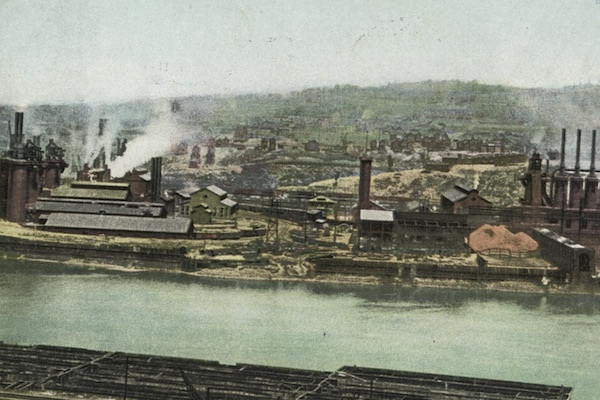
Braddock, which is now almost a ghost town (a young mayor is trying to bring it back), is the only one of the three that still has a steel mill. Indeed, its Edgar Thompson Works is the only mill left on the river; ironically, it’s also the oldest, having opened in 1872. The reason Pittsburgh originally became a center of steel production was its rivers (the Allegheny and Monongahela meet at Pittsburgh to form the Ohio). The largest of the US Steel mills was in Homestead, where I worked in the 100-inch mill office during the summer of 1956 until my mother died and I moved to Chicago.

The mill could produce sheet steel up to that width. What I did specifically was mimeograph sheets of instructions called Rolling Orders, then deliver them around the mill to stations that needed that information. My strongest memory was crossing the bridges that went over the production line when a slab of molten steel would roll beneath me, causing a rush of heat would take your breath away.

Although I was living in McKeesport then, in the last years of World War II, my family actually lived in Homestead. My mother worked for the US Navy in a lab that tested steel meant for ship construction. We moved to Chicago not long after the war ended.

I mention all this because during our recent visit we stayed at a hotel in Homestead, located on the river in an immense shopping center located where the mill had been. When we checked in, I mentioned to the desk clerk that I had once worked there. He thought I meant the hotel. When I explained I had worked on the site when there was a vast steel mill there, he still was confused, since he was too young to remember it had ever existed.

Our room overlooked the river. The bank opposite was a pristine, tree-covered hill. It had snowed, creating a magical effect. As I watched, an animal – was it a raccoon? – ran along the base of the hill on an abandoned railroad right of way. You could have been in the middle of nowhere, instead of on the former site of a mill whose blast furnaces had lit up the night, and whose chimneys spewed soot that covered surfaces for miles around.

Pittsburgh was then an unhealthy place to live. I remember coming back on the train with my family from Chicago for Christmas. It might have been 1947 or 1948. We arrived mid-morning as I recall, and it could have been the middle of the night, for the smog had literally turned day into night. After an agonizing decline in the 1960s and beyond, Pittsburgh has transformed itself into a clean and thriving small city. If you’ve never been there, you should give it a try after the current pandemic is over. For its size, there is much to see and do.

Back to Homestead. Just the other day, I was watching a documentary on PBS on the Gilded Age, when the so-called Robber Barons held sway. One of them was Andrew Carnegie, whose Carnegie-Illinois Steel Corporation owned the Homestead mill, along with the majority of the country’s steel mills until he sold it all to J.P. Morgan and retired.

When the workers at Homestead went on strike on July 1, 1892 after Carnegie – who was vacationing in Scotland – had lowered their wages, his associate, Henry Clay Frick, with Carnegie’s enthusiastic encouragement, sent a barge of armed Pinkerton agents down the river from Pittsburgh to protect workers hired to break the strike. The striking workers, many also armed, fired on the barge. In the battle that followed, 19 men were killed and more than 100 wounded.

Predictably for the time, the government sided with the company and the strike was broken. Coincidentally, I had just recently written about the Pullman strike of 1894 in Chicago, which had the same result. Together, they largely ended the effectiveness of industrial unions, until legislation in the 1930s codified their rights to organize and bargain.

I don’t suppose the tug of war between capital and labor will ever end. So I leave you with a quote from my friend and partner, Jim Caulfield, perhaps apropos of the recent $2 trillion COVID 19 spending bill: “Isn’t it strange that folks living paycheck to paycheck are supposed to have months’ worth of savings for emergencies while billion dollar corporations are so poorly managed that they’re on the brink of bankruptcy after a week of reduced profits?”

######

Copyright 2020, Patrick F. Cannon

Human Nature Prevails

Human Nature Prevails

By Patrick F. Cannon

There always comes a point in any unexpected event when the usual human responses begin to kick in. In the current COVID 19 pandemic, it was for me about two weeks ago when I saw a man exiting the Jewel Foods store in River Forest with a shopping cart full of toilet paper.

It was early on a Thursday morning, a time and day when I would expect to see very few shoppers. Instead, there were long lines at every check out; in mine, the store manager was manning the cash register. It was, and continues to be, all hands on deck at every food store. As I write this, toilet paper is still in short supply, as if the entire population had suddenly developed the trots.

The impulse to hoard among a certain sector of the population is entirely predictable. If a blizzard or flood is predicted, the hoarders will come out in force. They never disappoint. Nor do our politicians. Both Governor Pritzker and Mayor Lightfoot have yet to fail mentioning the failure of the Federal government to be perfect. I notice that this same litany is sung by Governor Cuomo of New York and Mayor Bill de Blasio of New York City, fellow Democrats. Can I suggest that if a Democrat were in the White House, the Republican office holders would be doing exactly the same?

The temptation to assign blame is entirely human, and has been done as long as history has been recorded. When the so-called Black Death (Bubonic plague) killed a minimum of 75 million people in Europe in the 14th Century, religious leaders were inclined to blame the sins of their flocks, i.e., God was punishing moral backsliding with a death sentence. President Trump – rarely at a loss for interesting utterances — originally said we were being attacked by a “foreign” virus, meaning Chinese. The Chinese, not to be outdone, have claimed the virus – which after all started appearing in China – was actually brought to China as part of a plot by the United States. Vegans have suggested that if we banished animals from the world, our troubles would be over.

I’m sure a search of the internet would yield even more conspiracies. As of today, no one actually knows what has caused this strain of Coronavirus to emerge. Eventually, the actual cause will likely be uncovered. And a report will be published with this information, and no doubt suggestions for more effective responses. And, believe me, what we’re doing now is about the best we can under the circumstances. At the risk of disrupting our lives and almost certainly causing a deep recession, fewer people will contract the virus, and thus fewer people will die.

Governor Pritzker, who is so fond of blaming President Trump for all of our woes, will face dwindling state revenues, exacerbating pension shortfalls he and the Democratic Party have thus far notably failed to address. But as the stock markets continue to tumble, Bernie Sanders, he of the perpetual scowl, may crack a smile as he realizes that the hated rich are getting poorer by the hour. But wait! Doesn’t that mean they’ll have less for us to tax?

######

Copyright 2020, Patrick F. Cannon


I’m Entitled!

I’m Entitled!

By Patrick F. Cannon

A few days ago, Mr. Shelton Jackson “Spike” Lee, the noted film director, announced he would boycott the remaining games of the NBA’s New York Knicks, of which he has been a long-time courtside season ticket holder. It seems he feels disrespected, since he had been asked to use the VIP elevator instead of the one set aside for employee use only.

In his defense, Lee has been a season ticket holder for many years; currently courtside season tickets cost north of $30,000. I don’t know anything about Madison Square Garden and its elevators, but ones first reaction to news of this kind is to mark it down as just another example of celebrity hubris. The story did get me to thinking about how we have fed their expectations by giving in to their excessive demands. Who has not heard of rock musicians demanding booze, drugs and women in their dressing rooms as a condition for performing?

For many years, I hired speakers for the Lions Clubs International annual convention. In addition to a hefty fee, we routinely provided a hotel suite and first-class air fare. In many cases, we would also get a list of required “amenities,” which could include brands of alcoholic drinks and other goodies that they expected to be in their suites. As far as I can recall, drugs and women were never requested, but occasionally we did have to provide private plane travel for the more sensitive.

If the celebrity happened to be our nation’s President, we didn’t have to worry about anything; we just did what the Secret Service told us. But in the case of one international celebrity, our usual expectations were confounded. One of the features of the convention was the presentation of the Lions Humanitarian Award, which included a nice piece of sculpture and a cash grant to a non-profit of the recipient’s choice. In 1986, due to the exertions of Lions club members in India, the awardee was to be none other than Mother Teresa, who had agreed to accept the award in person.

The convention that year was in New Orleans. At the suggestion of the Indian Lions, I duly sent a letter to Mother Teresa, confirming the date and location of the convention, and advising her that we would be pleased to make travel arrangements for her and a companion, and reserve a suite at our headquarters hotel; in this case, the New Orleans Hilton. I don’t recall the exact timing, but some time passed without a reply, so I queried my contact in India. He responded by telling me that she had asked only for the date, time and location of the event, and would make her own arrangements.

This was, of course, unheard of, and caused extreme consternation among the leaders of the association. Thinking perhaps that I had been derelict in my duty, they themselves tried to get more information, to no avail. In the end, we all had to take her appearance on faith. I should also mention that Archbishop Phillip Hannon of New Orleans found out that she was coming, and was equally flabbergasted that I could provide no real information about her travel plans.

The day and time of her promised arrival finally came, and a group consisting of our international president, the archbishop, assorted other nabobs, and me gathered at the entrance to the New Orleans Super Dome. Just at the time specified, I noticed a rather old and faded Chevrolet sedan pull up to the curb. Don’t ask me how, but I immediately knew that it would contain Mother Teresa, so I walked over just as she and another nun emerged from the back seat.

“Are you Mr. Cannon?”, she asked.

I won’t bore you with all the details, except to say that when we all got to the holding room, she sat next to me and asked me about my family first, then about who would be in the audience. I won’t say she actually ignored the dignitaries, but they didn’t seem very happy. I don’t really remember her remakes after receiving the award, but we had a large video screen behind the stage and the cameraman focused on her face as she spoke. There must have been 15,000 people in the audience and there was not a sound as she spoke, and I noticed tears in many eyes.

It turned out she had been staying in Baton Rouge, at a convent of her order, the Missionaries of Charity. I think we did end up sending her a check to help defer her travel costs, but that was it. And I’m sure she never worried about what elevator she used.  By the way, she remains the only official saint I’ve ever met. As for sinners…

######

Copyright 2020, Patrick F. Cannon


Words, Words, Words

Words, Words, Words

By Patrick F. Cannon

This is the 225th post in a series of essays I’ve written under the general title “Cannonnade.” The correct spelling should be “Cannonade,” but it wasn’t available because some knucklehead had already taken it. As far as I can tell, my first post was on November 10, 2015; I have not missed a week since.

That initial offering, Common Sense, ran to over 2700 words. I soon came to my senses, and the average piece since then has been about 600 words. In total, then, I have written some 140,000 words for “Cannonnade”, give or take. In addition, since 2006, I have collaborated with photographer Jim Caulfield on five books on Chicago architecture and architects (we are now working on number six). A rough estimate of the number of words in these, including captions, would be 150,000. I won’t even hazard a guess of the number of words in e-mails and letters involved in cajoling home and building owners to let us photograph their properties.

I retired from a career in public relations and communications in 2001. In the nearly 40 years I spent doing this, I wrote articles, press releases, brochures, speeches, and film and video scripts. At the end, I had entered the digital age and was writing content for a web site. I won’t even hazard a guess at how many words I spewed forth, but it must have been in the millions.

I turned 82 on Monday, and it occurred to me that what keeps me going is simply continuing to do what I have always done. Other than an occasional round of golf in good weather, I have no other hobbies. I don’t collect anything, and I don’t dress up as a super hero and attend conventions. I do volunteer. For more than 40 years, I have given architectural tours for the Frank Lloyd Wright Trust. Indeed, doing so is what led to eventually writing my five books.

The retired people I know who are still vital and interesting are the ones who never stopped working or volunteering. There is something to be said for getting up every morning and checking the calendar to see what’s on that day’s schedule. This past Monday, in addition to my birthday, my calendar included a visit to the dentist, proving that you can’t win them all.

Before I get carried away with self-congratulation, I should also mention that I looked over some of my old pieces, and have to admit a few were a bit on the pompous side. Also, my political prognostications have proven defective. One of my first posts assured my readers that Donald Trump didn’t stand a chance of getting the Republican nomination. I went to great lengths to show how the math just didn’t add up for him. I failed to realize that he would continue to get the votes of his “base,” while too many of the “real” Republicans stayed in the race long enough to divide the vote until it was too late to stop him.

In the past week, it looks like the Democrats have come to their senses early enough to save the country from a Sanders/Trump race. But don’t count on it. Remember, you read it here!

######

Copyright 2020, Patrick F. Cannon


Gotcha!

Gotcha!

By Patrick F. Cannon

I took a quick look to see how many of my fellow Americans have been watching the so-called debates featuring the interesting people who want to be the Democratic Party standard-bearer to rid the country of Donald Trump, whose presidency has given heart to the descendants of James Buchanan.

On average, the total seems to be about 6.5 million. Coincidentally, this seems to be the number of journalists, consultants, pundits and bloggers whose jobs and self-esteem are closely tied to the election cycle. I have done an informal survey of my friends, and found none who would admit to watching them. Nor have I. Frankly, I see no connection between success in these debates and the ability to be an effective President of these United States.

The debates are a product of the television age, and are really an offshoot of the 1960 debates between John Kennedy and Richard Nixon. These gentlemen were already the chosen candidates of their parties. Now, the debates begin the year before the actual election as part of the ridiculous primary process that separates the losers from the winners, or hopes to.

Each of the parties has its own formula for deciding which candidates may appear on the stage, which has little to do with their actual competence. All of this is supported by an army of political lifers, who have no political principles themselves, but whose services are available to the highest bidder. You shouldn’t be surprised to discover that some of them have worked for candidates of both parties.

You should also not be surprised to discover that the reason candidates need to raise so much money isn’t just the cost of television, internet and radio ads – although this is considerable – but the cost of hiring professionals at all levels to actually run their campaigns. A subset of this group of happy, but cynical, warriors are the men and women who prepare their candidates for the debates.

For the early debates, when the stage is full side to side, debate consultants for candidate X will only research the most likely opponents. What did he or she say or do 30 years ago that no longer passes the PC litmus test? Then, when candidate X is asked to answer a question on, say, health care, he can segue after his non answer to casually mentioning that candidate Y has never owned a dog. Or, if she did own a dog, did it die under mysterious circumstances?

As the candidates are winnowed out over time by either not having a sufficient showing in the polls, or the inability to raise cash, the debate consultants can sharpen their focus. They dig deeper, often succeeding in finding an associate of candidate Y who suddenly remembers that she once claimed to be direct descendant of Chief Sitting Bull, or perhaps Florence Nightingale. When these turn out to have been exaggerations designed to get the candidate into law or nursing school, we have a “gotcha” moment. They then disclose that her most famous actual relative was Bonnie Parker.

Despite the fact that the candidates this year are members of the same Democratic Party, they act more like mortal enemies. The Republicans have no such problem. Having sold their souls to the devil, they are marching lock step into disgrace. There are now two Democratic parties – the Social Democrats of Biden, et al; and the Democratic Socialists of Bernie Sanders and his followers, the Children’s Crusaders. Isn’t it time to form a new party from the moderates who have more in common with each other than with the lunatic fringes of their own parties?

Perhaps an idle dream. One thing for sure – the hired guns would have no problem espousing whatever programs the candidates think the voters think they want. Or just the opposite. Whatever.

######

Copyright 2020, Patrick F. Cannon


Watch Out! The Bernie Man Will Get You!

Watch Out! The Bernie Man Will Get You!

By Patrick F. Cannon

Recent headlines have claimed that the Democratic Party “establishment” is quaking in terror over the possibility that Senator Bernie Sanders, the proud Socialist senator from Vermont – by way of Brooklyn – may end up winning their party’s nomination for President. In which case, so the theory goes, Trump would win again.

As I recall, they had the same fear four years ago, so made sure the party nominated Hillary Clinton instead. We all know how that ended up. The Democrats now face the same problem that the Republicans struggled with in 2016 – too many candidates. Here are the results of the somewhat tainted Iowa caucuses:

Buttigieg                     26.2%

Sanders                       26.1

Warren                       18.0

Biden                           15.8

Klobuchar                   12.3

Yang                               1.0

In the New Hampshire primary, close to home for Sanders, the results were:

Sanders                       25.7%

Buttigieg                     24.4

Klobuchar                 19.8

Warren                         9.2

Biden                             8.4

Being the ace political analyst that I am, I noticed that so-called moderate Democratic candidates (not counting the minor ones) got 55.3% of the vote; and the far lefties, 44.1%.  In New Hampshire, the numbers were 52.6% and 34.9%. This would lead one to believe that the majority of Democrats would prefer a candidate somewhat closer to the center, rather than the avowed socialist (and it must be said, Marxist) Sanders.

Despite his age, Sanders seems to have become the darling of our young voters. Because socialist thought has found a refuge in academia – where actual history and the real world are not permitted to intrude – they seem to think Marxism deserves another chance. Perhaps you recall that famous definition of madness?

In 2016, by the time the Republican field had dwindled, it was too late to stop Trump. Now, they’re stuck with him and don’t seem able to do anything but sit in his lap and hope for a belly rub or two. While it may not be too late to stop Sanders, it may reach that point. Did I just read that Republicans in South Carolina are planning to vote for Sanders in the Democratic primary?  What’s to stop them from doing the same in other states?

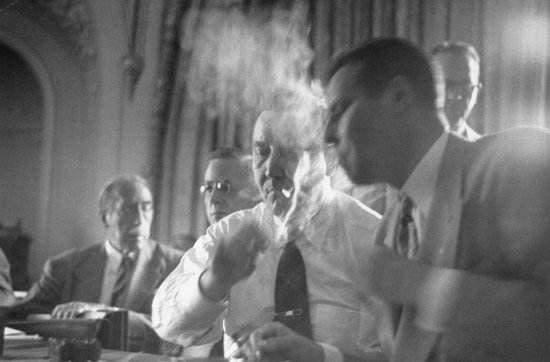
All of this nonsense could be avoided by scrapping the primary system altogether and letting the party leaders decide who their best candidate would be. The current system isn’t enshrined in the Constitution, or in any Federal or state statute. It developed over the years in a mostly misguided effort to promote “a more democratic process.” It hasn’t worked. It’s given us Jimmie Carter, George W. Bush and (yikes!) Donald Trump. And it may give us (horrors!) Bernie Sanders, who can’t seem to stop yelling at us. Bring back the smoke-filled room, I say!

######

Copyright 2020, Patrick F. Cannon

Gimme Shelter

Gimme Shelter

By Patrick F. Cannon

As someone who has written several books on architecture, I am familiar with man’s ongoing struggles to seek shelter from the storm. Since our species emerged in Africa, we have progressed from shaky lean-tos and caves to the sophisticated dwellings of today. With their computer-controlled heating and cooling systems, and stout walls and roofs, they are proof against almost anything Mother Nature might wish to assail us with.

Yet, among us are folk who seek to return to a more primitive past. I refer to the restless wanderers who hoist upon their backs a pack containing a tent and other necessities and venture forth in search of the woods and mountains that ennoble our sacred land. This despite the undoubted fact that all of our majestic sites can be easily reached from a nearby hotel (free breakfast included).

I must admit that my own distaste for roughing it may be based on my experience as a proud member of the United States Army. As part of its basic training, the Army feels obligated to march you – with a 65-pound pack on your back and a rifle on your shoulder – some 20 miles into a remote corner of one of its properties, in my case, Fort Benning, Georgia. Once in an area chosen for its dampness and venomous creature infestation, you were instructed to pitch your pup tent. Now, in those days, you carried only half the tent. Officially called a shelter half, it required you to pair up with a fellow soldier to create a tent, which you would then share (see illustration).

The material for the tent was a kind of canvas, ingeniously designed by the Quartermaster Corps to be waterproof until you touched or poked it by accident. Through a fortunate twist of fate, I was paired with a young man from central Illinois who had been an Eagle Scout. Jim not only warned me never to touch the tent roof, but made certain that we pitched our tent on a slight incline, whereupon he conspired a series of trenches designed to direct water away from the tent. As you might expect, it rained that night and most of the next day. We remained blissfully dry, while all around us we heard the curses of the tent pokers. I should also mention that, once wet, an army sleeping bag takes several years to dry. To add to the general gloom, they decided to treat us to an overdone steak dinner that day. It was still raining, and you had to carry your meal back to your tent. Needless to say, dinner went swimmingly.

My next camping experience came more than a year later, when the signal company of which I was then associated was flown, along with its vehicles, in C-130 cargo planes to Fort Hood, Texas. We were there to support a corps headquarters directing armored troop maneuvers. Our company commander, a fine and typical graduate of West Point, choose a likely-looking flat spot for our tents – still of the same classic pup variety. For the officers and sergeants, he chose a site on higher ground, no doubt so he could admire the admirably straight rows of tents below.

As you might have guessed, it rained, this time a torrent for which the Texas hill country is justly famous. No ingenious trenching system could have saved us from the torrent that came rushing down the hill. The next morning was pure misery, until a stroke of good fortune came my way. Just while I was choking back tears, an unknown sergeant appeared and asked me if I would be interested in returning to the post, where they had need of a cryptographer for special duty. It turned out it was related to the looming Cuban missile crisis, and even the threat of nuclear annihilation seemed preferable to another night camping in the Texas wilderness.

I did some years later buy a nice tent, which I pitched in the back yard for my children. It never occurred to me to fold it up, put in a pack and wander off into the woods. By the way, if you chance to wander into the woods yourself, watch your step. Not all campers bother to dig a hole and cover it over after doing the necessary.

Copyright 2020, Patrick F. Cannon


Favorite Things

Favorite Things 

By Patrick F. Cannon

The Rogers and Hammerstein musical, The Sound of Music, is despised by sophisticates like me as being excessively sentimental and cheerful. A case in point would be the song “My Favorite Things,” which extols the virtues of “Raindrops on roses, And whiskers on kittens, Bright copper kettles, And warm woolen mittens.” Yikes!

Nevertheless, the musical may be the most popular of all time, and contains some of Richard Roger’s most beautiful melodies. The heirs of the composer and lyricist are happily counting their royalties and could care less about the “tut tuts” of people like me.

While “whiskers on kittens” isn’t one of my favorite things (I don’t hate cats, but I could happily live without them), the song got me to thinking.  So, from time to time, in this space, I’ll let you know about some of the things that I prize most highly.

One is Bach’s Goldberg Variations. Originally written for the harpsichord as a series of exercises for the 13-year-old Johann Gottlieb Goldberg, who must have been quite the prodigy, it consists of an aria and 30 variations. It runs to about 80 minutes, give or take. While there are many recordings on the original instrument, it is now most often played on the piano. The most famous recordings are the two versions done by the wonderfully eccentric Canadian virtuoso, Glenn Gould. He was given to humming along with his playing, which must have driven recording engineers crazy; and was so adverse to cold that he wore a hat, coat and mittens even when visiting Florida. He was only 50 when he died in 1962.

I own both of his recordings and listen to them often, usually during long car rides. How many times? I’ve lost count, but it must be over 100. While that may make me seem as eccentric as Gould himself, I have a simple defense: the Goldberg Variations is one of the greatest musical accomplishments of all time. If you haven’t heard it, you can find various versions, including Gould’s, on the internet. What can it hurt to give it a listen?

One of my pet peeves (one of many) is that the majority of people simply never listen to so-called Classical music. And not only that – the audience for it is dwindling. Now, you might hear about sold-out houses when Ricardo Muti, the music director of the Chicago Symphony, is conducting, but “sold out” doesn’t mean what it used to. The total audience for Classical music has stayed roughly the same while the population continues to increase. Thus, in real terms, the audience is declining. A sold-out audience at Symphony Center totals 2,500, while a sell-out at a rock concert at Chicago’s United Center totals 23,500. I believe the Rolling Stones sold it out three times recently. And no doubt would continue to do so even when they have to be rolled on to the stage.

With due respect to the Stones, their lifetime musical output doesn’t equal the Goldberg Variations. It doesn’t bother me that people like the Rolling Stones – I like a good deal of popular music myself – what amazes me is that they dismiss Classical music without actually ever listening to it  Do they think it’s too hard? It’s music, for God’s sake! All you have to do is listen. For most of it, you don’t even have to worry about the words. It doesn’t require thought. It is the purest of all the arts because it reaches us most directly.

That’s why the Goldberg Variations is one of my favorite things.

#####

Copyright 2016, 2020, Patrick F. Cannon


The Cost of Being Healthy

The Cost of Being Healthy

By Patrick F. Cannon

Insurance companies do not pay for health care. The Federal Government does not pay for health care. We – you and me – pay for the nation’s health care, along with the stockholders and members of corporations and associations.

I’m always amused when politicians talk about free health care. I have Medicare coverage now. For it, and a supplemental policy, my wife and I pay $11,184 a year in premiums. Before we retired, we paid about 1.5 percent of our income in Medicare withholding tax. These, by the way, are just basic costs; out-of-pocket expenditures are not included.

Although it’s constantly increasing, it was estimated that the total cost of health care in the United States was $3.65 trillion in 2019. The latest per capita figures I could find were for 2017, when the US spent $10,224. The next highest amount was in Switzerland, with $8,009. The average for developed countries was $5,280. Administrative costs in the US were approximately 8-percent, as opposed to from one- to three-percent in comparable countries. Finally, before I bore you to tears, the average physician here makes $218,173 per year; the next highest is Germany, with $150,000.

While the breakdown can vary slightly year to year, private health insurance pays 34-percent of the total healthcare bill. Medicare has a 20-percent share; and Medicaid, 17 percent. Other sources, including out-of-pocket, make up the balance.

Were we to go to a single payer system – i.e., “Medicare for All” – presumably reliable sources tell us that one trillion dollars a year would be added to a Federal deficit that is already running at that level. Politicians like Bernie Sanders don’t see a problem here. You simply tax the rich. In this, he has been remarkably consistent throughout his career. He is on record as believing that there should be no such thing as a billionaire. And as a committed Marxist, he has been perfectly happy to ignore its long and persistent history of failure.

Here’s what I think. Except for some pockets in rural America, we have the finest health care in the world, as I have recently personally experienced. Nothing we do to “reform” it should jeopardize that. It’s also clear that we cannot trust the current political parties to solve the health care funding problem, since they have been obviously unable to agree on ways to even fund the government we currently have. The Republicans, who once could be counted upon to at least try to hold the line on spending, are now as profligate as the Democrats. Indeed, they lowered taxes just when tax revenues from a growing economy might have significantly lowered deficits.

We have smart people in this country, experts in health care and economics who could study the problem in detail and devise a system that would provide a high level of care at a cost the country would be willing to pay. None of these people are politicians. As reluctant as I am to turn over the government to experts, in this case I believe that only a non-partisan commission would be able to study the problem in detail and recommend a way forward.

What we have now is a Republican Party whose only idea is to repeal Obamacare; and a Democratic Party whose increasingly radical base thinks only of a Federal government-run single-payer system, funded by the rich. I frankly don’t know what a workable system would look like, except I’m certain it’s neither of those. It’s perhaps a vain hope, but what this country really needs is a new political party, which I would name the Pragmatic Party. The current failed ideologies of the right and left will not solve any of our problems.

Copyright 2020, Patrick F. Cannon