They is Me!

They is Me!

By Patrick F. Cannon

To the continuing consternation of the French, English long ago overtook it as the most internationally spoken language. Among many reasons for this, it seems to me, is its flexibility. Unlike French, whose dictionary is controlled by the Académie Francaise, there is no official body to pass judgement on proposed new words. The Oxford English Dictionary, although highly respected, is not an official authority. The latest edition of this 20 volume collection includes 176,476 words in current use with full definitions; and 47,156 obsolete ones. But its compilers are constantly looking at new words that could be added.

While English is a Germanic language, it happily is home to words from many others, including French, Spanish, Italian, Chinese, Japanese, Hindi – well, you get the idea. Often, we are unaware of their derivation. I doubt that many people who live in them know that “bungalow” comes from Hindi, for example. But it’s so ingrained in the language that it really doesn’t matter.

What does matter is structure and convention. Just as in any language, the words only make sense if they are arranged in a way that everyone can understand. I don’t believe it’s done anymore, but I spent countless hours at the blackboard diagramming sentences under the steely gaze of a nun. The basic structure is “subject, predicate, object.” Add to that the adjectives, adverbs, independent and dependent clauses, tenses, pronouns – all of which can be confusing to the poor soul trying to learn English, but seem to make perfect sense to us.

Hitherto, words had established meanings, although many had more than one. Those 176,476 words in the Oxford actually swell to more than 600,000 when the various meanings are included. But some words, personal pronouns in this case, have had settled meanings for hundreds of years, although spellings and some forms have changed over time.

Not anymore. A few days ago, I read an article in the Chicago Tribune about a woman on the staff of a local museum who asked to be described as “they” instead of “her.” This is apparently becoming more common, as more and more people decide that they either encompass both sexes or none at all, or perhaps haven’t yet made up their minds either way.

The newspaper, of course, complied, since they seem to have an utter horror of offending even persons who probably don’t read newspapers in the first place. This policy follows along from the policy they established some years ago to identify persons by the sex they claimed to be rather than the sex they actually were. In many states, you can even change your birth certificate – an official document – if you disagree with the gender you were “assigned” at birth.

Pity the poor “assigners.” They counted upon the evidence of their eyes, and the reality of biology, to check the male or female box. There is an essential difference, it seems to me, between tolerance and belief. If a male person decides to live as a female, he is doing nothing that hasn’t been done throughout history. And vice versa, of course. But the apparently unpalatable fact is that you can’t change your sex, even if you have what is now called gender reassignment surgery.

As with so many matters of “political correctness,” I suppose we’ll just have to accept this as one of the many absurdities that the existentialists like me must embrace. It reminds me of the former comic strip hero Pogo’s (look him up) famous comment (and I paraphrase): “We have met the enemy, and they is me.”

Copyright 2020, Patrick F. Cannon


A Noble Repast, Indeed!

A Noble Repast, Indeed!

By Patrick F. Cannon

As famous as I’ve become for my gourmet recipes – you’ll recall my Bologna Wellington, I’m sure – I realize that not everyone has the time or inclination to scale the culinary heights. This week, then, I’ll provide my faithful readers with simple, hearty food that can be on the table in mere minutes.

One of my favorite luncheons is the fried bologna sandwich, proving anew that this encased meat is eminently flexible. Ingredients are simple: two regular (not thin!) slices of your favorite bologna; one slice of American cheese (I prefer Kraft); Heinz Ketchup (no substitutes); and two slices of bread (I prefer Whole Wheat, but any sandwich bread will do). I should also warn you against low-fat bologna, particularly the Turkey variant. They may claim it’s real bologna, just as the almond growers of California claim their vile juice is “Almond Milk.” But it’s not!

            Prepare the bread by spreading ketchup on both slices. Cut a slice of cheese in half and have at the ready. Place the two slices of bologna on a hot frying pan. As they fry, they will almost certainly curl up, but don’t let this concern you. When you’re satisfied that they’re done on the first side, turn over with a spatula. Viola! The curl will dissipate. Now, bend the cheese halves in half again and place directly in the middle of the bologna. When the cheese is melted, place the two slices of be-cheesed bologna on one of the slices of bread, then cover with the other (do I have to remind you to have the ketchup sides in?). At this point, I like to slice the sandwich on the diagonal.

Present this classic sandwich on a plate with a kosher pickle spear and a mound of potato chips. By the way, to add a bit of historical perspective, the word “sandwich” comes from the 4th Earl of Sandwich, John Montagu, who is said to have invented the handy eatable one day when he was gambling away his inheritance. It seemed he didn’t want to leave the table to take nourishment, and had a minion slap some slices of beef between two pieces of handy bread, so he could eat with one noble hand, and toss the dice with the other. The current Earl, the 11th of the line, often regales his fellow member of Britain’s House of Lords with this legend, at least those not napping.

(To be fair to the noble 4th Earl, he also helped to finance Captain Cook’s voyage of discovery, and the Sandwich Islands – now Hawaii – were named in his honor. It is perhaps all to the best that the islands were later renamed. Who would be willing to say “I’m from the State of Sandwich?)

There is no record of any of the Earls having eaten that other classic, the peanut butter and jelly sandwich, or the P&J as it’s known for short. You wouldn’t think such simple fare would require a recipe, but you would be mistaken. As with everything worthwhile, complications enhance the experience. First, the bread. While other sandwiches may be made with a variety of breads, the P&J can only be made with mushy white sandwich bread. Wonder Bread still makes the classic of the type, but there are others. If in doubt, apply the squish test (which consists of compressing the loaf at both ends like a concertina. If it soon returns to its original shape, it passes the test).

Please note that it’s called the peanut butter and jelly sandwich, not the peanut butter and jam or preserves sandwich. And, really, why would you use anything but grape jelly? I realize there are other kinds – apple, mint (!), cherry, strawberry, pomegranate (!!) – but none are as aesthetically pleasing as the classic grape, particularly Welch’s.

As to peanut butter, there is some question whether regular creamy, or chunky, is best. I admit to some vacillation here, but personally come down on the side of chunky. In this regard, I permit personal preference to decide the issue.  As to brand, it is my understanding that all are made with peanuts, so actually vary little in taste. I prefer Smucker’s because I like the name, but Skippy, JIF and Peter Pan all have their passionate adherents. Avoid “natural” types at all costs. These come with the oil separated from the solids, requiring one to laboriously mix until the proper consistency is achieved. Why would any sane person do this?

I like to spread the peanut butter first, and liberally at that. Under no circumstances spread the jelly on the peanut butter! Instead, spread the jelly on the other piece of bread, then join the two together with due care. Many connoisseurs like to cut this sandwich into quarters, but this seems excessively precious to me.

I do like to precede it with a bowl of Campbell’s Cream of Tomato Soup; thus all the major food groups are accounted for. As to the soup, you will need to add a can of liquid to reconstitute this condensed product. You could, of course, economize by adding water; but I much prefer whole milk. If you were to add the aforementioned almond juice instead, you would create an abomination that would reverberate down through the ages. Don’t.

Copyright 2020, Patrick F. Cannon


What’s Your Background?

What’s Your Background?

By Patrick F. Cannon

My daughter Beth often suggests subjects for this weekly bit of wisdom, and this is one of them. On a recent morning, during our regular daily phone conversation, I happened to mention that I was watching the morning news, upon which a local doc was imparting his wisdom regarding the inevitable and relentless Coronavirus. He was obviously in his office, beaming his thoughts through Zoom or Shazam or whatever remote video thingy was available.

He had a fine head of white hair, which imparted a hint of wisdom; unfortunately, a fine shock of his manly mane was hanging in his face. Had he been in the studio, the staff makeup person would no doubt have combed the good docs hair and sprayed it with that gluey stuff to keep it in place.  In addition, his rather pasty face would have had a heavy coating of makeup to prevent that oily shine.

I know this from personal experience, having been interviewed on television many times. When you’re doing it in the studio, the resident makeup artiste does up your hair and slathers pancake makeup on your face, which gives you a healthy-looking tan, much like our eminent president. I hate it, because it’s the very devil to remove, short of a lengthy scrub with soap and water.

If you’re interviewed outside the studio, you can be a victim of the elements, as I was in Phoenix one July in a convention venue we were just setting up. The organization I was working for was notoriously cheap – who else would have a convention in Phoenix in July? – and would not pay to turn on the air conditioning until the venue was opened to the public. The local news team swooped down on me as I was dripping with sweat. The interview duly appeared that evening on the local news. Not only was my very red face dripping with sweat, but my shirt was covered with sweat stains.

I’m sure you’ve noticed that local and national news reporters and anchors are often broadcasting from their homes these days. It is the backgrounds that interest me most. A favorite is a bookcase filled with weighty tomes, a few family photos, and bits of pottery and sculpture (which might be a bust of Abe Lincoln, or some unrecognizable hunk of iron).  It’s difficult to see the titles of most of the books – they might be the collected works of Dame Barbara Cartland – but one I was able to read was behind Judy Woodruff of the PBS News Hour. It was Ron Chernow’s biography of U.S. Grant. In her case, it was possible to believe she had actually read it.

Most of the local anchors and personalities don’t seem to read, which doesn’t surprise me. One, who shall remain nameless, recites the weather from what appears to be her living room. On the wall behind her are framed bits of greenery, likely chosen by some designer. There is a couch and matching chair. On the chair sits a beagle, no doubt there to add some homey charm. Unlike most beagles, known for their energy, it never seems to move. Perhaps it’s dear departed Rover, stuffed.

The major network anchors live in New York, and mostly live in apartments on the upper east side. They can, of course, hire the best decorators. Two primary styles seem to be in favor – either what I would call “old money” coziness; or the spare rigor of the modernist sensibility, with the walls festooned with Pop Art and Abstract Expressionism. In both, one sees immense art books prominently displayed on coffee tables.

As an antidote to all this, I suggest you watch the regular Friday appearance of syndicated columnists Mark Shields and David Brooks on the PBS News Hour. Brooks does have bookcases in the background, but he’s entitled – he’s actually written several. Shields, an old campaigner at 82, comes to us from a room that looks both lived and worked in. The first time I saw the room, obviously his home office, it was more than a little unkempt. The following week it looked a bit more picked up. I suspect Shield’s wife watched it on the screen in horror, and decided to at least make the piles of stuff neater. But it still looks like a real room, not a stage set.

Next time, instead of watching the news reader recite the news, which is uniformly bad anyway, see if you can find any hints of actual human habitation where they live.

Copyright 2020, Patrick F. Cannon

A Noble Roast!

A Noble Roast!

By Patrick F. Cannon

On the 18th of June, 1815, Field Marshall Arthur Wellesley, First Duke of Wellington, defeated the French armies of Napoleon Bonaparte on the plains of Belgium near the village of Waterloo. The bloody battle ended more than 20 years of Napoleon’s rule of France and much of Europe. Wellington, already a hero for his exploits in India, Spain and southern France, was now the most famous man in the world.

Soon after his return to England, he was feted at a lavish banquet at London’s Guild Hall. For the occasion, a special dish was created, ironically by Napoleon’s former chef, Savarin de Escoffier, who was happy to get the job, chefs being loyal only to their kitchens. The result? What we now know as Beef Wellington! Although there were many other courses – no wonder gout was rampant among the upper classes – the beef was served with white asparagus and Hollandaise sauce. For desert, Escoffier created a Bombe au Chocolat.  As promised, I will tell you how to make this historical meal. You will truly eat like a Duke!

The basis for this noble roast is beef tenderloin. This is the same cut of beef used for filet mignon, thus the tenderest part of the cow. Do no skimp here; buy only Prime grade. It may cost $30 a pound or even more, but remember that some fancy restaurant would charge you three times that to cook it for you. For eight servings, a six-pound roast should suffice.

To transform it into Beef Wellington, you will need a hunk of pate de foie gras, some mushrooms, spices, and prosciutto. You will also need the ingredients for butter-rich pastry to cover the whole lot. Now, I checked on the cost of the pate de foie gras, and it should only cost another $100 or so for the amount needed. I would estimate the other ingredients at another $25 or so; so the total cost would only amount to about $300.

$300? You gotta be kidding! Nobody in their right mind would spend that kind of dough to feed eight people, so let’s be realistic and come up with a substitute that would completely satisfy, but only cost a few bucks!

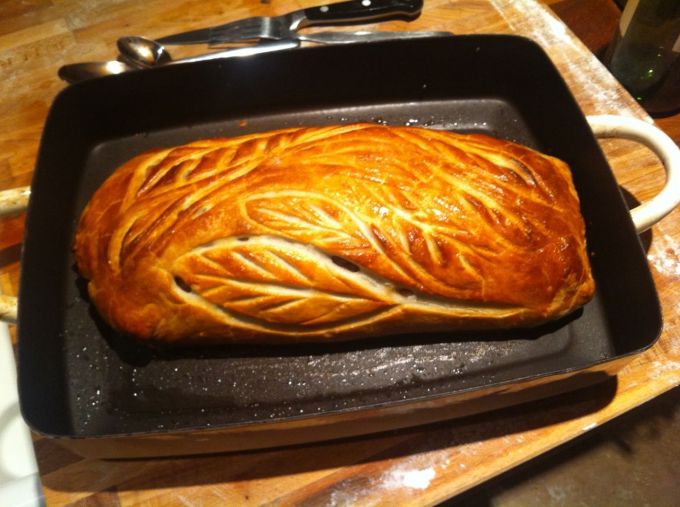
It’s my famous Bologna Wellington. Instead of beef tenderloin, have your butcher cut you a hunk of bologna about 8-inches long. Our butcher, Joseph’s Finest Meats in Chicago, makes a toothsome bologna, but by all means choose your favorite brand. Instead of the imported French pate – made by force feeding geese to fatten up their livers – you can opt for chicken-liver pate or braunschweiger liver sausage (I favor Usinger’s). Regular button mushrooms will suffice, but if imported prosciutto is too rich for your blood, thin-sliced boiled ham should do the trick. For the pastry covering, I find that Pillsbury’s Crescent Dough Sheets – available in your grocer’s cooler — are a handy substitute.

Set the bologna aside. Chop the mushrooms into little bits – a food processor comes in handy here – and put into a sauce pan with gobs of butter and a generous sprinkling of Herbs de Provence. It’s my go-to seasoning, and includes basil, fennel, parsley, sage, rosemary and thyme. Cook until it turns into a paste, then set aside. Put on Simon and Garfunkel’s “Scarborough Fair” while you’re chopping, if it helps you along.

Take your pate or liver sausage and slather it generously over the bologna. Ditto the mushroom paste. Cover this appetizing mess with a layer of the prosciutto or ham, then finish with the dough sheets. When all is snug, cut a few slits in the dough, and decorate if you have an artistic touch. Place it in a baking pan and slide in a 350 degree pre-heated oven. Bake until the pastry is golden brown. Since the bologna is already cooked, no tricky beef temperature to worry about.

I won’t insult you by telling you how to cook the white asparagus, but you may want to substitute bottled tartar sauce for the Hollandaise. The Bombe au Chocolat requires some instructions. For the base, I favor Hostess Twinkies, but lady fingers can work in a pinch.. Using the number of these classic delights you’ll have to work out for yourself, form a rough circle, then fill with more Twinkies. Add layers in descending size until you have something that looks like a rough dome. Fill in the spaces with marshmallow fluff, using a spatula to form the final dome shape. Pour chocolate sauce over the edifice to cover. Refrigerate until the chocolate hardens.

Plate the Wellington, sliced into one-inch slabs. Add three or four asparagus to each. A sprig of parsley as a garnish would not be amiss. A good wine for this incomparable dinner would be generous amounts of Carlo Rossi Paisano. After everything settles, hack into the Bombe au Chocolat and serve generous hunks. With the coffee, you might treat your guests to a tumbler of Mogen David Extra Heavy Malaga. And Bon Appetit!

Copyright 2020, Patrick F. Cannon


Aprons On!

Aprons On!

By Patrick F. Cannon

Many people who never learned how to cook are stuck at home, discovering that ordering out can be both expensive and frustrating. They could, of course, eat Lucky Charms for every meal, hoping no doubt that the luck of the Irish would rub off on them. Or, they could learn how to cook, which would both save them cash and fill their lonely hours. Regular readers of this space will know that I’m uniquely qualified to teach this skill (and many others, if I may say so).

Almost everyone I know has a kitchen, so I assume this room is almost universal. If you’re not sure you have one, I suggest you wander around your house or apartment to see if there’s a space that contains at least a refrigerator, stove, and sink. If it includes a dishwasher and micro-wave oven, so much the better. I have been in several homes where this room is the largest in the house, with immense refrigerators, freezers, and stoves that would not look out of place in a restaurant. Many also include wine coolers and separate pizza ovens. Most of them look suspiciously pristine.

If you search carefully, I’m sure you’ll also find pots and pans and other accoutrements needed for the recipes that follow. Be of good cheer and put the frying pan on the fire!

Classic Bacon and Eggs.  As a young lad, my usual breakfast was a bowl of Kellogg’s Pep, unfortunately no longer available. On weekends, we might have bacon and eggs, or perhaps pancakes or waffles. It was only when the US Army sent me to France that I discovered to my astonishment that the French eschewed a proper breakfast in favor of a croissant or brioche, consumed at the local café, and washed down with something they call café au lait, which turned out to be coffee with too much milk (although artfully poured by the waiter). This was only one of many French customs that confound me to this day. For example, the first thing they do upon awakening is make love, then have a cigarette.

Anyway, the classic bacon and eggs can be found throughout the United States, Canada, the United Kingdom and Ireland. It is usually accompanied by a piece of toast, or perhaps a crumpet. Seems complicated, but not if you follow my directions.

Bacon is sold already sliced, so no worry there. I see something called “Applewood Smoked” bacon has become popular. It doesn’t seem to taste much different than the regular kind, but feel free to indulge. By the way, my culinarily-accomplished son-in-law Boyd sometimes makes his own bacon, but he graciously slices it before delivery. Eggs are typically sold by the dozen, in medium, large, extra-large and jumbo sizes. I say go for the jumbo, and cholesterol be damned!

Fortunately, this is a one pan meal; in this case, a frying pan. Ideally, it should have a flat bottom of perhaps 10 inches, and tapering sides of two. One with a non-stick surface is preferable, although some cooks prefer a cast-iron pan. I believe only experts are wise to their cranky ways, so you should avoid their use. Put the pan on a stove burner and adjust the heat to medium. If you don’t know how to turn on the burner, please refer to the manufacturer’s instructions. Peel off individual strips of bacon and place on the pan. Three for each breakfaster should suffice. When the bacon turns brown, turn it over until it reaches a doneness you favor. Some people prefer their bacon burned; the same kind of people, it seems to me, who order expensive steaks well done.

Place the cooked bacon on a paper towel, which will absorb some of the excess fat. The bottom of the pan will have an abundance of this fat. It is flavorful, but the amount is likely excessive. Drain some into a container for later use, then add my secret ingredient, a large pat of butter. Faced with breaking an egg, many recoil in fear. Please don’t whack it with a large knife, hammer, or other implement. Tap it on a flat surface until it cracks, then break it into a small bowl. If the yolk – that’s the yellow part – is intact, repeat with another egg. If one of the yolks breaks, cast it into the garbage. When you have two eggs with intact yolks, pour gently into the pan. You will notice that the clear part of the egg will begin to turn white. When it seems completely firm, gently slide a spatula (see internet for description) under the egg and lift onto nearby plate. Treat the other egg(s) in precisely the same way.

As it happens, many egg eaters are frightened of runny whites, and will want their eggs turned over to fully cook them. This can be called over-easy, over-medium, or over-hard (for those truly terrified of both runny whites and yolks). Again, one slides the spatula under the eggs, but instead on transferring to a plate, you flip it over onto the other side. With constant practice, you will break the yolk only half the time. For over easy, a mere ten seconds on the second side will suffice; for over medium, another five seconds; for over hard, until the yolk is fully hardened and inedible.

In the meantime, you should have placed a couple of slices of bread in your toaster, which should be found somewhere in among your kitchen cabinets. When they pop up, slather with butter (no substitutes please, especially avocado). Add the bacon to the plate with the eggs, but serve the toast on a separate plate. It would be a kindness to provide some jam or preserves to complete the hearty meal.

Frankfurters a la Boston. What could be more American that hot dogs and Boston baked beans?  To make this wholesome and tasty meal, you will require two sauce pans. Fill one with water; the other with a can or two of pork and beans. You may wish to serve two dogs per person; thus you should multiply the number of persons to be served by two. What could be simpler? As to brand, this can vary by geography. Here, in the Chicago area, I prefer Vienna, but surely this is a matter of taste? In any event, all you have to do is put the dogs in the water and turn on the heat. When the water comes to a boil (that’s when bubbles appear) it will only be a matter of minutes until the dogs are heated through.

If cooking the beans at the same time is too daunting, you can just turn the water off and let the dogs stay warm. You can then turn the heat on under the bean pot, and stir occasionally until they reach a level of heat compatible with your wishes. However, I would advise adding some additional flavors to the beans, as the canned product is a bit on the bland side. I favor a dollop of barbeque sauce, a squirt of ketchup, and a soupcon of Dijon mustard. The truly adventurous will essay a dash of some hot sauce – Tabasco, for example – into the beans to add a bit of heat. I’m told that some cooks even chop an onion and toss it in, but I have never personally witnessed this, so it may just be an urban legend.

Decision time has now arrived. Do you serve the hot dogs on a bun, or naked? If on a bun, complications arise. Do you wish to serve a true Chicago dog? If so, you will need to have some poppy-seed buns, green relish, yellow mustard, diced onions and tomato, little peppers and celery salt. If this seem too complicated, limit your accompaniments to the mustard and relish. Do not be tempted to use fancy bakery buns – the cheaper the better. Sans buns, you need only serve jars of condiments, which one may use for dipping – but never ketchup!

To maintain proper standards, you must pour the beans into a serving bowl. Provide it with a large spoon, so each diner may partake as he or she wishes. It would be most helpful to also provide salt and pepper shakers, cutlery and napkins. A good lager would suit this menu. Wine choice can be tricky, but I would recommend a fruity Alsatian Riesling, properly chilled.

(Next time – Beef Wellington, with white Asparagus Hollandaise, and Bombe au Chocolat.)

Copyright 2020, Patrick F. Cannon

The Name Dropper

The Name Dropper

By Patrick F. Cannon

(This is retelling of a classic tale that I explored a few years ago. Here, I have personalized and Celtcized it. During this fraught period, I will try to generate a few smiles to help mitigate some of the grim news. Another positive thing we could all do is consider donating a portion (or all) of the cash payments the government plans to send us. Not all of us will need this windfall. If you don’t, why not donate to organizations that are struggling; or to individuals and families that are without income?)

Most of us have known someone like Shaughnessy on our travels through life. You know, the braggart, they guy who knows everything and everyone? I met him in grammar school on Chicago’s great South Side. His father was something for the city, and Shaughnessy claimed he was Mayor Kennelly’s best friend and confidant. He also claimed that President Truman often called his old man to ask for advice.

More pertinent to his fellow students, he said his father was a proud graduate of Notre Dame, and counted the legendary Frank Leahy as a pal. Oh, and George Halas was a regular dinner guest at Chez Shaughnessy. While the White Sox didn’t offer much to brag about then, the owners, the Comiskey family, often made their private box available for an afternoon of watching the Sox lose to the hated Yankees.

Even at that young age, I have to confess that I took whatever he said with a grain of salt. When I was in 7th grade, we moved away. Many years later, I moved back to Chicago. I was living on the North Side, and one day, on a whim, I went back to the old neighborhood to see how it had fared.  Sure enough, the legendary local tavern, Ryan’s, was still there. My father had been a regular, and often the whole family would gather there on a Sunday for their famous fried shrimp. I decided to stop in for a beer, and sure enough, there at the bar was Shaughnessy, holding forth with his old chum, Kelly.

How did I know it was him?, you might ask. Even after all those years, the pug nose, red hair and booming basso were unmistakable. I walked over. “Shaughnessy,” I said, “nice to see you after all these years.” He looked up, puzzled. “Pat Cannon,” I said, “we were at St. Brigid’s together.”

“Of course! It’s been years. What have you been up to?”

I won’t bore you with the next few minutes of catching up. I bought a round of Hamm’s, and while it was being served the television news was reporting on the new Pope, who had just been elected. Kelly, wise to his ways, said: “I suppose you know the new Pope?”

“Of course I do”, says Shaughnessy, “I met him at the Cardinal’s when he was visiting Chicago when he was just an Archbishop. We hit it off big time. He speaks great English, and I took him out to dinner at Henrici’s. Of course, he wore civvies, so everyone wouldn’t be coming up asking to kiss his ring. Then, when he was Cardinal in Milan, Mary and I stayed with him at his palace when we went to Italy on vacation.”

This was too much, even for the long-suffering Kelly. “I don’t believe you, and I’ll tell you what. Janey has always wanted to go to Rome. Let’s the four of us go, and if you can prove you know the Pope while we’re there, I’ll pay for all of us!”

“You’re on,” says Shaughnessy. “How about October?”

Well, after we finished our Hamm’s, I left, promising to keep in touch. As it happened, it was near Thanksgiving when I was downtown and bumped into Kelly as he was leaving City Hall. I couldn’t resist asking him how his trip to Rome had gone.

“We had a great time, but I kept bugging Shaughnessy to prove he knew the new Pope. Finally, he said the next day the Pope was going to come out on his balcony and bless the multitude in St. Peter’s Square. I should be there and keep an eye on the balcony. So I went, and to make sure I had a good view, brought along my binoculars. There was a vast crowd waiting and watching the balcony. Finally, out comes the Pope; just behind him comes Shaughnessy! I couldn’t believe it! Just then, I feel someone tugging on my sleeve. It was a tiny little nun. “Sister?”, I says. And she responds: “who is that on the balcony with Shaughnessy?”

Copyright 2020 (this version anyway), Patrick F. Cannon


Embrace Isolation

Embrace Isolation!

By Patrick F. Cannon

I abandoned the daily grind in July, 2001. Since then, I have earned my living by being retired. Yet, I have managed to find enough badly-paid work to keep me reasonably busy. This is all to the good, since I have no hobbies, other than golf, which I indulge in weekly during the fair weather months, assuming it doesn’t rain.

The current mandated isolation has therefore not much changed my daily routine. For example, my faithful dog Rosie (I was not responsible for that name, by the way) is right now conked out near my feet, but will eventually bestir herself, thinking that it has been an eternity since she last had nourishment. Her idea of sustenance, in descending order of preference, is (1) people food, (2) doggie treats, and (3) dog food. She also requires – since she’s now 15 – regular medications of various expensive kinds.

Because of these medications, she needs more frequent forays to the out-of-doors, although I’m told that some people train their doggies to do their business indoors on disposable mats. If they are physically incapable of walking their dog, I suppose this is acceptable. If they are, it’s abominable. It’s bad enough to have to pick up your dog’s excrement on a sidewalk or lawn, but in your own home? Please don’t invite me.

When you walk your dog now, you are likely to see only your fellow dog walkers. They will take a wide berth when passing, but will often give you a wan smile and a “hello.”  In the good old days, they might have added “my, what a cute dog.” I would thank them, but stifle the urge to respond: “where in God’s name did you get that mangy cur?”

Since my wife Jeanette is first to take the dog out, usually at around 6:00 am, I am able to read the newspaper after breakfasting, check my e-mail and do my morning exercise and toilet, then take Rosie for her second walk. It’s usually around 9:00 am when I get down to work. Some days I’ll work on this blog, which I have done weekly since the Fall of 2015. On most days, I’ll pursue my main literary labors.

These have involved publishing five books on Chicago architecture and architects, graced with the stunning photographs of my partner, Jim Caulfield.  Most days, I’ll work on the text of our new book, a survey of housing in Chicago from the 1830s until now. The time spent writing pales in comparison with the time spent cajoling owners and others into permitting us to photograph their residences; and, of course, the photography itself. Alas, all of our books have required the same kind of dogged effort, and considerable research to boot. I have often envied fiction writers, who can make it all up and get even with their parents and siblings at the same time.

Before the current isolation, I could vary the schedule with trips to the library, the supermarket, museums, or even the local cinema. Now, of course, the library and theatre are closed, and my daughter Beth is doing most of the shopping for us, as she believes, probably correctly, that we’re more vulnerable to COVID-19.

Fortunately, Jeanette has had some consulting work she can do at home, in addition to keeping track of her many friends and family by phone, text and e-mail. So, we manage to have enough to do. If you’re looking for something to keep you busy, here are some recommendations:

  • You can start writing your autobiography. I’m told your children will benefit from knowing their family’s history, and you will be able to put yourself in the best possible light. As part of the process, you could join Ancestry.com and get lost in the past, which always seems better than the present.
  • Read War and Peace. I have the Modern Library edition and see that it runs to about 1,100 pages. If you do 100 pages a day, and take the weekend off, that’s two weeks of ennoblement. Actually it could take longer, since you’ll find yourself constantly going back to find out just who Gratskalnikov is. As an alternative, you could finally read Moby Dick. Depending on the edition, it only runs to about 400 pages, and it’s fairly easy to remember the character’s names. The main character – other than the white whale – is a fellow named Ahab, rather than a Russian with the unlikely name of Pierre.
  • Clean up your photo files. You may actually have photo prints that need sorting, but most of us have our more recent photos in some sort of computer file. I could probably spend many productive hours deleting the duplicates and the truly bad from laptop and phone, but I won’t. But don’t let me stop you.
  • It’s Spring! Sort of. So if you have a yard, venture forth with rake, shovel and clippers for that Spring cleanup. Also, isn’t this the year you’re going to grow your own organic veggies? Now’s the time to turn over the soil, enrich it with compost and fertilizer, and plant those seeds!
  • If you don’t have a yard, isn’t it high time you deep-cleaned your house? Now, many hard-working wage slaves use cleaning services, claiming their busy schedules don’t leave enough time or energy for domestic concerns. This excuse no longer works, does it? Besides, cleaning services would break the law if they showed up. You wouldn’t want that on your conscience, would you?
  • Haul out that unused musical instrument and give it a workout. Sit by an open window while you’re strumming your cords, and share your talent with your neighbors. So much the better if you play the trumpet or tuba. Or perhaps you’re a frustrated contralto?
  • Hit the bricks! Not literally, as the average brick doesn’t understand violence. Daily exercise of some kind will both pass the time and improve your health. I myself spend at least 20 minutes most days riding my stationary bike, and doing countless repetitions with a massive 15-pound dumbbell. I find that most people have some kind of exercise apparatus gathering dust in the basement. Whether treadmill, elliptical trainer or exercise bike, rescue it from ignominy and work up a sweat.
  • Order food from your favorite restaurant(s). It’s my understanding that the majority of the younger generations (X, Y and Z?) never learned how to actually cook. Either they picked up prepared food at the grocery store; ordered pizza delivered from Guido’s; or actually dined out at a favorite restaurant. Since learning how to cook at this late date will likely lead to tragedy, I suggest you pick up food at restaurants that are struggling to survive.
  • On a more serious note, send actual cash to the performance venues you would generally attend. They struggle at the best of times; this is not the best of times.
  • Finally, if none of the above appeals, you can binge watch The Beverly Hillbillies and envy their wealthy lifestyle.
  • Oh, did I mention the daily nap? I usually take mine at about 1:30 pm.

Good luck!

Copyright 2020, Patrick F. Cannon


Metamorphosis

Metamorphosis

By Patrick F. Cannon

A few weeks ago, we went to the Pittsburgh area to visit my brother Pete, who is battling some health issues. He and I were born in Braddock, PA, downstream on the Monongahela River from Pittsburgh. In the 15 years or so that I lived in the area, I also lived in McKeesport and Homestead, on the banks of the same river.

Braddock, which is now almost a ghost town (a young mayor is trying to bring it back), is the only one of the three that still has a steel mill. Indeed, its Edgar Thompson Works is the only mill left on the river; ironically, it’s also the oldest, having opened in 1872. The reason Pittsburgh originally became a center of steel production was its rivers (the Allegheny and Monongahela meet at Pittsburgh to form the Ohio). The largest of the US Steel mills was in Homestead, where I worked in the 100-inch mill office during the summer of 1956 until my mother died and I moved to Chicago.

The mill could produce sheet steel up to that width. What I did specifically was mimeograph sheets of instructions called Rolling Orders, then deliver them around the mill to stations that needed that information. My strongest memory was crossing the bridges that went over the production line when a slab of molten steel would roll beneath me, causing a rush of heat would take your breath away.

Although I was living in McKeesport then, in the last years of World War II, my family actually lived in Homestead. My mother worked for the US Navy in a lab that tested steel meant for ship construction. We moved to Chicago not long after the war ended.

I mention all this because during our recent visit we stayed at a hotel in Homestead, located on the river in an immense shopping center located where the mill had been. When we checked in, I mentioned to the desk clerk that I had once worked there. He thought I meant the hotel. When I explained I had worked on the site when there was a vast steel mill there, he still was confused, since he was too young to remember it had ever existed.

Our room overlooked the river. The bank opposite was a pristine, tree-covered hill. It had snowed, creating a magical effect. As I watched, an animal – was it a raccoon? – ran along the base of the hill on an abandoned railroad right of way. You could have been in the middle of nowhere, instead of on the former site of a mill whose blast furnaces had lit up the night, and whose chimneys spewed soot that covered surfaces for miles around.

Pittsburgh was then an unhealthy place to live. I remember coming back on the train with my family from Chicago for Christmas. It might have been 1947 or 1948. We arrived mid-morning as I recall, and it could have been the middle of the night, for the smog had literally turned day into night. After an agonizing decline in the 1960s and beyond, Pittsburgh has transformed itself into a clean and thriving small city. If you’ve never been there, you should give it a try after the current pandemic is over. For its size, there is much to see and do.

Back to Homestead. Just the other day, I was watching a documentary on PBS on the Gilded Age, when the so-called Robber Barons held sway. One of them was Andrew Carnegie, whose Carnegie-Illinois Steel Corporation owned the Homestead mill, along with the majority of the country’s steel mills until he sold it all to J.P. Morgan and retired.

When the workers at Homestead went on strike on July 1, 1892 after Carnegie – who was vacationing in Scotland – had lowered their wages, his associate, Henry Clay Frick, with Carnegie’s enthusiastic encouragement, sent a barge of armed Pinkerton agents down the river from Pittsburgh to protect workers hired to break the strike. The striking workers, many also armed, fired on the barge. In the battle that followed, 19 men were killed and more than 100 wounded.

Predictably for the time, the government sided with the company and the strike was broken. Coincidentally, I had just recently written about the Pullman strike of 1894 in Chicago, which had the same result. Together, they largely ended the effectiveness of industrial unions, until legislation in the 1930s codified their rights to organize and bargain.

I don’t suppose the tug of war between capital and labor will ever end. So I leave you with a quote from my friend and partner, Jim Caulfield, perhaps apropos of the recent $2 trillion COVID 19 spending bill: “Isn’t it strange that folks living paycheck to paycheck are supposed to have months’ worth of savings for emergencies while billion dollar corporations are so poorly managed that they’re on the brink of bankruptcy after a week of reduced profits?”

######

Copyright 2020, Patrick F. Cannon
Human Nature Prevails

Human Nature Prevails

By Patrick F. Cannon

There always comes a point in any unexpected event when the usual human responses begin to kick in. In the current COVID 19 pandemic, it was for me about two weeks ago when I saw a man exiting the Jewel Foods store in River Forest with a shopping cart full of toilet paper.

It was early on a Thursday morning, a time and day when I would expect to see very few shoppers. Instead, there were long lines at every check out; in mine, the store manager was manning the cash register. It was, and continues to be, all hands on deck at every food store. As I write this, toilet paper is still in short supply, as if the entire population had suddenly developed the trots.

The impulse to hoard among a certain sector of the population is entirely predictable. If a blizzard or flood is predicted, the hoarders will come out in force. They never disappoint. Nor do our politicians. Both Governor Pritzker and Mayor Lightfoot have yet to fail mentioning the failure of the Federal government to be perfect. I notice that this same litany is sung by Governor Cuomo of New York and Mayor Bill de Blasio of New York City, fellow Democrats. Can I suggest that if a Democrat were in the White House, the Republican office holders would be doing exactly the same?

The temptation to assign blame is entirely human, and has been done as long as history has been recorded. When the so-called Black Death (Bubonic plague) killed a minimum of 75 million people in Europe in the 14th Century, religious leaders were inclined to blame the sins of their flocks, i.e., God was punishing moral backsliding with a death sentence. President Trump – rarely at a loss for interesting utterances — originally said we were being attacked by a “foreign” virus, meaning Chinese. The Chinese, not to be outdone, have claimed the virus – which after all started appearing in China – was actually brought to China as part of a plot by the United States. Vegans have suggested that if we banished animals from the world, our troubles would be over.

I’m sure a search of the internet would yield even more conspiracies. As of today, no one actually knows what has caused this strain of Coronavirus to emerge. Eventually, the actual cause will likely be uncovered. And a report will be published with this information, and no doubt suggestions for more effective responses. And, believe me, what we’re doing now is about the best we can under the circumstances. At the risk of disrupting our lives and almost certainly causing a deep recession, fewer people will contract the virus, and thus fewer people will die.

Governor Pritzker, who is so fond of blaming President Trump for all of our woes, will face dwindling state revenues, exacerbating pension shortfalls he and the Democratic Party have thus far notably failed to address. But as the stock markets continue to tumble, Bernie Sanders, he of the perpetual scowl, may crack a smile as he realizes that the hated rich are getting poorer by the hour. But wait! Doesn’t that mean they’ll have less for us to tax?

######

Copyright 2020, Patrick F. Cannon


I’m Entitled!

I’m Entitled!

By Patrick F. Cannon

A few days ago, Mr. Shelton Jackson “Spike” Lee, the noted film director, announced he would boycott the remaining games of the NBA’s New York Knicks, of which he has been a long-time courtside season ticket holder. It seems he feels disrespected, since he had been asked to use the VIP elevator instead of the one set aside for employee use only.

In his defense, Lee has been a season ticket holder for many years; currently courtside season tickets cost north of $30,000. I don’t know anything about Madison Square Garden and its elevators, but ones first reaction to news of this kind is to mark it down as just another example of celebrity hubris. The story did get me to thinking about how we have fed their expectations by giving in to their excessive demands. Who has not heard of rock musicians demanding booze, drugs and women in their dressing rooms as a condition for performing?

For many years, I hired speakers for the Lions Clubs International annual convention. In addition to a hefty fee, we routinely provided a hotel suite and first-class air fare. In many cases, we would also get a list of required “amenities,” which could include brands of alcoholic drinks and other goodies that they expected to be in their suites. As far as I can recall, drugs and women were never requested, but occasionally we did have to provide private plane travel for the more sensitive.

If the celebrity happened to be our nation’s President, we didn’t have to worry about anything; we just did what the Secret Service told us. But in the case of one international celebrity, our usual expectations were confounded. One of the features of the convention was the presentation of the Lions Humanitarian Award, which included a nice piece of sculpture and a cash grant to a non-profit of the recipient’s choice. In 1986, due to the exertions of Lions club members in India, the awardee was to be none other than Mother Teresa, who had agreed to accept the award in person.

The convention that year was in New Orleans. At the suggestion of the Indian Lions, I duly sent a letter to Mother Teresa, confirming the date and location of the convention, and advising her that we would be pleased to make travel arrangements for her and a companion, and reserve a suite at our headquarters hotel; in this case, the New Orleans Hilton. I don’t recall the exact timing, but some time passed without a reply, so I queried my contact in India. He responded by telling me that she had asked only for the date, time and location of the event, and would make her own arrangements.

This was, of course, unheard of, and caused extreme consternation among the leaders of the association. Thinking perhaps that I had been derelict in my duty, they themselves tried to get more information, to no avail. In the end, we all had to take her appearance on faith. I should also mention that Archbishop Phillip Hannon of New Orleans found out that she was coming, and was equally flabbergasted that I could provide no real information about her travel plans.

The day and time of her promised arrival finally came, and a group consisting of our international president, the archbishop, assorted other nabobs, and me gathered at the entrance to the New Orleans Super Dome. Just at the time specified, I noticed a rather old and faded Chevrolet sedan pull up to the curb. Don’t ask me how, but I immediately knew that it would contain Mother Teresa, so I walked over just as she and another nun emerged from the back seat.

“Are you Mr. Cannon?”, she asked.

I won’t bore you with all the details, except to say that when we all got to the holding room, she sat next to me and asked me about my family first, then about who would be in the audience. I won’t say she actually ignored the dignitaries, but they didn’t seem very happy. I don’t really remember her remakes after receiving the award, but we had a large video screen behind the stage and the cameraman focused on her face as she spoke. There must have been 15,000 people in the audience and there was not a sound as she spoke, and I noticed tears in many eyes.

It turned out she had been staying in Baton Rouge, at a convent of her order, the Missionaries of Charity. I think we did end up sending her a check to help defer her travel costs, but that was it. And I’m sure she never worried about what elevator she used.  By the way, she remains the only official saint I’ve ever met. As for sinners…

######

Copyright 2020, Patrick F. Cannon